Cell Anatomy Worksheet
This printable matching worksheet on the topic of Cell Biology has 26 questions and answers to match. This matching worksheet is also available to download as a Microsoft Word document or a PDF.
Description
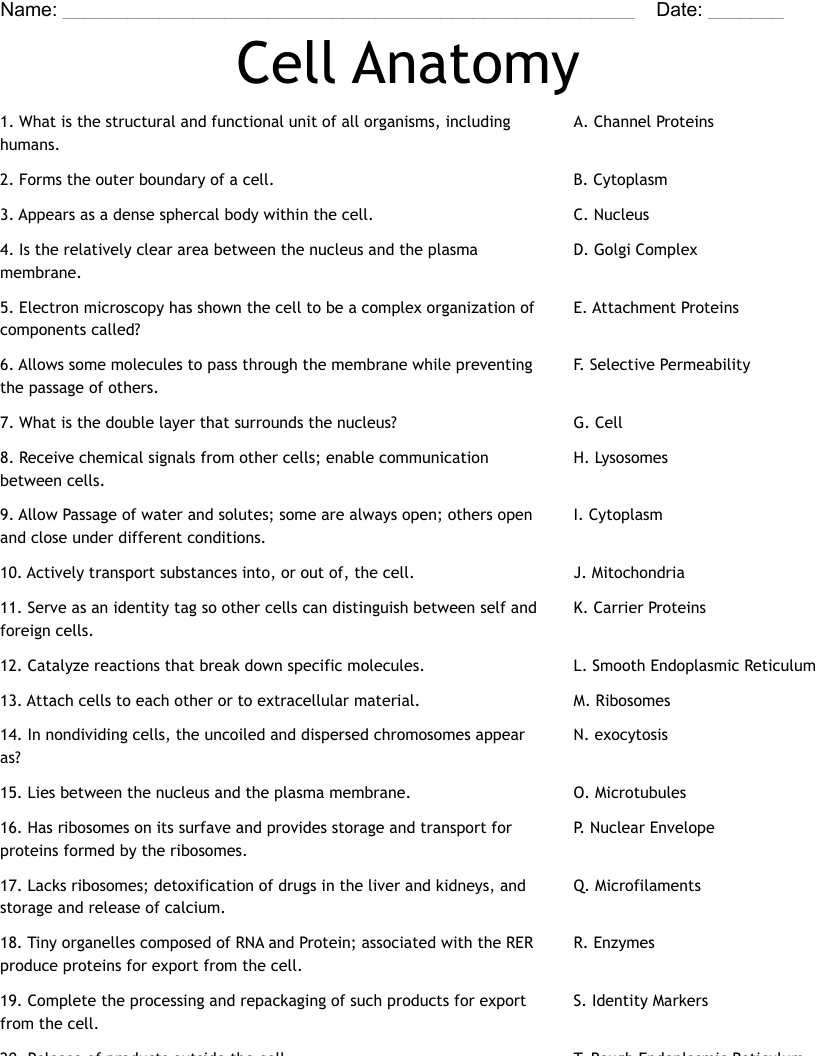
What is the structural and functional unit of all organisms, including humans.
Forms the outer boundary of a cell.
Appears as a dense sphercal body within the cell.
Is the relatively clear area between the nucleus and the plasma membrane.
Electron microscopy has shown the cell to be a complex organization of components called?
Allows some molecules to pass through the membrane while preventing the passage of others.
What is the double layer that surrounds the nucleus?
Receive chemical signals from other cells; enable communication between cells.
Allow Passage of water and solutes; some are always open; others open and close under different conditions.
Actively transport substances into, or out of, the cell.
Serve as an identity tag so other cells can distinguish between self and foreign cells.
Catalyze reactions that break down specific molecules.
Attach cells to each other or to extracellular material.
In nondividing cells, the uncoiled and dispersed chromosomes appear as?
Lies between the nucleus and the plasma membrane.
Has ribosomes on its surfave and provides storage and transport for proteins formed by the ribosomes.
Lacks ribosomes; detoxification of drugs in the liver and kidneys, and storage and release of calcium.
Tiny organelles composed of RNA and Protein; associated with the RER produce proteins for export from the cell.
Complete the processing and repackaging of such products for export from the cell.
Release of products outside the cell.
Moves substances into the cell.
Power house of the cell; consists of cristae; sites of ATP synthesis by cellular respiration.
Contain digestive enzymes and probably are formed by the Golgi Complex; release their enzymes into vaculoes.
Fluid-filled, membrane-enclosed sacs in the cytoplasm.
Serve as pathways for the movement of vesicles and other organelles within the cytoplasm and provide support for the cell.
Responsible for cell movements because of their contractility (shortening).