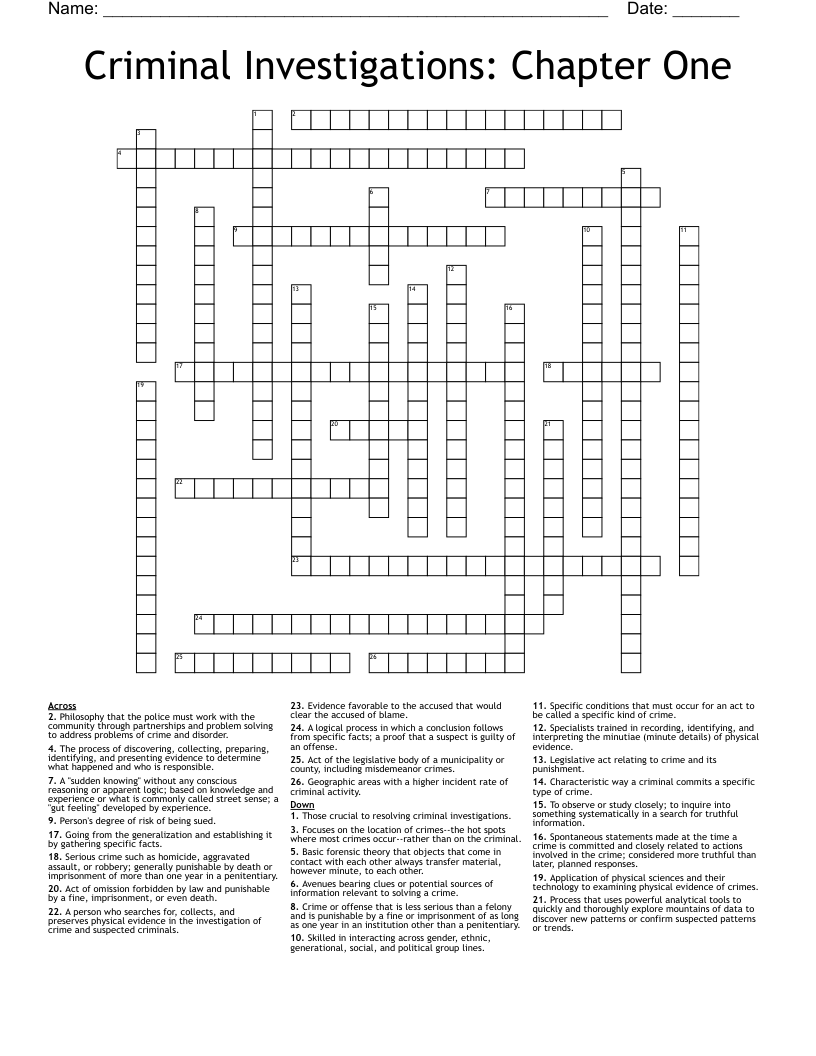
Criminal Investigations: Chapter One Crossword
This printable crossword puzzle on the topic of Law & Legal has 26 clues. Answers range from 5 to 26 letters long. This crossword is also available to download as a Microsoft Word document or a PDF.
Description
Person's degree of risk of being sued.
Philosophy that the police must work with the community through partnerships and problem solving to address problems of crime and disorder.
Act of omission forbidden by law and punishable by a fine, imprisonment, or even death.
Focuses on the location of crimes--the hot spots where most crimes occur--rather than on the criminal.
The process of discovering, collecting, preparing, identifying, and presenting evidence to determine what happened and who is responsible.
A person who searches for, collects, and preserves physical evidence in the investigation of crime and suspected criminals.
Specialists trained in recording, identifying, and interpreting the minutiae (minute details) of physical evidence.
Legislative act relating to crime and its punishment.
Skilled in interacting across gender, ethnic, generational, social, and political group lines.
Process that uses powerful analytical tools to quickly and thoroughly explore mountains of data to discover new patterns or confirm suspected patterns or trends.
A logical process in which a conclusion follows from specific facts; a proof that a suspect is guilty of an offense.
Specific conditions that must occur for an act to be called a specific kind of crime.
Evidence favorable to the accused that would clear the accused of blame.
Serious crime such as homicide, aggravated assault, or robbery; generally punishable by death or imprisonment of more than one year in a penitentiary.
Application of physical sciences and their technology to examining physical evidence of crimes.
Geographic areas with a higher incident rate of criminal activity.
Going from the generalization and establishing it by gathering specific facts.
A "sudden knowing" without any conscious reasoning or apparent logic; based on knowledge and experience or what is commonly called street sense; a "gut feeling" developed by experience.
To observe or study closely; to inquire into something systematically in a search for truthful information.
Avenues bearing clues or potential sources of information relevant to solving a crime.
Basic forensic theory that objects that come in contact with each other always transfer material, however minute, to each other.
Crime or offense that is less serious than a felony and is punishable by a fine or imprisonment of as long as one year in an institution other than a penitentiary.
Characteristic way a criminal commits a specific type of crime.
Act of the legislative body of a municipality or county, including misdemeanor crimes.
Spontaneous statements made at the time a crime is committed and closely related to actions involved in the crime; considered more truthful than later, planned responses.
Those crucial to resolving criminal investigations.