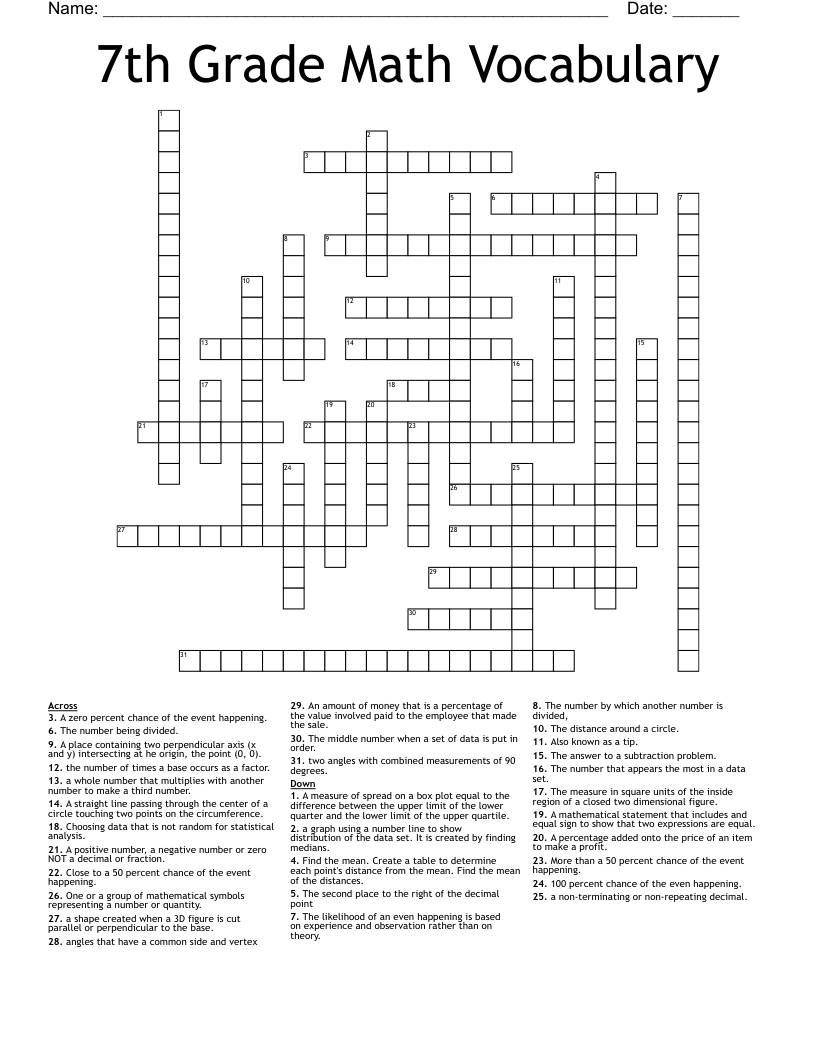
7th Grade Math Vocabulary Crossword
This printable crossword puzzle on the topic of Arithmetic & Numbers has 31 clues. Answers range from 4 to 23 letters long. This crossword is also available to download as a Microsoft Word document or a PDF.
Description
angles that have a common side and vertex
The measure in square units of the inside region of a closed two dimensional figure.
Choosing data that is not random for statistical analysis.
a graph using a number line to show distribution of the data set. It is created by finding medians.
100 percent chance of the even happening.
The distance around a circle.
An amount of money that is a percentage of the value involved paid to the employee that made the sale.
two angles with combined measurements of 90 degrees.
A place containing two perpendicular axis (x and y) intersecting at he origin, the point (0, 0).
a shape created when a 3D figure is cut parallel or perpendicular to the base.
A straight line passing through the center of a circle touching two points on the circumference.
The answer to a subtraction problem.
The number being divided.
The number by which another number is divided,
Close to a 50 percent chance of the event happening.
A mathematical statement that includes and equal sign to show that two expressions are equal.
The likelihood of an even happening is based on experience and observation rather than on theory.
the number of times a base occurs as a factor.
One or a group of mathematical symbols representing a number or quantity.
a whole number that multiplies with another number to make a third number.
Also known as a tip.
The second place to the right of the decimal point
A zero percent chance of the event happening.
A positive number, a negative number or zero NOT a decimal or fraction.
A measure of spread on a box plot equal to the difference between the upper limit of the lower quarter and the lower limit of the upper quartile.
a non-terminating or non-repeating decimal.
More than a 50 percent chance of the event happening.
A percentage added onto the price of an item to make a profit.
Find the mean. Create a table to determine each point's distance from the mean. Find the mean of the distances.
The middle number when a set of data is put in order.
The number that appears the most in a data set.