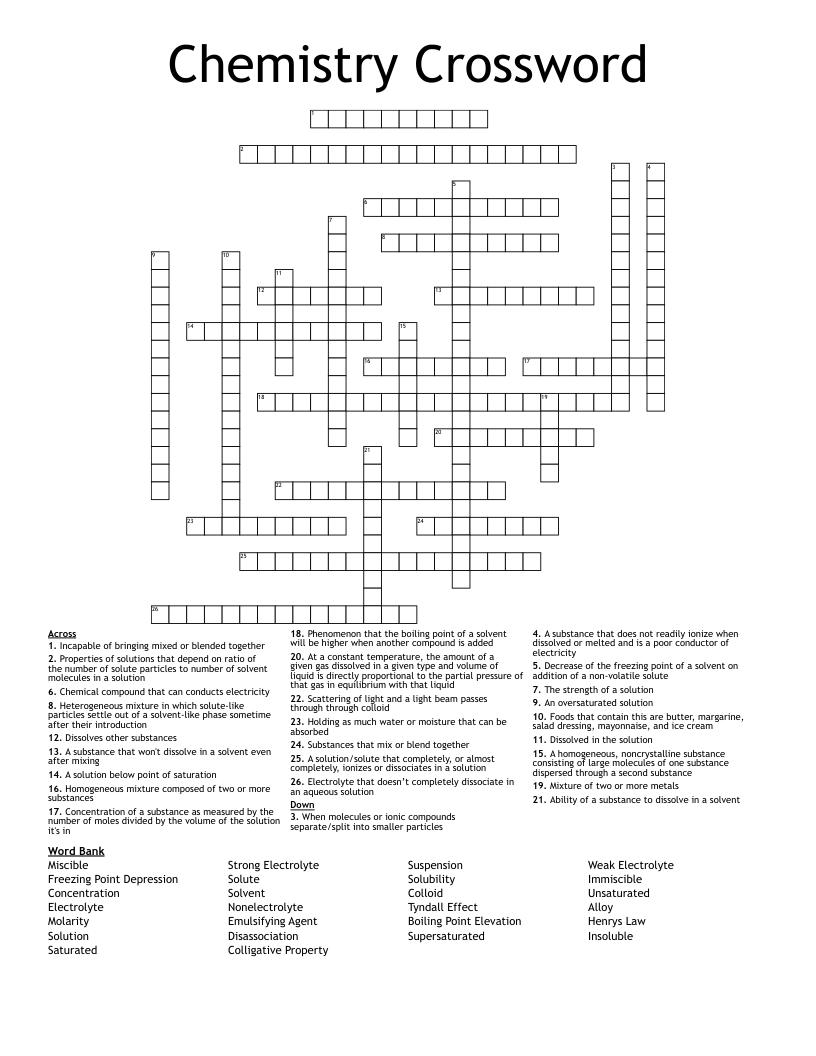
Chemistry Crossword
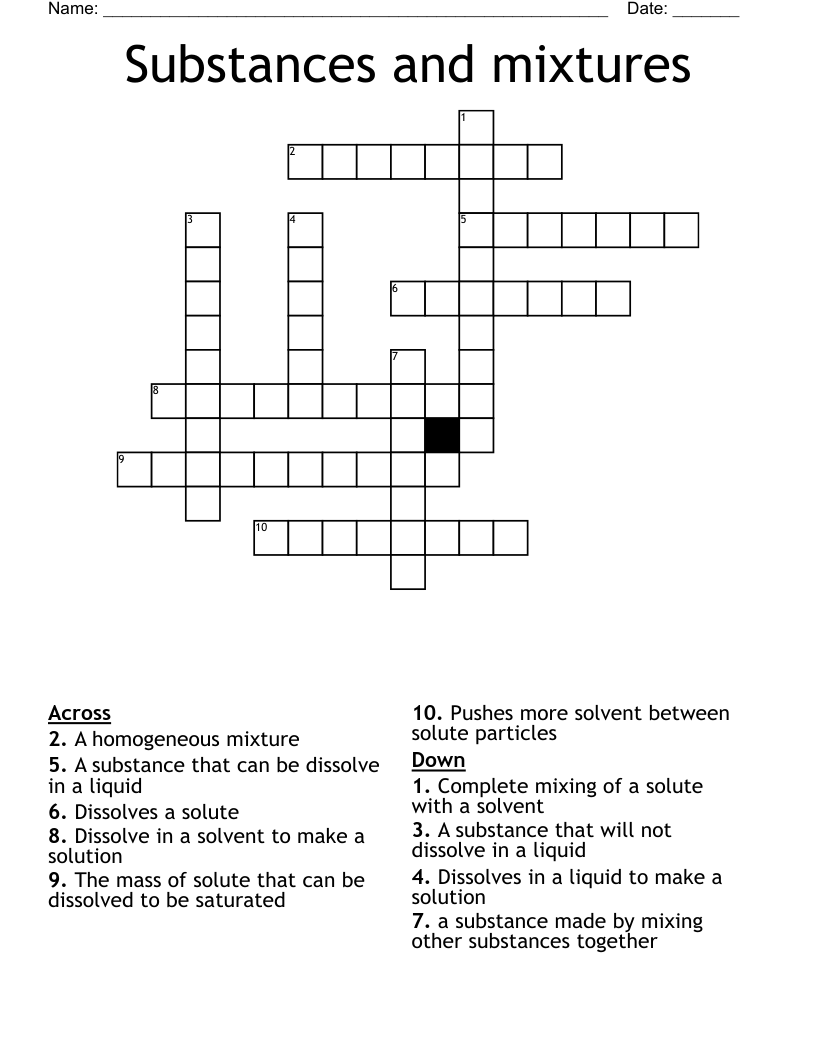
This printable crossword puzzle on the topic of Chemical Bonding & Reactions has 26 clues. Answers range from 5 to 23 letters long. This crossword is also available to download as a Microsoft Word document or a PDF.
Description
Mixture of two or more metals
When molecules or ionic compounds separate/split into smaller particles
Properties of solutions that depend on ratio of the number of solute particles to number of solvent molecules in a solution
The strength of a solution
Foods that contain this are butter, margarine, salad dressing, mayonnaise, and ice cream
Chemical compound that can conducts electricity
Incapable of bringing mixed or blended together
A substance that won't dissolve in a solvent even after mixing
Substances that mix or blend together
Concentration of a substance as measured by the number of moles divided by the volume of the solution it's in
Holding as much water or moisture that can be absorbed
Dissolved in the solution
Homogeneous mixture composed of two or more substances
Ability of a substance to dissolve in a solvent
Dissolves other substances
An oversaturated solution
Heterogeneous mixture in which solute-like particles settle out of a solvent-like phase sometime after their introduction
A solution below point of saturation
At a constant temperature, the amount of a given gas dissolved in a given type and volume of liquid is directly proportional to the partial pressure of that gas in equilibrium with that liquid
Decrease of the freezing point of a solvent on addition of a non-volatile solute
Phenomenon that the boiling point of a solvent will be higher when another compound is added
A homogeneous, noncrystalline substance consisting of large molecules of one substance dispersed through a second substance
Scattering of light and a light beam passes through through colloid
A solution/solute that completely, or almost completely, ionizes or dissociates in a solution
Electrolyte that doesn’t completely dissociate in an aqueous solution
A substance that does not readily ionize when dissolved or melted and is a poor conductor of electricity