Mammalogy Crossword
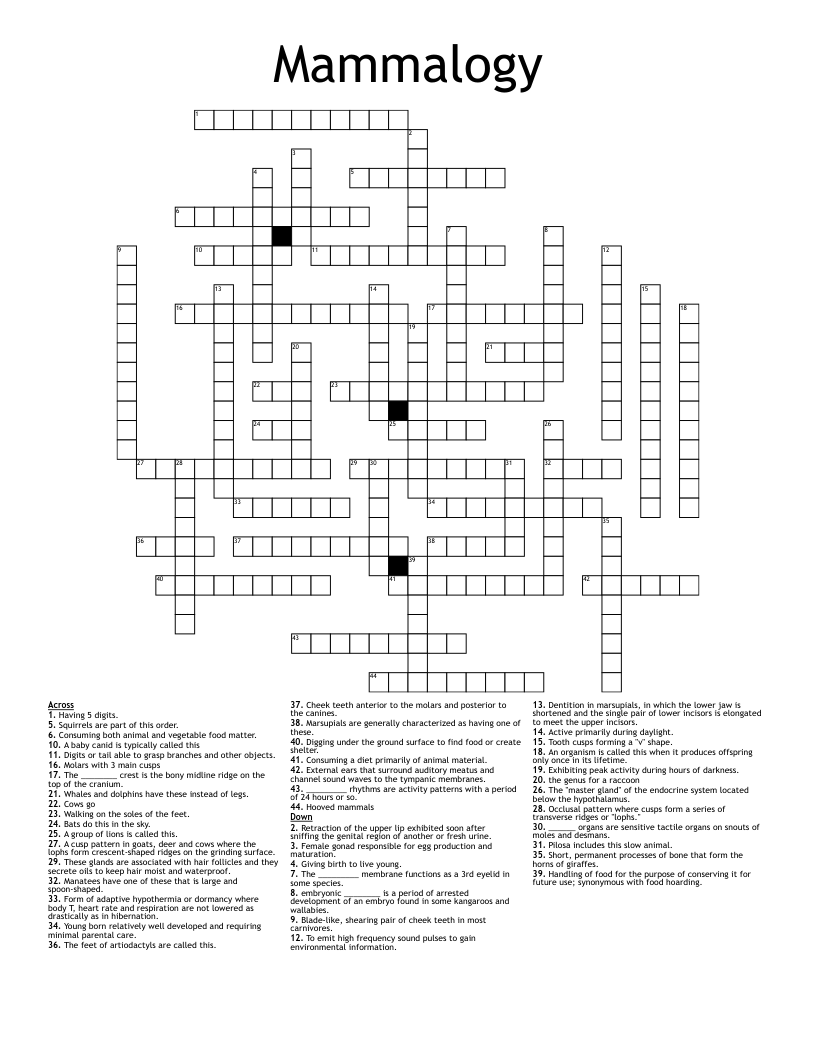
This printable crossword puzzle on the topic of Ecology & Evolution has 44 clues. Answers range from 3 to 12 letters long. This crossword is also available to download as a Microsoft Word document or a PDF.
Description
Dentition in marsupials, in which the lower jaw is shortened and the single pair of lower incisors is elongated to meet the upper incisors.
Active primarily during daylight.
To emit high frequency sound pulses to gain environmental information.
______ organs are sensitive tactile organs on snouts of moles and desmans.
embryonic ________ is a period of arrested development of an embryo found in some kangaroos and wallabies.
External ears that surround auditory meatus and channel sound waves to the tympanic membranes.
The "master gland" of the endocrine system located below the hypothalamus.
Walking on the soles of the feet.
Cheek teeth anterior to the molars and posterior to the canines.
Digits or tail able to grasp branches and other objects.
Young born relatively well developed and requiring minimal parental care.
The ________ crest is the bony midline ridge on the top of the cranium.
An organism is called this when it produces offspring only once in its lifetime.
A cusp pattern in goats, deer and cows where the lophs form crescent-shaped ridges on the grinding surface.
These glands are associated with hair follicles and they secrete oils to keep hair moist and waterproof.
Handling of food for the purpose of conserving it for future use; synonymous with food hoarding.
Consuming a diet primarily of animal material.
Blade-like, shearing pair of cheek teeth in most carnivores.
_________ rhythms are activity patterns with a period of 24 hours or so.
Giving birth to live young.
Tooth cusps forming a "v" shape.
The _________ membrane functions as a 3rd eyelid in some species.
Exhibiting peak activity during hours of darkness.
Consuming both animal and vegetable food matter.
Short, permanent processes of bone that form the horns of giraffes.
Female gonad responsible for egg production and maturation.
Form of adaptive hypothermia or dormancy where body T, heart rate and respiration are not lowered as drastically as in hibernation.
Molars with 3 main cusps
Hooved mammals
Retraction of the upper lip exhibited soon after sniffing the genital region of another or fresh urine.
Digging under the ground surface to find food or create shelter.
A baby canid is typically called this
Bats do this in the sky.
Pilosa includes this slow animal.
Manatees have one of these that is large and spoon-shaped.
Whales and dolphins have these instead of legs.
Cows go
The feet of artiodactyls are called this.
A group of lions is called this.
Marsupials are generally characterized as having one of these.
the genus for a raccoon
Having 5 digits.
Squirrels are part of this order.
Occlusal pattern where cusps form a series of transverse ridges or "lophs."