PASRR Crossword
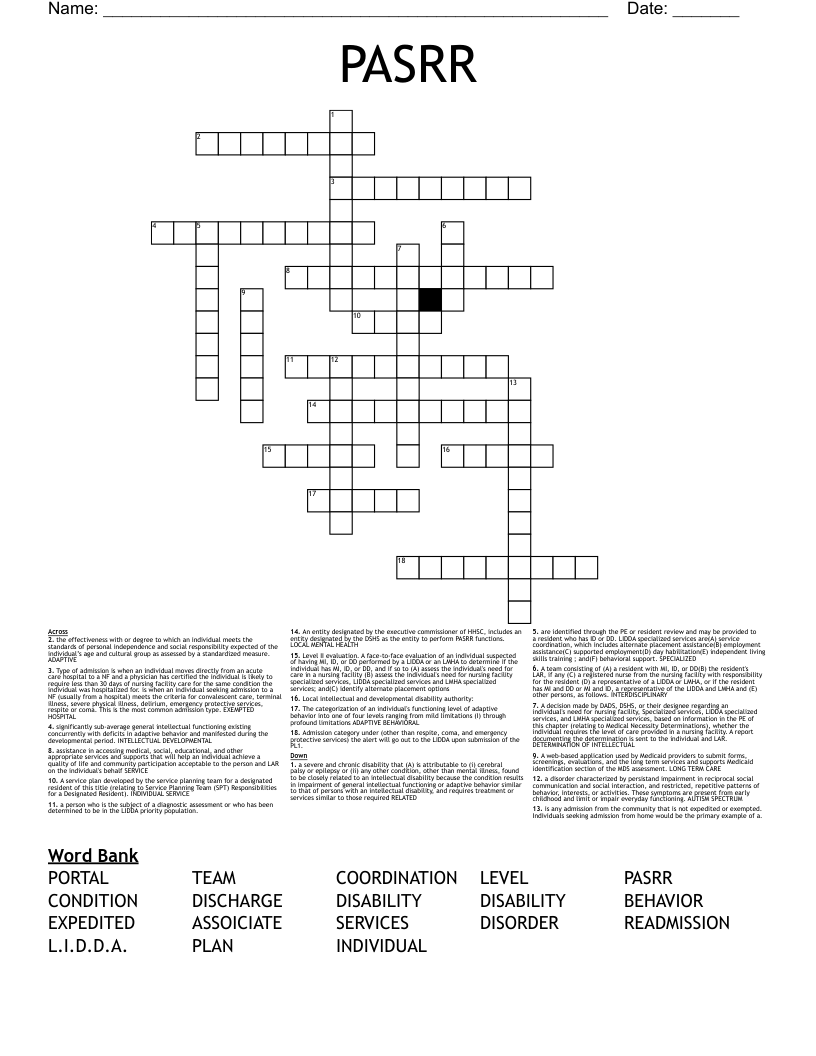
This printable crossword puzzle on the topic of Nursing & Healthcare Careers has 18 clues. Answers range from 4 to 12 letters long. This crossword is also available to download as a Microsoft Word document or a PDF.
Description
Local intellectual and developmental disability authority:
a severe and chronic disability that (A) is attributable to (i) cerebral palsy or epilepsy or (ii) any other condition, other than mental illness, found to be closely related to an intellectual disability because the condition results in impairment of general intellectual functioning or adaptive behavior similar to that of persons with an intellectual disability, and requires treatment or services similar to those required RELATED
The categorization of an individual's functioning level of adaptive behavior into one of four levels ranging from mild limitations (I) through profound limitations ADAPTIVE BEHAVIORAL
significantly sub-average general intellectual functioning existing concurrently with deficits in adaptive behavior and manifested during the developmental period. INTELLECTUAL DEVELOPMENTAL
Type of admission is when an individual moves directly from an acute care hospital to a NF and a physician has certified the individual is likely to require less than 30 days of nursing facility care for the same condition the individual was hospitalized for. is when an individual seeking admission to a NF (usually from a hospital) meets the criteria for convalescent care, terminal illness, severe physical illness, delirium, emergency protective services, respite or coma. This is the most common admission type. EXEMPTED HOSPITAL
Admission category under (other than respite, coma, and emergency protective services) the alert will go out to the LIDDA upon submission of the PL1.
is any admission from the community that is not expedited or exempted. Individuals seeking admission from home would be the primary example of a.
An entity designated by the executive commissioner of HHSC, includes an entity designated by the DSHS as the entity to perform PASRR functions. LOCAL MENTAL HEALTH
A service plan developed by the service planning team for a designated resident of this title (relating to Service Planning Team (SPT) Responsibilities for a Designated Resident). INDIVIDUAL SERVICE
A team consisting of (A) a resident with MI, ID, or DD(B) the resident's LAR, if any (C) a registered nurse from the nursing facility with responsibility for the resident (D) a representative of a LIDDA or LMHA, or if the resident has MI and DD or MI and ID, a representative of the LIDDA and LMHA and (E) other persons, as follows. INTERDISCIPLINARY
are identified through the PE or resident review and may be provided to a resident who has ID or DD. LIDDA specialized services are(A) service coordination, which includes alternate placement assistance(B) employment assistance(C) supported employment(D) day habilitation(E) independent living skills training ; and(F) behavioral support. SPECIALIZED
A web-based application used by Medicaid providers to submit forms, screenings, evaluations, and the long term services and supports Medicaid identification section of the MDS assessment. LONG TERM CARE
A decision made by DADS, DSHS, or their designee regarding an individual's need for nursing facility, Specialized services, LIDDA specialized services, and LMHA specialized services, based on information in the PE of this chapter (relating to Medical Necessity Determinations), whether the individual requires the level of care provided in a nursing facility. A report documenting the determination is sent to the individual and LAR. DETERMINATION OF INTELLECTUAL
Level II evaluation. A face-to-face evaluation of an individual suspected of having MI, ID, or DD performed by a LIDDA or an LMHA to determine if the individual has MI, ID, or DD, and if so to (A) assess the individual's need for care in a nursing facility (B) assess the individual's need for nursing facility specialized services, LIDDA specialized services and LMHA specialized services; and(C) identify alternate placement options
assistance in accessing medical, social, educational, and other appropriate services and supports that will help an individual achieve a quality of life and community participation acceptable to the person and LAR on the individual's behalf SERVICE
the effectiveness with or degree to which an individual meets the standards of personal independence and social responsibility expected of the individual’s age and cultural group as assessed by a standardized measure. ADAPTIVE
a person who is the subject of a diagnostic assessment or who has been determined to be in the LIDDA priority population.
a disorder characterized by persistand impairment in reciprocal social communication and social interaction, and restricted, repetitive patterns of behavior, interests, or activities. These symptoms are present from early childhood and limit or impair everyday functioning. AUTISM SPECTRUM