Chemistry of Life Vocabulary Pre-assessment Worksheet
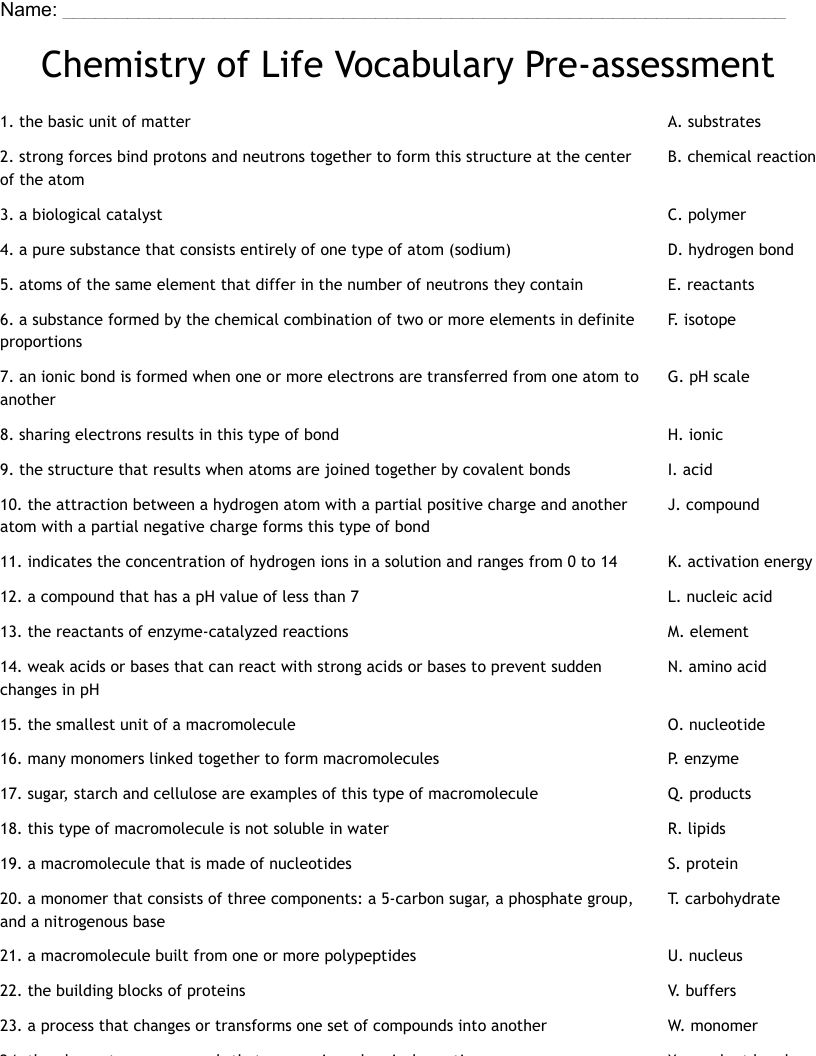
This printable matching worksheet on the topic of Organic Chemistry & Biochemistry has 26 questions and answers to match. This matching worksheet is also available to download as a Microsoft Word document or a PDF.
Description
the basic unit of matter
strong forces bind protons and neutrons together to form this structure at the center of the atom
a biological catalyst
a pure substance that consists entirely of one type of atom (sodium)
atoms of the same element that differ in the number of neutrons they contain
a substance formed by the chemical combination of two or more elements in definite proportions
an ionic bond is formed when one or more electrons are transferred from one atom to another
sharing electrons results in this type of bond
the structure that results when atoms are joined together by covalent bonds
the attraction between a hydrogen atom with a partial positive charge and another atom with a partial negative charge forms this type of bond
indicates the concentration of hydrogen ions in a solution and ranges from 0 to 14
a compound that has a pH value of less than 7
the reactants of enzyme-catalyzed reactions
weak acids or bases that can react with strong acids or bases to prevent sudden changes in pH
the smallest unit of a macromolecule
many monomers linked together to form macromolecules
sugar, starch and cellulose are examples of this type of macromolecule
this type of macromolecule is not soluble in water
a macromolecule that is made of nucleotides
a monomer that consists of three components: a 5-carbon sugar, a phosphate group, and a nitrogenous base
a macromolecule built from one or more polypeptides
the building blocks of proteins
a process that changes or transforms one set of compounds into another
the elements or compounds that engage in a chemical reaction
the elements or compounds produced by a chemical reaction
the energy that is needed to get a reaction started