AP GOPO Unit 2 Vocab Quiz Worksheet
This printable matching worksheet on the topic of US Government & Constitution has 26 questions and answers to match. This matching worksheet is also available to download as a Microsoft Word document or a PDF.
Description
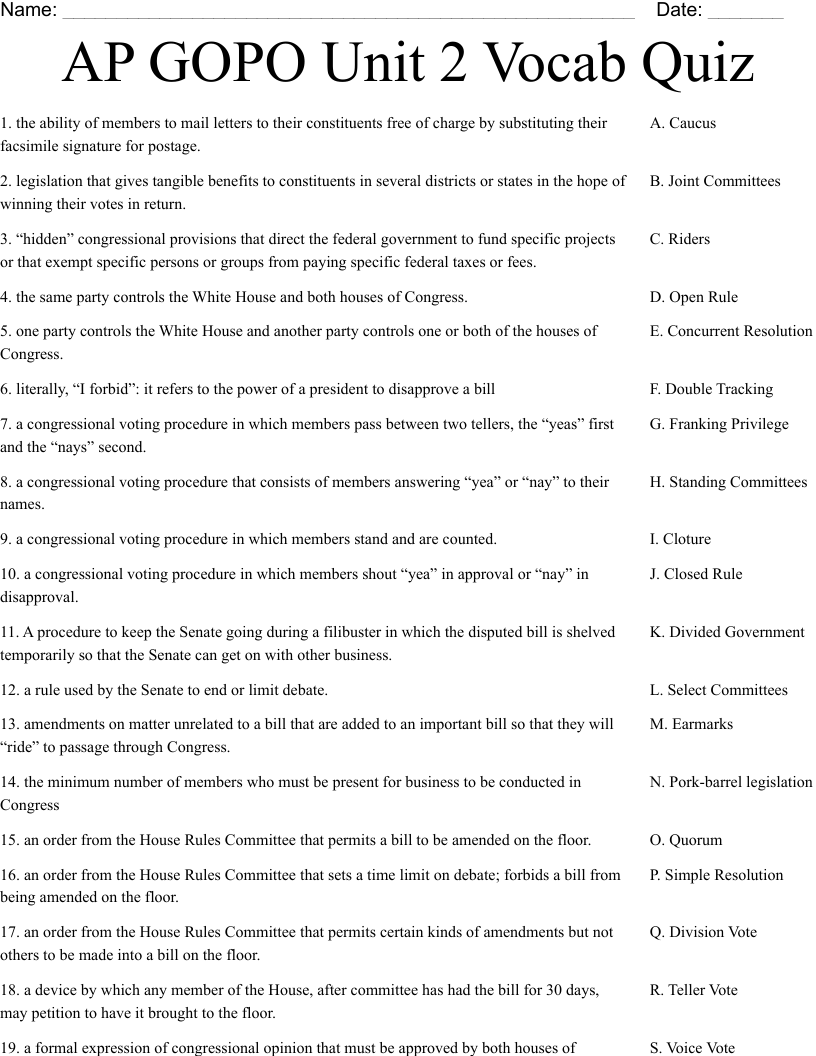
the ability of members to mail letters to their constituents free of charge by substituting their facsimile signature for postage.
legislation that gives tangible benefits to constituents in several districts or states in the hope of winning their votes in return.
“hidden” congressional provisions that direct the federal government to fund specific projects or that exempt specific persons or groups from paying specific federal taxes or fees.
the same party controls the White House and both houses of Congress.
one party controls the White House and another party controls one or both of the houses of Congress.
literally, “I forbid”: it refers to the power of a president to disapprove a bill
a congressional voting procedure in which members pass between two tellers, the “yeas” first and the “nays” second.
a congressional voting procedure that consists of members answering “yea” or “nay” to their names.
a congressional voting procedure in which members stand and are counted.
a congressional voting procedure in which members shout “yea” in approval or “nay” in disapproval.
A procedure to keep the Senate going during a filibuster in which the disputed bill is shelved temporarily so that the Senate can get on with other business.
a rule used by the Senate to end or limit debate.
amendments on matter unrelated to a bill that are added to an important bill so that they will “ride” to passage through Congress.
the minimum number of members who must be present for business to be conducted in Congress
an order from the House Rules Committee that permits a bill to be amended on the floor.
an order from the House Rules Committee that sets a time limit on debate; forbids a bill from being amended on the floor.
an order from the House Rules Committee that permits certain kinds of amendments but not others to be made into a bill on the floor.
a device by which any member of the House, after committee has had the bill for 30 days, may petition to have it brought to the floor.
a formal expression of congressional opinion that must be approved by both houses of Congress and by the president; constitutional amendments need not be signed by the president.
an expression of opinion without the force of law that requires the approval of both the House and the Senate, but not the president.
an expression of opinion either in the House or Senate to settle procedural matters in either body.
joint committees appointed to resolve differences in the Senate and House versions of the same bill.
committees on which both senators and representatives serve.
congressional committees appointed for a limited time and purpose.
permanently established legislative committees that consider and are responsible for legislation within a certain subject area.
an association of congressional members created to advance a political ideology or a regional, ethnic, or economic interest.