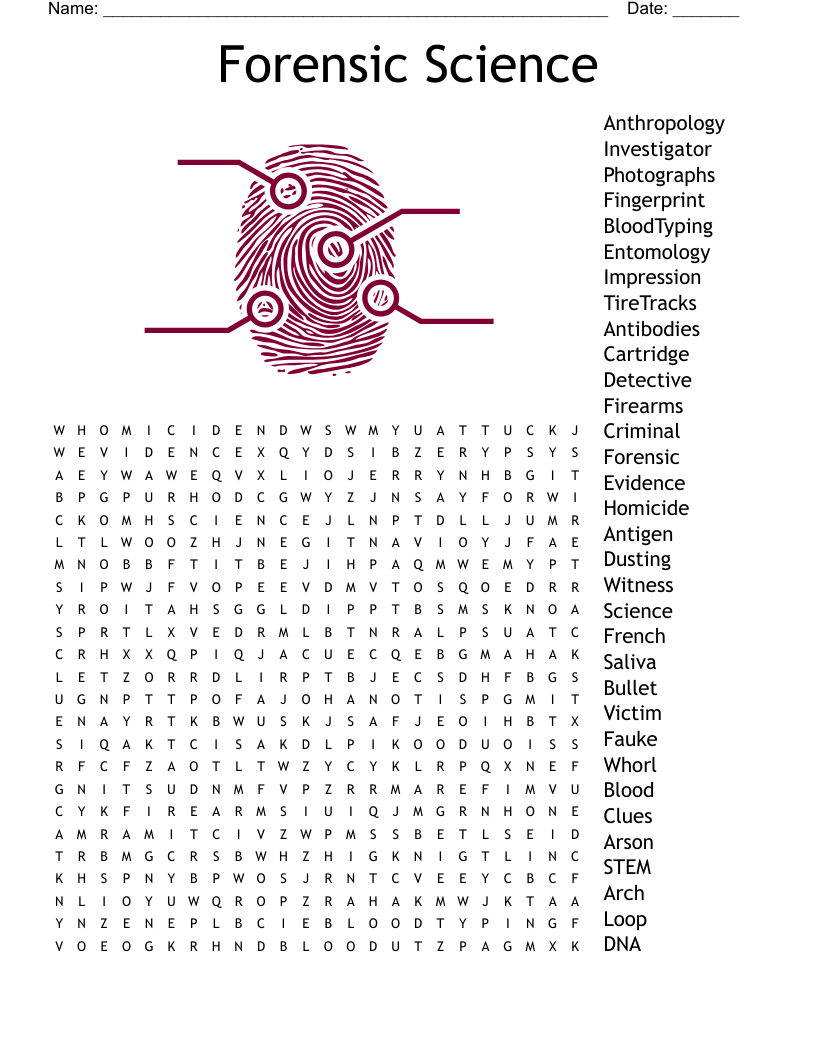
Forensic Science Crossword Puzzle
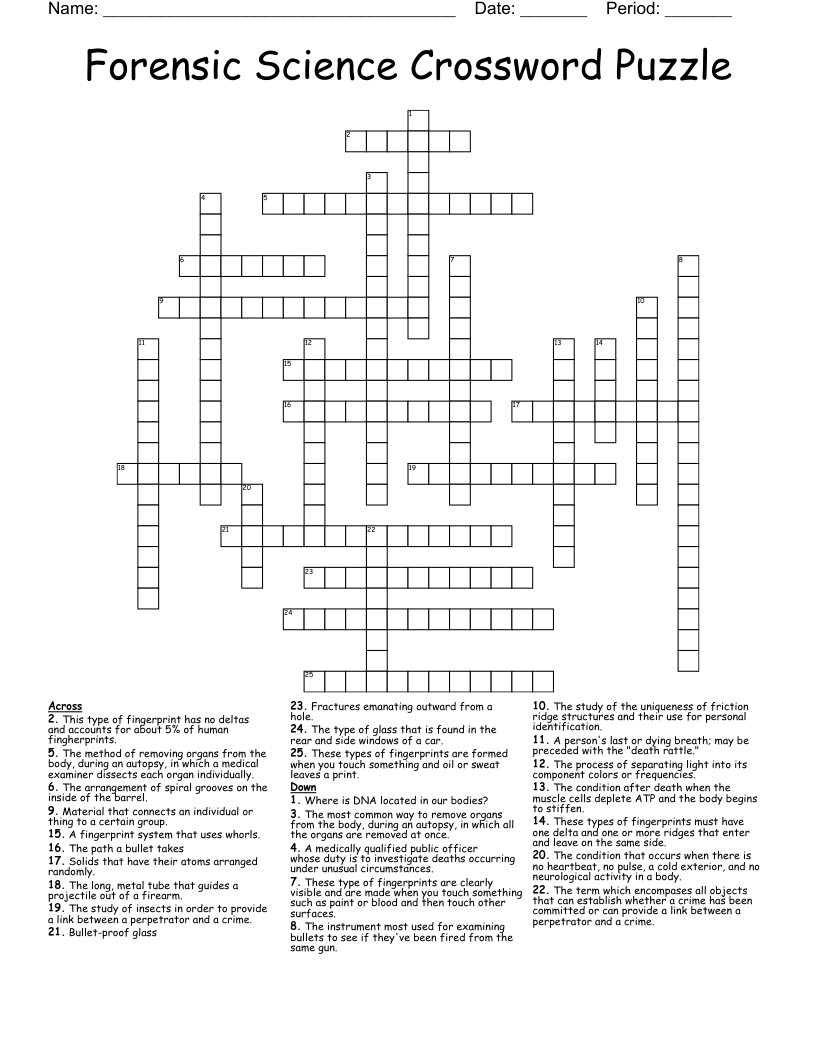
This printable crossword puzzle on the topic of Law & Legal has 25 clues. Answers range from 5 to 20 letters long. This crossword is also available to download as a Microsoft Word document or a PDF.
Description
Material that connects an individual or thing to a certain group.
This type of fingerprint has no deltas and accounts for about 5% of human fingherprints.
The most common way to remove organs from the body, during an autopsy, in which all the organs are removed at once.
These type of fingerprints are clearly visible and are made when you touch something such as paint or blood and then touch other surfaces.
The path a bullet takes
The type of glass that is found in the rear and side windows of a car.
Solids that have their atoms arranged randomly.
The arrangement of spiral grooves on the inside of the barrel.
The term which encompases all objects that can establish whether a crime has been committed or can provide a link between a perpetrator and a crime.
The process of separating light into its component colors or frequencies.
The study of insects in order to provide a link between a perpetrator and a crime.
Where is DNA located in our bodies?
The study of the uniqueness of friction ridge structures and their use for personal identification.
These types of fingerprints must have one delta and one or more ridges that enter and leave on the same side.
The condition that occurs when there is no heartbeat, no pulse, a cold exterior, and no neurological activity in a body.
The condition after death when the muscle cells deplete ATP and the body begins to stiffen.
A person's last or dying breath; may be preceded with the "death rattle."
A medically qualified public officer whose duty is to investigate deaths occurring under unusual circumstances.
A fingerprint system that uses whorls.
Bullet-proof glass
Fractures emanating outward from a hole.
The instrument most used for examining bullets to see if they've been fired from the same gun.
The long, metal tube that guides a projectile out of a firearm.
These types of fingerprints are formed when you touch something and oil or sweat leaves a print.
The method of removing organs from the body, during an autopsy, in which a medical examiner dissects each organ individually.