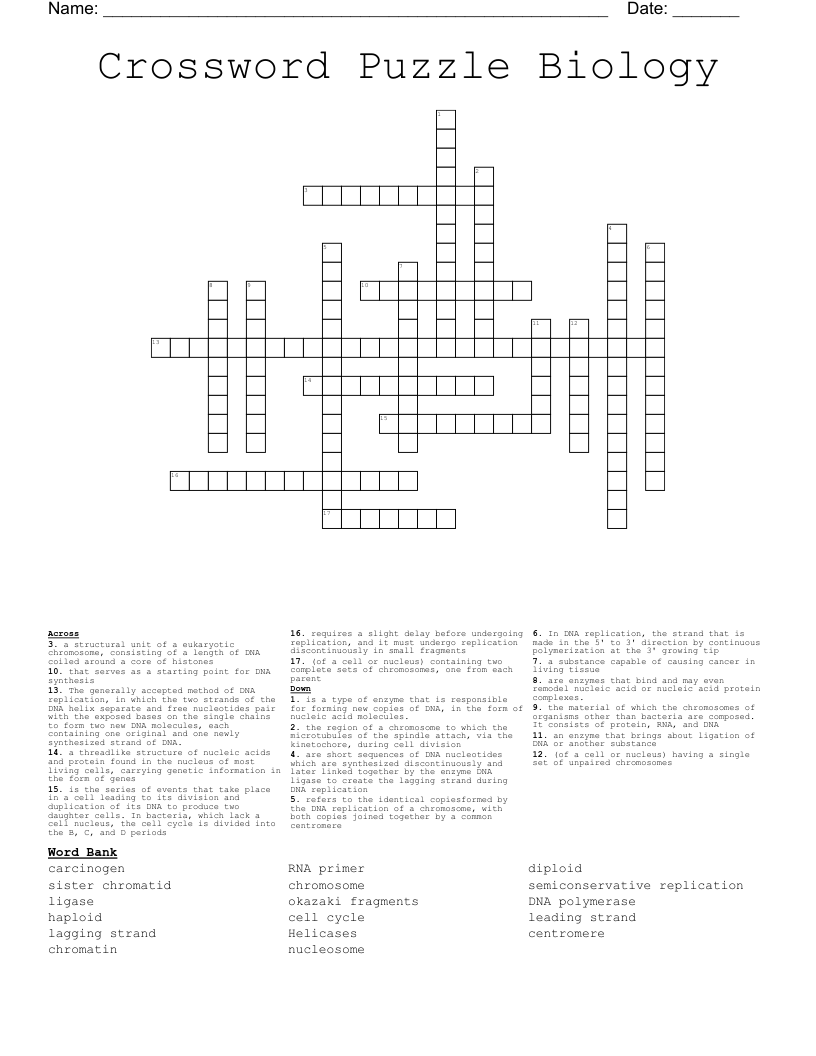
Crossword Puzzle Biology
This printable crossword puzzle on the topic of Genetics & DNA has 17 clues. Answers range from 6 to 27 letters long. This crossword is also available to download as a Microsoft Word document or a PDF.
Description
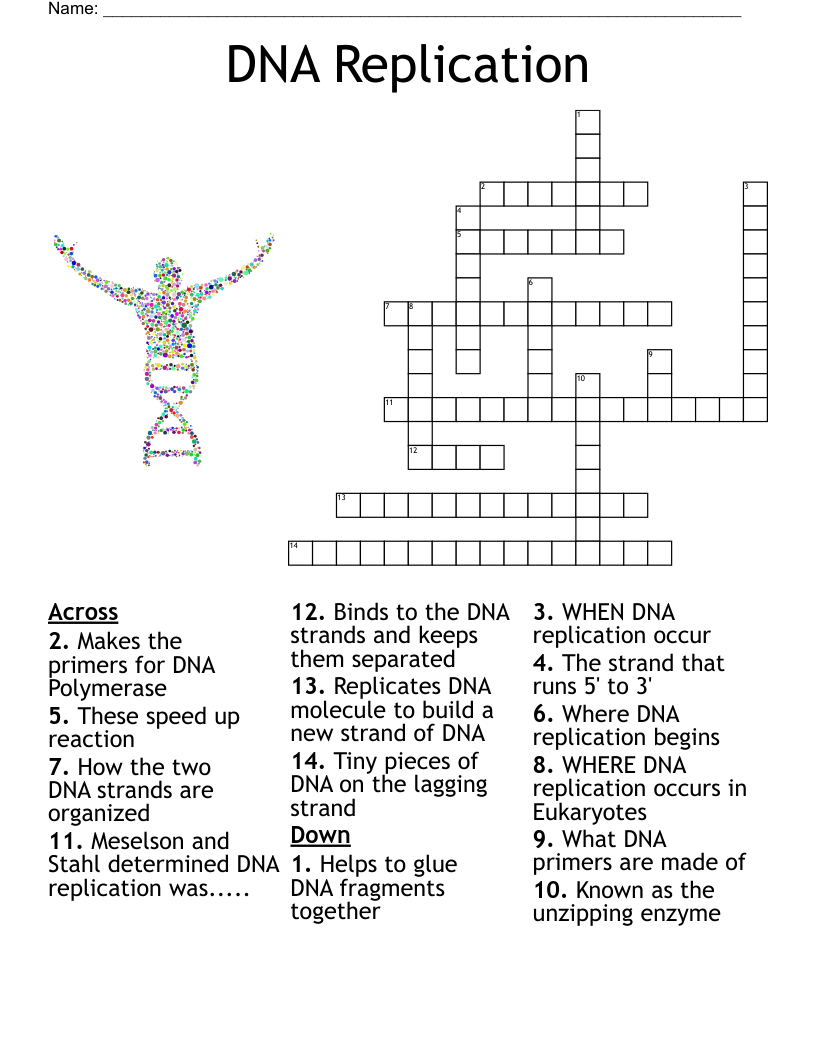
The generally accepted method of DNA replication, in which the two strands of the DNA helix separate and free nucleotides pair with the exposed bases on the single chains to form two new DNA molecules, each containing one original and one newly synthesized strand of DNA.
are enzymes that bind and may even remodel nucleic acid or nucleic acid protein complexes.
is a type of enzyme that is responsible for forming new copies of DNA, in the form of nucleic acid molecules.
an enzyme that brings about ligation of DNA or another substance
that serves as a starting point for DNA synthesis
In DNA replication, the strand that is made in the 5' to 3' direction by continuous polymerization at the 3' growing tip
requires a slight delay before undergoing replication, and it must undergo replication discontinuously in small fragments
are short sequences of DNA nucleotides which are synthesized discontinuously and later linked together by the enzyme DNA ligase to create the lagging strand during DNA replication
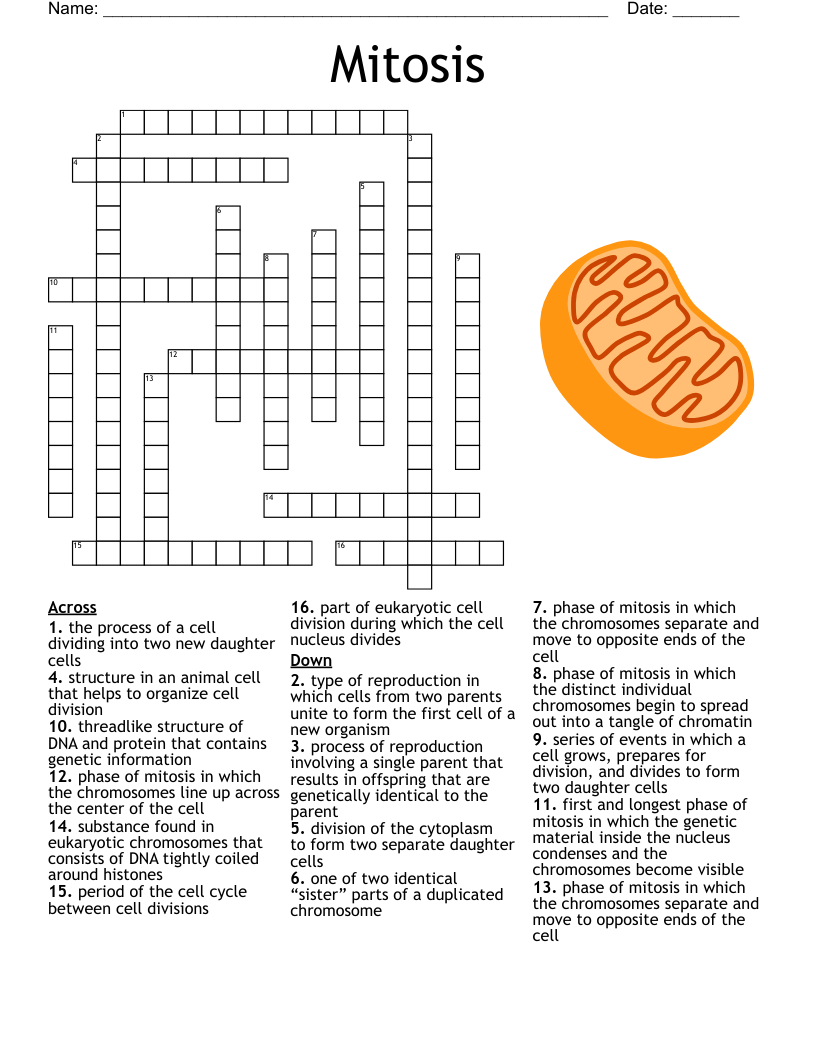
is the series of events that take place in a cell leading to its division and duplication of its DNA to produce two daughter cells. In bacteria, which lack a cell nucleus, the cell cycle is divided into the B, C, and D periods
a threadlike structure of nucleic acids and protein found in the nucleus of most living cells, carrying genetic information in the form of genes
the material of which the chromosomes of organisms other than bacteria are composed. It consists of protein, RNA, and DNA
a structural unit of a eukaryotic chromosome, consisting of a length of DNA coiled around a core of histones
refers to the identical copiesformed by the DNA replication of a chromosome, with both copies joined together by a common centromere
the region of a chromosome to which the microtubules of the spindle attach, via the kinetochore, during cell division
(of a cell or nucleus) containing two complete sets of chromosomes, one from each parent
(of a cell or nucleus) having a single set of unpaired chromosomes
a substance capable of causing cancer in living tissue