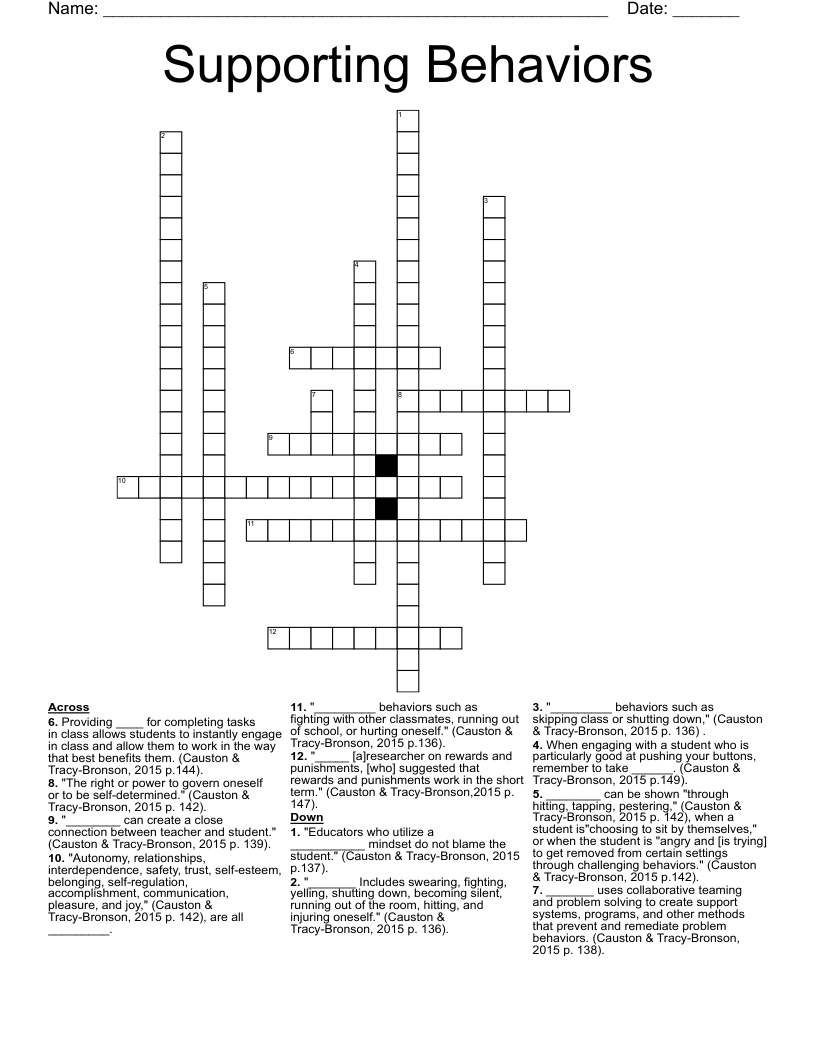
Supporting Behaviors Crossword
This printable crossword puzzle on the topic of Mental Health & Counseling has 12 clues. Answers range from 3 to 27 letters long. This crossword is also available to download as a Microsoft Word document or a PDF.
Description
"The right or power to govern oneself or to be self-determined." (Causton & Tracy-Bronson, 2015 p. 142).
________ can be shown "through hitting, tapping, pestering," (Causton & Tracy-Bronson, 2015 p. 142), when a student is"choosing to sit by themselves," or when the student is "angry and [is trying] to get removed from certain settings through challenging behaviors." (Causton & Tracy-Bronson, 2015 p.142).
"Autonomy, relationships, interdependence, safety, trust, self-esteem, belonging, self-regulation, accomplishment, communication, pleasure, and joy," (Causton & Tracy-Bronson, 2015 p. 142), are all _________.
"________ can create a close connection between teacher and student." (Causton & Tracy-Bronson, 2015 p. 139).
"_______ Includes swearing, fighting, yelling, shutting down, becoming silent, running out of the room, hitting, and injuring oneself." (Causton & Tracy-Bronson, 2015 p. 136).
"_________ behaviors such as skipping class or shutting down," (Causton & Tracy-Bronson, 2015 p. 136) .
"_________ behaviors such as fighting with other classmates, running out of school, or hurting oneself." (Causton & Tracy-Bronson, 2015 p.136).
"Educators who utilize a ___________ mindset do not blame the student." (Causton & Tracy-Bronson, 2015 p.137).
_______ uses collaborative teaming and problem solving to create support systems, programs, and other methods that prevent and remediate problem behaviors. (Causton & Tracy-Bronson, 2015 p. 138).
"_____ [a]researcher on rewards and punishments, [who] suggested that rewards and punishments work in the short term." (Causton & Tracy-Bronson,2015 p. 147).
When engaging with a student who is particularly good at pushing your buttons, remember to take ______. (Causton & Tracy-Bronson, 2015 p.149).
Providing ____ for completing tasks in class allows students to instantly engage in class and allow them to work in the way that best benefits them. (Causton & Tracy-Bronson, 2015 p.144).