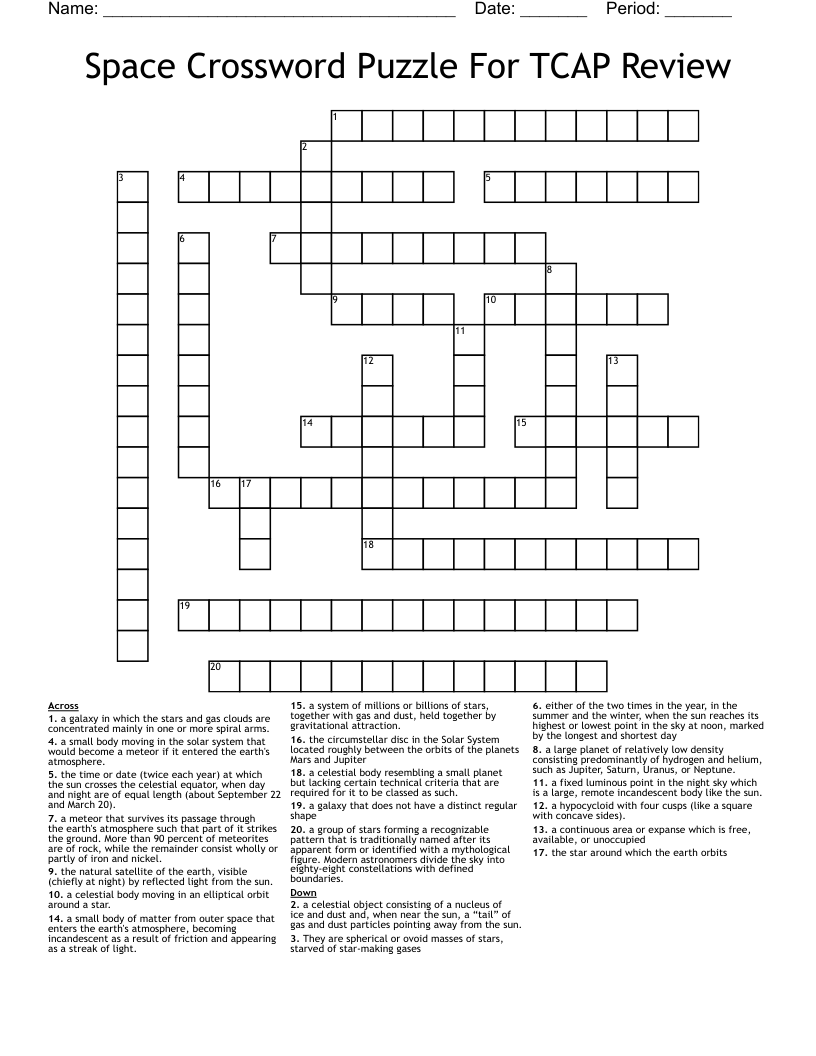
Space Crossword Puzzle For TCAP Review
This printable crossword puzzle has 20 clues. Answers range from 3 to 16 letters long. This crossword is also available to download as a Microsoft Word document or a PDF.
Description
a fixed luminous point in the night sky which is a large, remote incandescent body like the sun.
the star around which the earth orbits
a celestial body moving in an elliptical orbit around a star.
the natural satellite of the earth, visible (chiefly at night) by reflected light from the sun.
a celestial body resembling a small planet but lacking certain technical criteria that are required for it to be classed as such.
a hypocycloid with four cusps (like a square with concave sides).
a small body of matter from outer space that enters the earth's atmosphere, becoming incandescent as a result of friction and appearing as a streak of light.
a meteor that survives its passage through the earth's atmosphere such that part of it strikes the ground. More than 90 percent of meteorites are of rock, while the remainder consist wholly or partly of iron and nickel.
a small body moving in the solar system that would become a meteor if it entered the earth's atmosphere.
a celestial object consisting of a nucleus of ice and dust and, when near the sun, a “tail” of gas and dust particles pointing away from the sun.
either of the two times in the year, in the summer and the winter, when the sun reaches its highest or lowest point in the sky at noon, marked by the longest and shortest day
the time or date (twice each year) at which the sun crosses the celestial equator, when day and night are of equal length (about September 22 and March 20).
a large planet of relatively low density consisting predominantly of hydrogen and helium, such as Jupiter, Saturn, Uranus, or Neptune.
a group of stars forming a recognizable pattern that is traditionally named after its apparent form or identified with a mythological figure. Modern astronomers divide the sky into eighty-eight constellations with defined boundaries.
the circumstellar disc in the Solar System located roughly between the orbits of the planets Mars and Jupiter
a system of millions or billions of stars, together with gas and dust, held together by gravitational attraction.
a galaxy in which the stars and gas clouds are concentrated mainly in one or more spiral arms.
They are spherical or ovoid masses of stars, starved of star-making gases
a galaxy that does not have a distinct regular shape
a continuous area or expanse which is free, available, or unoccupied