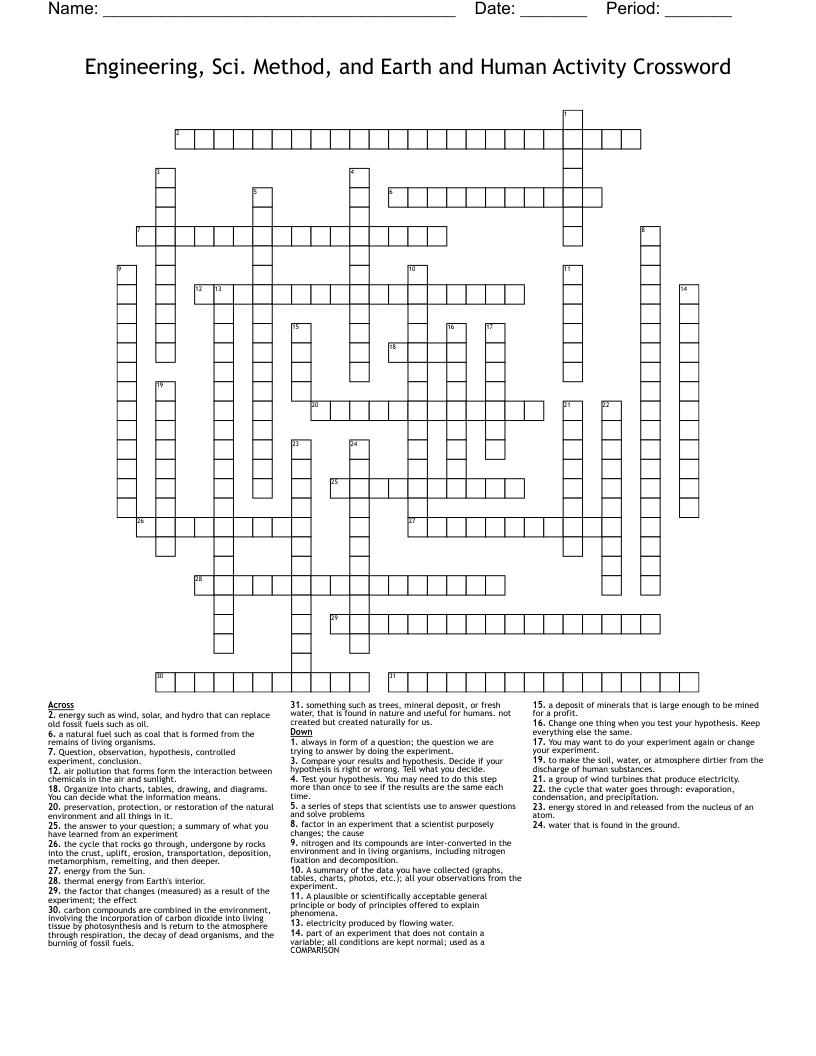
Engineering, Sci. Method, and Earth and Human Activity Crossword
This printable crossword puzzle has 31 clues. Answers range from 4 to 24 letters long. This crossword is also available to download as a Microsoft Word document or a PDF.
Description
You may want to do your experiment again or change your experiment.
A plausible or scientifically acceptable general principle or body of principles offered to explain phenomena.
Question, observation, hypothesis, controlled experiment, conclusion.
always in form of a question; the question we are trying to answer by doing the experiment.
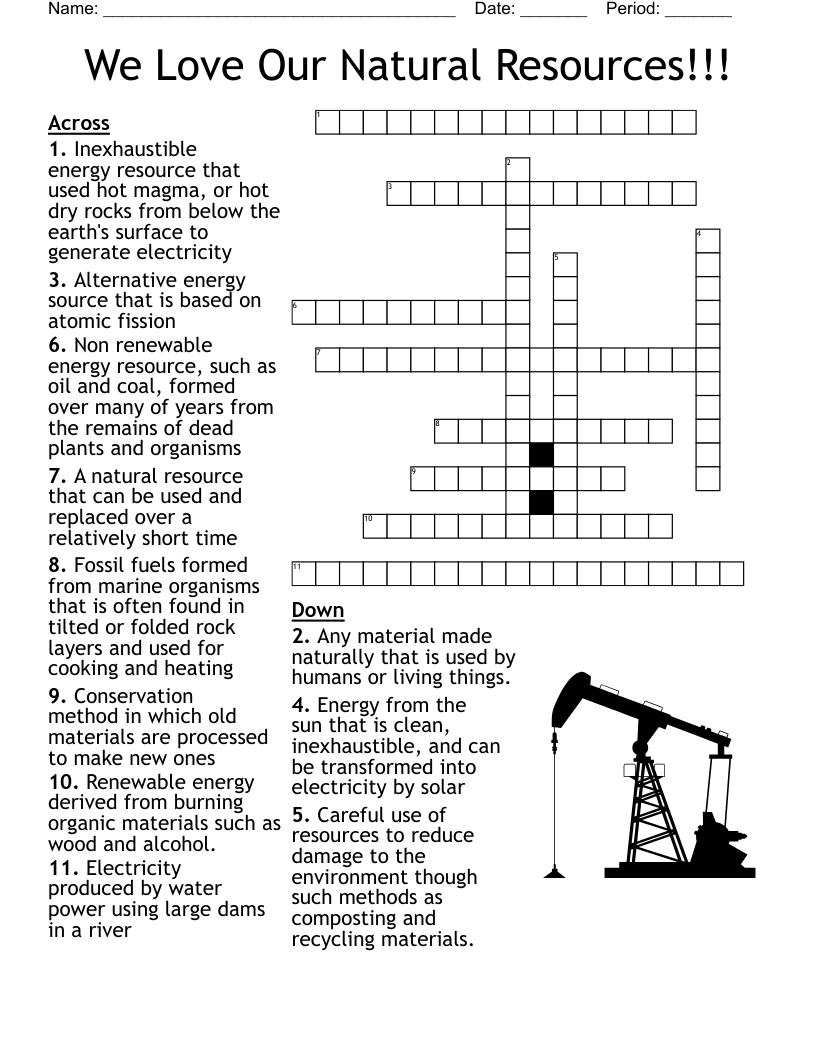
energy from the Sun.
a deposit of minerals that is large enough to be mined for a profit.
A summary of the data you have collected (graphs, tables, charts, photos, etc.); all your observations from the experiment.
part of an experiment that does not contain a variable; all conditions are kept normal; used as a COMPARISON
air pollution that forms form the interaction between chemicals in the air and sunlight.
to make the soil, water, or atmosphere dirtier from the discharge of human substances.
Change one thing when you test your hypothesis. Keep everything else the same.
energy such as wind, solar, and hydro that can replace old fossil fuels such as oil.
the cycle that water goes through: evaporation, condensation, and precipitation.
energy stored in and released from the nucleus of an atom.
a natural fuel such as coal that is formed from the remains of living organisms.
nitrogen and its compounds are inter-converted in the environment and in living organisms, including nitrogen fixation and decomposition.
water that is found in the ground.
factor in an experiment that a scientist purposely changes; the cause
a group of wind turbines that produce electricity.
Test your hypothesis. You may need to do this step more than once to see if the results are the same each time.
carbon compounds are combined in the environment, involving the incorporation of carbon dioxide into living tissue by photosynthesis and is return to the atmosphere through respiration, the decay of dead organisms, and the burning of fossil fuels.
the cycle that rocks go through, undergone by rocks into the crust, uplift, erosion, transportation, deposition, metamorphism, remelting, and then deeper.
Organize into charts, tables, drawing, and diagrams. You can decide what the information means.
the answer to your question; a summary of what you have learned from an experiment
Compare your results and hypothesis. Decide if your hypothesis is right or wrong. Tell what you decide.
electricity produced by flowing water.
a series of steps that scientists use to answer questions and solve problems
preservation, protection, or restoration of the natural environment and all things in it.
the factor that changes (measured) as a result of the experiment; the effect
something such as trees, mineral deposit, or fresh water, that is found in nature and useful for humans. not created but created naturally for us.
thermal energy from Earth's interior.