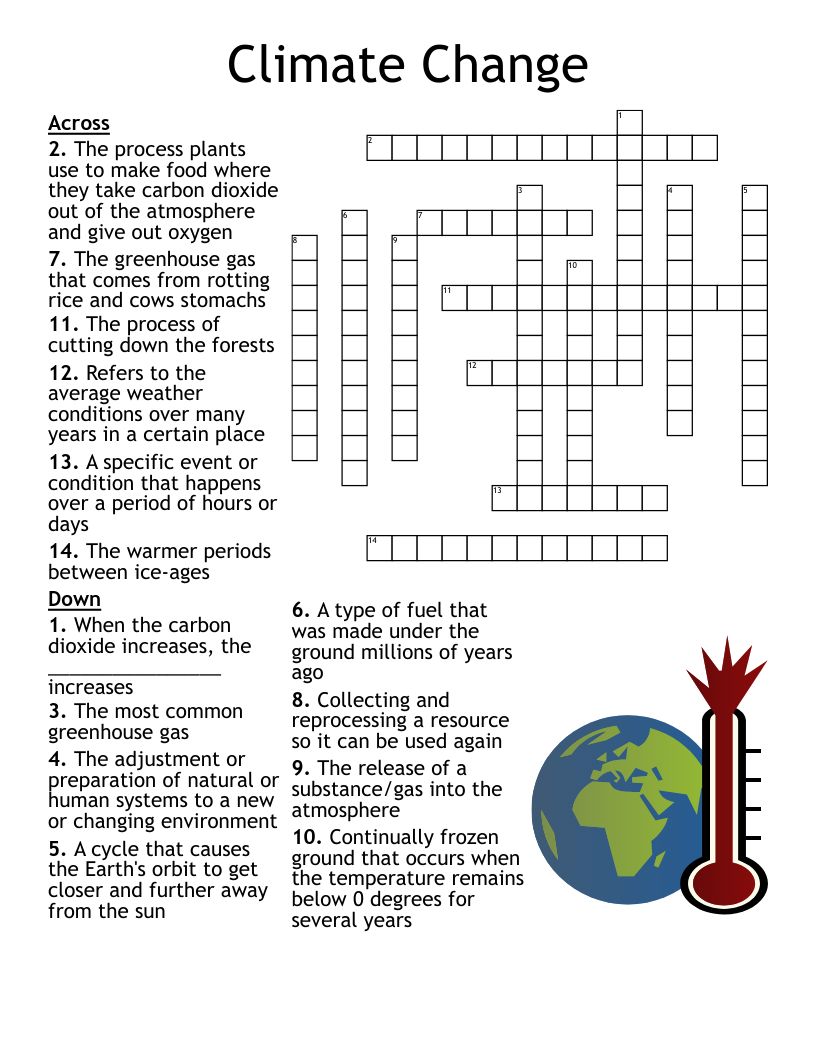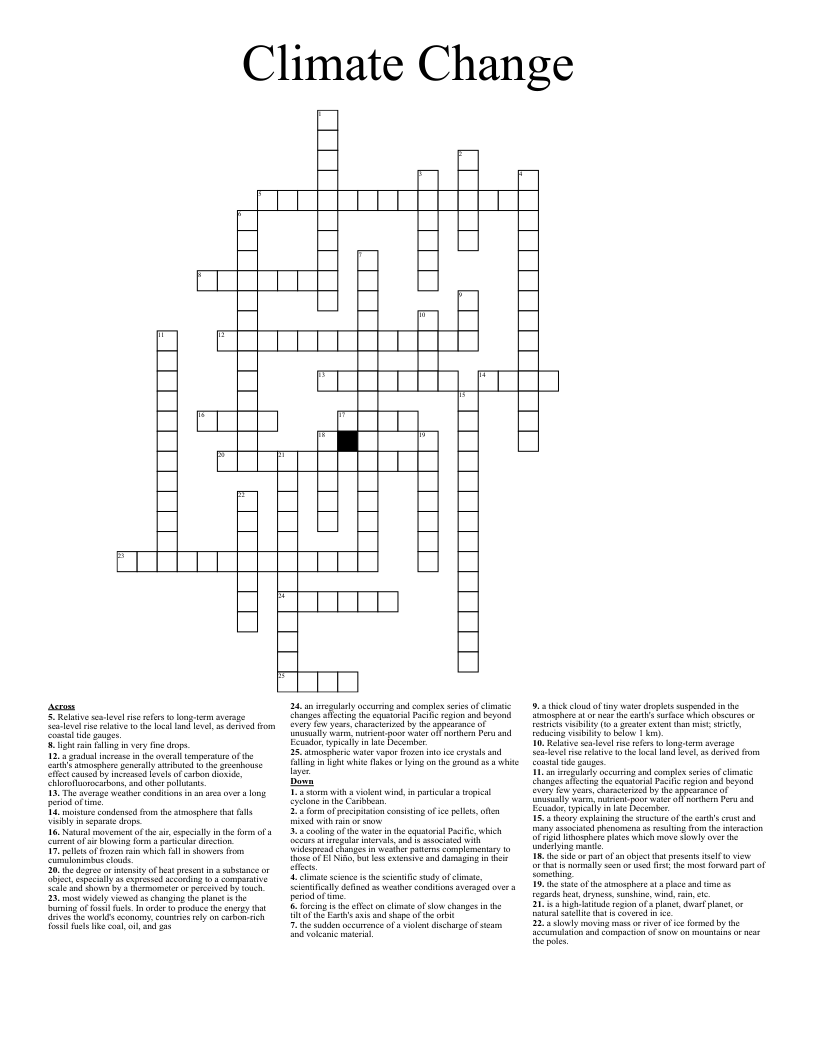
Climate Change Crossword
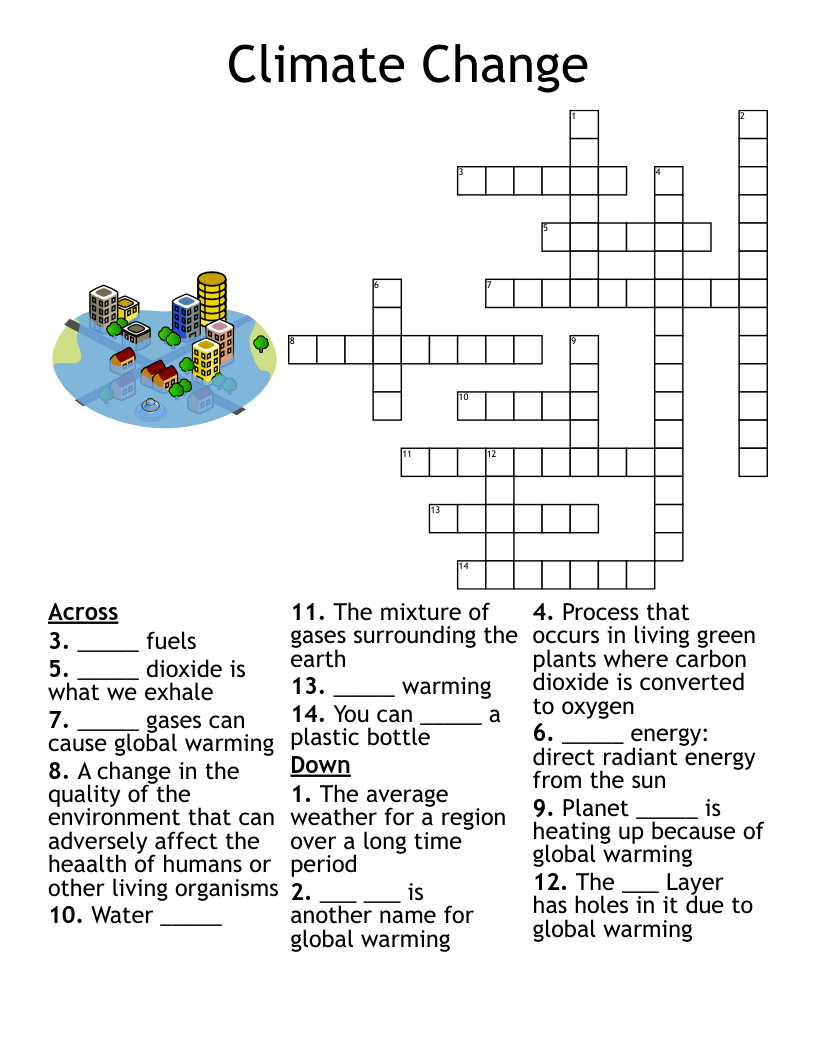
This printable crossword puzzle has 25 clues. Answers range from 3 to 16 letters long. This crossword is also available to download as a Microsoft Word document or a PDF.
Description
Relative sea-level rise refers to long-term average sea-level rise relative to the local land level, as derived from coastal tide gauges.
forcing is the effect on climate of slow changes in the tilt of the Earth's axis and shape of the orbit
an irregularly occurring and complex series of climatic changes affecting the equatorial Pacific region and beyond every few years, characterized by the appearance of unusually warm, nutrient-poor water off northern Peru and Ecuador, typically in late December.
an irregularly occurring and complex series of climatic changes affecting the equatorial Pacific region and beyond every few years, characterized by the appearance of unusually warm, nutrient-poor water off northern Peru and Ecuador, typically in late December.
a slowly moving mass or river of ice formed by the accumulation and compaction of snow on mountains or near the poles.
a theory explaining the structure of the earth's crust and many associated phenomena as resulting from the interaction of rigid lithosphere plates which move slowly over the underlying mantle.
the sudden occurrence of a violent discharge of steam and volcanic material.
Natural movement of the air, especially in the form of a current of air blowing form a particular direction.
a form of precipitation consisting of ice pellets, often mixed with rain or snow
moisture condensed from the atmosphere that falls visibly in separate drops.
light rain falling in very fine drops.
The average weather conditions in an area over a long period of time.
a gradual increase in the overall temperature of the earth's atmosphere generally attributed to the greenhouse effect caused by increased levels of carbon dioxide, chlorofluorocarbons, and other pollutants.
atmospheric water vapor frozen into ice crystals and falling in light white flakes or lying on the ground as a white layer.
a thick cloud of tiny water droplets suspended in the atmosphere at or near the earth's surface which obscures or restricts visibility (to a greater extent than mist; strictly, reducing visibility to below 1 km).
the side or part of an object that presents itself to view or that is normally seen or used first; the most forward part of something.
Relative sea-level rise refers to long-term average sea-level rise relative to the local land level, as derived from coastal tide gauges.
climate science is the scientific study of climate, scientifically defined as weather conditions averaged over a period of time.
is a high-latitude region of a planet, dwarf planet, or natural satellite that is covered in ice.
a storm with a violent wind, in particular a tropical cyclone in the Caribbean.
most widely viewed as changing the planet is the burning of fossil fuels. In order to produce the energy that drives the world's economy, countries rely on carbon-rich fossil fuels like coal, oil, and gas
the state of the atmosphere at a place and time as regards heat, dryness, sunshine, wind, rain, etc.
a cooling of the water in the equatorial Pacific, which occurs at irregular intervals, and is associated with widespread changes in weather patterns complementary to those of El Niño, but less extensive and damaging in their effects.
the degree or intensity of heat present in a substance or object, especially as expressed according to a comparative scale and shown by a thermometer or perceived by touch.
pellets of frozen rain which fall in showers from cumulonimbus clouds.