Administration, Consultation, and Supervision Crossword
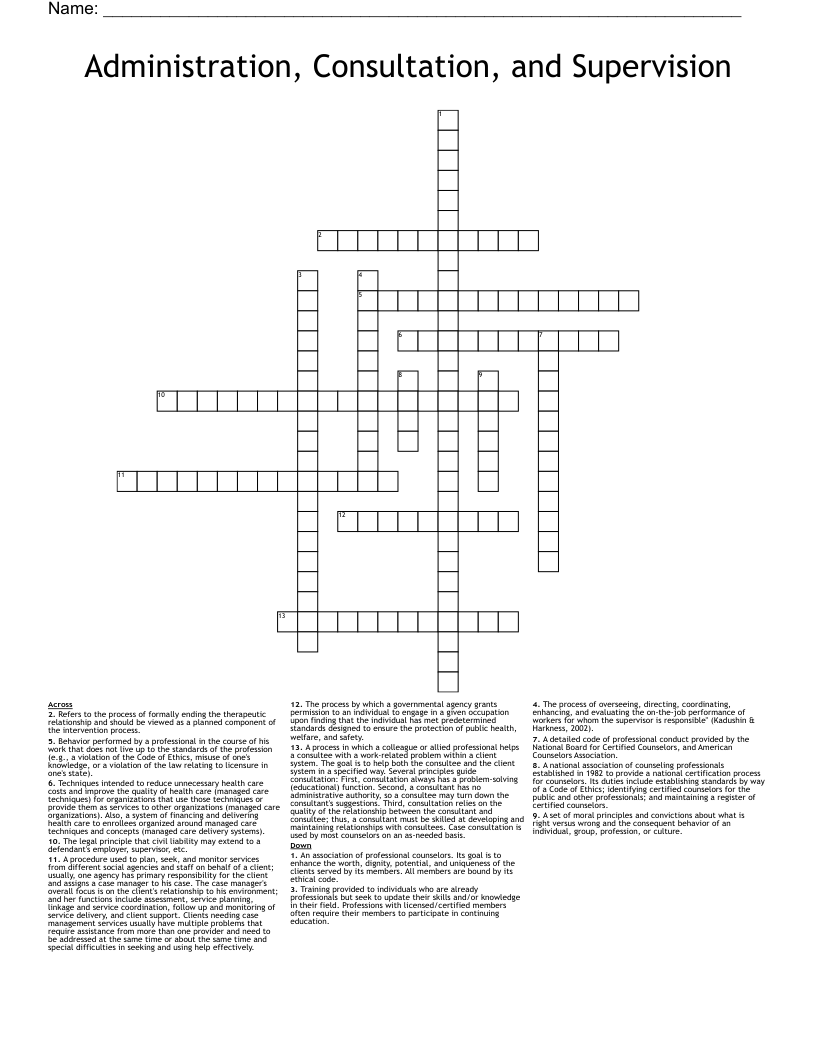
This printable crossword puzzle has 13 clues. Answers range from 4 to 29 letters long. This crossword is also available to download as a Microsoft Word document or a PDF.
Description
A procedure used to plan, seek, and monitor services from different social agencies and staff on behalf of a client; usually, one agency has primary responsibility for the client and assigns a case manager to his case. The case manager's overall focus is on the client's relationship to his environment; and her functions include assessment, service planning, linkage and service coordination, follow up and monitoring of service delivery, and client support. Clients needing case management services usually have multiple problems that require assistance from more than one provider and need to be addressed at the same time or about the same time and special difficulties in seeking and using help effectively.
An association of professional counselors. Its goal is to enhance the worth, dignity, potential, and uniqueness of the clients served by its members. All members are bound by its ethical code.
A detailed code of professional conduct provided by the National Board for Certified Counselors, and American Counselors Association.
A process in which a colleague or allied professional helps a consultee with a work-related problem within a client system. The goal is to help both the consultee and the client system in a specified way. Several principles guide consultation: First, consultation always has a problem-solving (educational) function. Second, a consultant has no administrative authority, so a consultee may turn down the consultant's suggestions. Third, consultation relies on the quality of the relationship between the consultant and consultee; thus, a consultant must be skilled at developing and maintaining relationships with consultees. Case consultation is used by most counselors on an as-needed basis.
Training provided to individuals who are already professionals but seek to update their skills and/or knowledge in their field. Professions with licensed/certified members often require their members to participate in continuing education.
A set of moral principles and convictions about what is right versus wrong and the consequent behavior of an individual, group, profession, or culture.
The process by which a governmental agency grants permission to an individual to engage in a given occupation upon finding that the individual has met predetermined standards designed to ensure the protection of public health, welfare, and safety.
Techniques intended to reduce unnecessary health care costs and improve the quality of health care (managed care techniques) for organizations that use those techniques or provide them as services to other organizations (managed care organizations). Also, a system of financing and delivering health care to enrollees organized around managed care techniques and concepts (managed care delivery systems).
A national association of counseling professionals established in 1982 to provide a national certification process for counselors. Its duties include establishing standards by way of a Code of Ethics; identifying certified counselors for the public and other professionals; and maintaining a register of certified counselors.
The process of overseeing, directing, coordinating, enhancing, and evaluating the on-the-job performance of workers for whom the supervisor is responsible" (Kadushin & Harkness, 2002).
Refers to the process of formally ending the therapeutic relationship and should be viewed as a planned component of the intervention process.
Behavior performed by a professional in the course of his work that does not live up to the standards of the profession (e.g., a violation of the Code of Ethics, misuse of one's knowledge, or a violation of the law relating to licensure in one's state).
The legal principle that civil liability may extend to a defendant's employer, supervisor, etc.