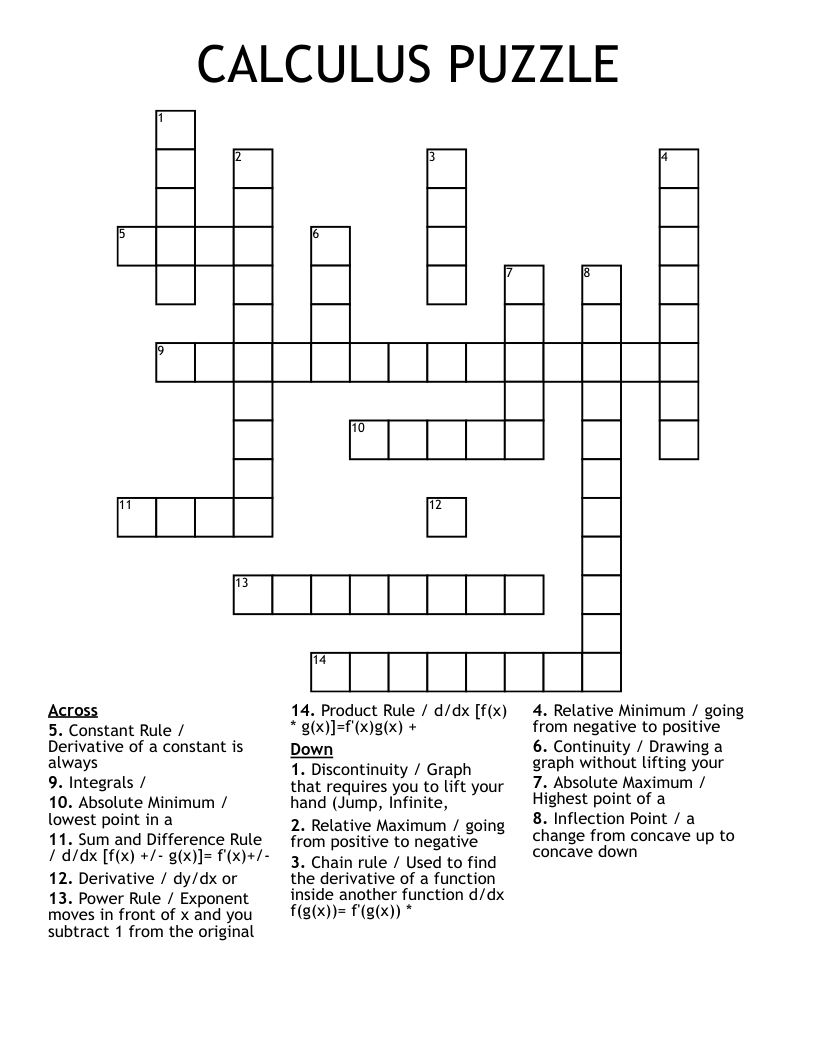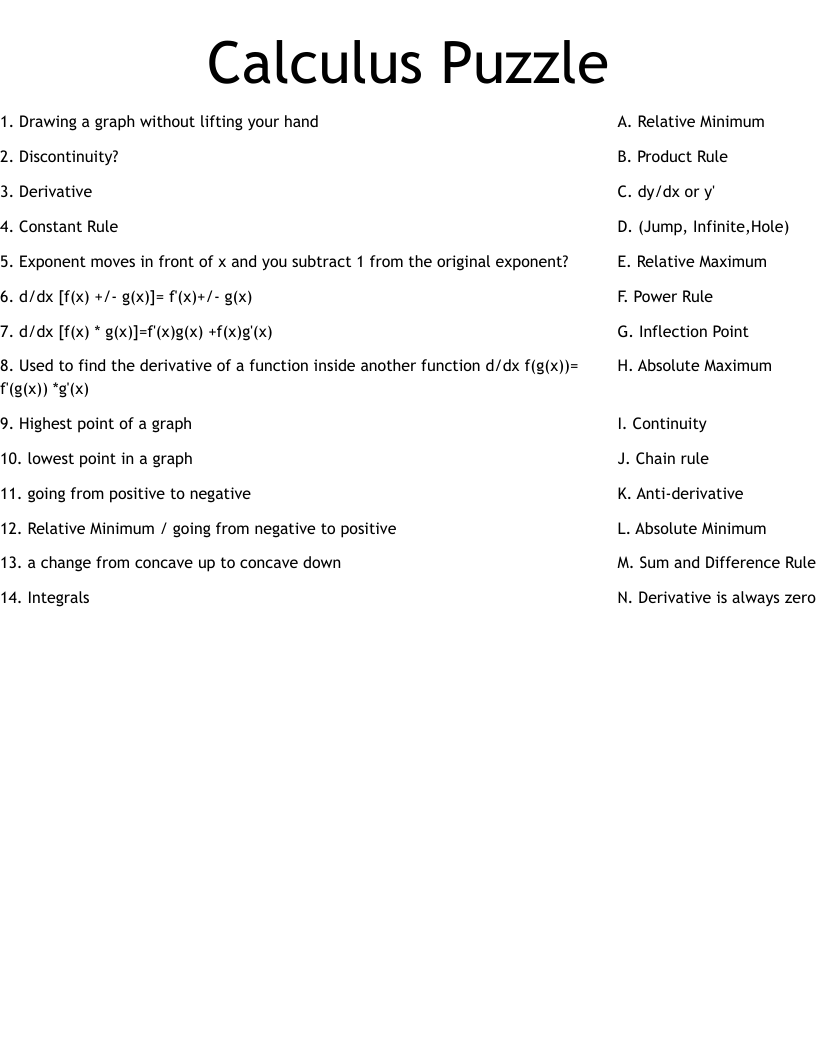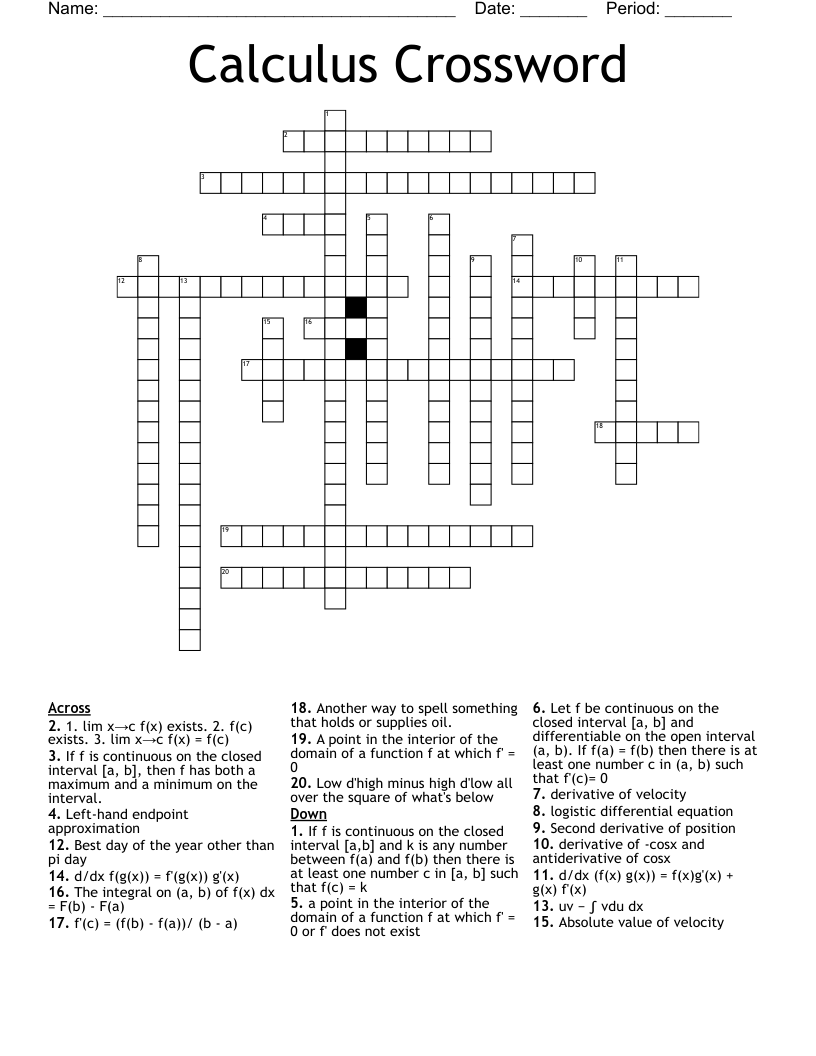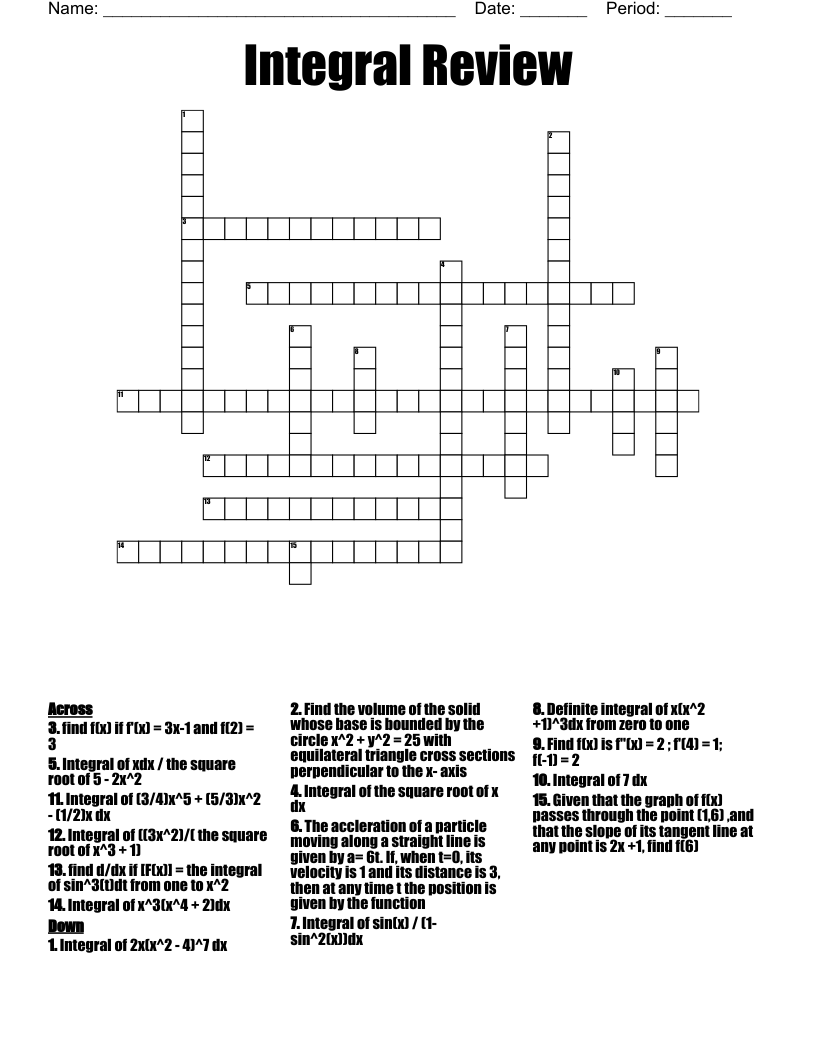
AP Calculus BC crossword
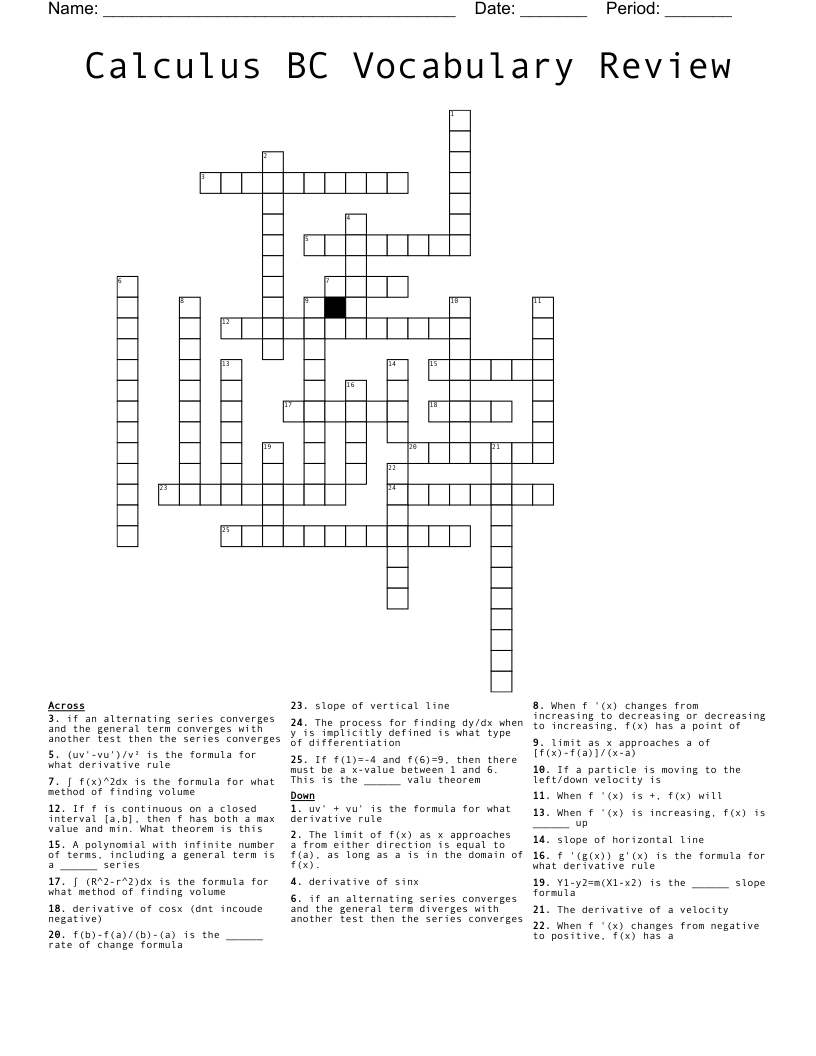
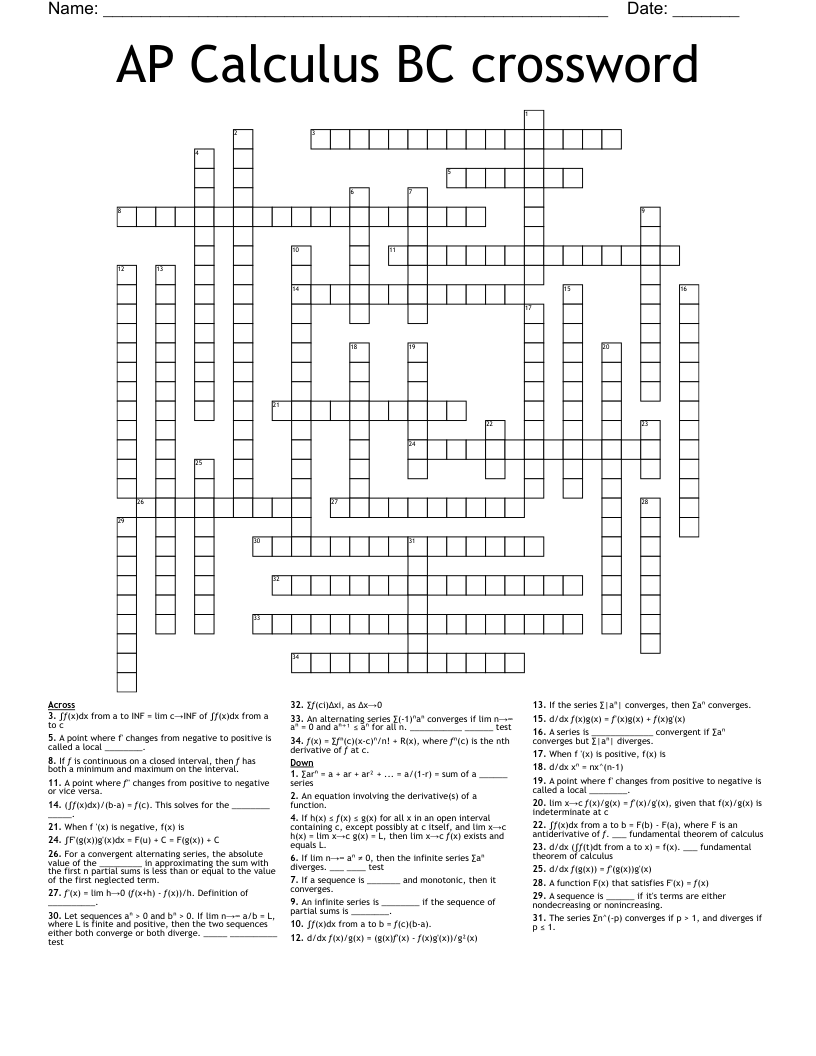
This printable crossword puzzle has 34 clues. Answers range from 3 to 21 letters long. This crossword is also available to download as a Microsoft Word document or a PDF.
Description
If ƒ is continuous on a closed interval, then ƒ has both a minimum and maximum on the interval.
∫ƒ(x)dx from a to b = ƒ(c)(b-a).
If h(x) ≤ ƒ(x) ≤ g(x) for all x in an open interval containing c, except possibly at c itself, and lim x→c h(x) = lim x→c g(x) = L, then lim x→c ƒ(x) exists and equals L.
d/dx ƒ(x)g(x) = ƒ'(x)g(x) + ƒ(x)g'(x)
d/dx xⁿ = nx^(n-1)
An infinite series is ________ if the sequence of partial sums is ________.
If lim n→∞ aⁿ ≠ 0, then the infinite series ∑aⁿ diverges. ___ ____ test
If a sequence is _______ and monotonic, then it converges.
A point where f' changes from positive to negative is called a local ________.
An equation involving the derivative(s) of a function.
∫ƒ(x)dx from a to INF = lim c→INF of ∫ƒ(x)dx from a to c
∑ƒ(ci)∆xi, as ∆x→0
lim x→c ƒ(x)/g(x) = ƒ'(x)/g'(x), given that f(x)/g(x) is indeterminate at c
Let sequences aⁿ > 0 and bⁿ > 0. If lim n→∞ a/b = L, where L is finite and positive, then the two sequences either both converge or both diverge. _____ __________ test
∫F'(g(x))g'(x)dx = F(u) + C = F(g(x)) + C
ƒ(x) = ∑ƒⁿ(c)(x-c)ⁿ/n! + R(x), where ƒⁿ(c) is the nth derivative of ƒ at c.
A series is _____________ convergent if ∑aⁿ converges but ∑|aⁿ| diverges.
d/dx ƒ(x)/g(x) = (g(x)ƒ'(x) - ƒ(x)g'(x))/g²(x)
d/dx ƒ(g(x)) = ƒ'(g(x))g'(x)
When f '(x) is negative, f(x) is
ƒ'(x) = lim h→0 (ƒ(x+h) - ƒ(x))/h. Definition of __________.
When f '(x) is positive, f(x) is
∑arⁿ = a + ar + ar² + ... = a/(1-r) = sum of a ______ series
A sequence is ______ if it's terms are either nondecreasing or nonincreasing.
For a convergent alternating series, the absolute value of the _________ in approximating the sum with the first n partial sums is less than or equal to the value of the first neglected term.
The series ∑n^(-p) converges if p > 1, and diverges if p ≤ 1.
A function F(x) that satisfies F'(x) = ƒ(x)
A point where f' changes from negative to positive is called a local ________.
∫ƒ(x)dx from a to b = F(b) - F(a), where F is an antiderivative of ƒ. ___ fundamental theorem of calculus
d/dx (∫ƒ(t)dt from a to x) = f(x). ___ fundamental theorem of calculus
If the series ∑|aⁿ| converges, then ∑aⁿ converges.
An alternating series ∑(-1)ⁿaⁿ converges if lim n→∞ aⁿ = 0 and aⁿ⁺¹ ≤ aⁿ for all n. ___________ ______ test
(∫ƒ(x)dx)/(b-a) = ƒ(c). This solves for the ________ _____.
A point where ƒ" changes from positive to negative or vice versa.