A & P Muscular System Crossword
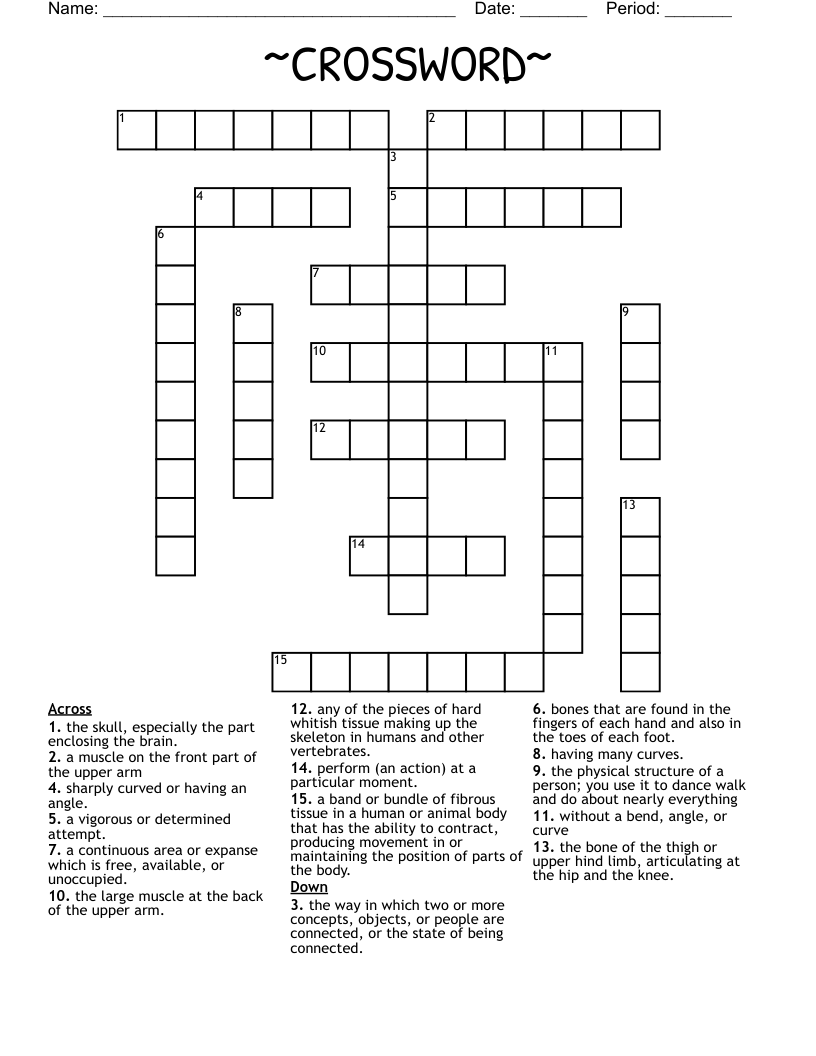
This printable crossword puzzle on the topic of Anatomy has 34 clues. Answers range from 6 to 19 letters long. This crossword is also available to download as a Microsoft Word document or a PDF.
Description
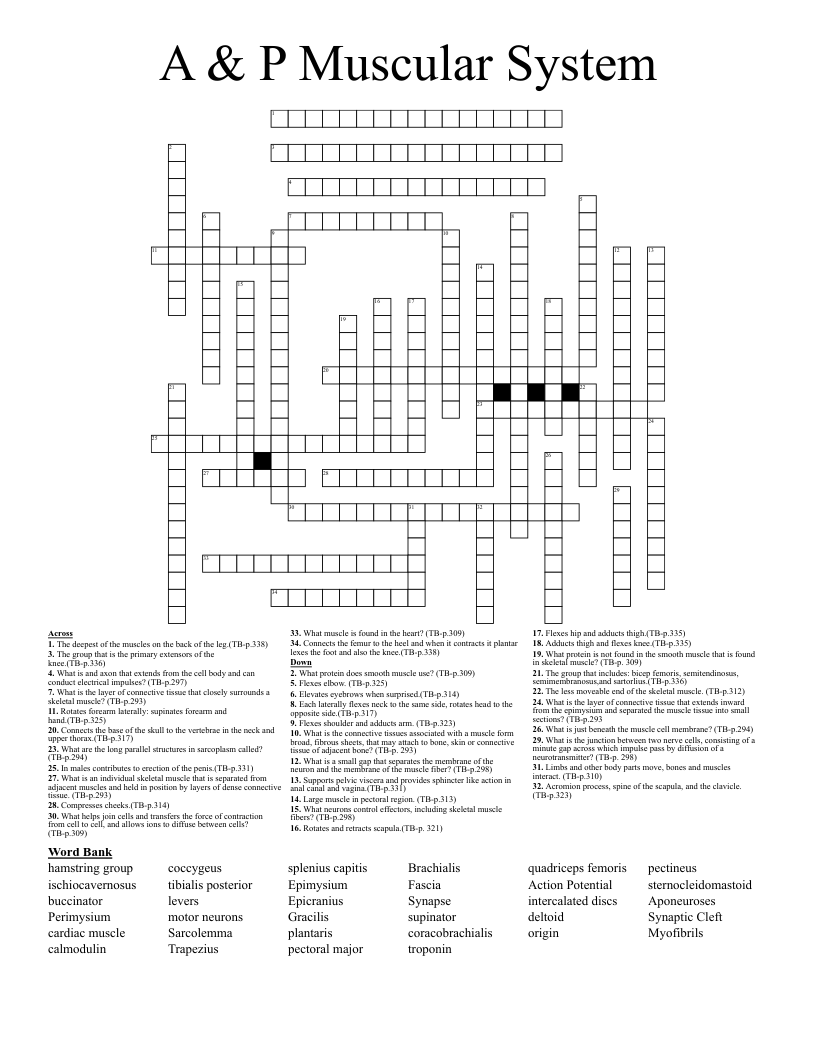
What is an individual skeletal muscle that is separated from adjacent muscles and held in position by layers of dense connective tissue. (TB-p.293)
What is the connective tissues associated with a muscle form broad, fibrous sheets, that may attach to bone, skin or connective tissue of adjacent bone? (TB-p. 293)
What is the layer of connective tissue that closely surrounds a skeletal muscle? (TB-p.293)
What is the layer of connective tissue that extends inward from the epimysium and separated the muscle tissue into small sections? (TB-p.293
What are the long parallel structures in sarcoplasm called? (TB-p.294)
What is just beneath the muscle cell membrane? (TB-p.294)
What is the junction between two nerve cells, consisting of a minute gap across which impulse pass by diffusion of a neurotransmitter? (TB-p. 298)
What is a small gap that separates the membrane of the neuron and the membrane of the muscle fiber? (TB-p.298)
What is and axon that extends from the cell body and can conduct electrical impulses? (TB-p.297)
What neurons control effectors, including skeletal muscle fibers? (TB-p.298)
What protein does smooth muscle use? (TB-p.309)
What protein is not found in the smooth muscle that is found in skeletal muscle? (TB-p. 309)
What muscle is found in the heart? (TB-p.309)
What helps join cells and transfers the force of contraction from cell to cell, and allows ions to diffuse between cells? (TB-p.309)
Limbs and other body parts move, bones and muscles interact. (TB-p.310)
The less moveable end of the skeletal muscle. (TB-p.312)
Large muscle in pectoral region. (TB-p.313)
Rotates and retracts scapula.(TB-p. 321)
Compresses cheeks.(TB-p.314)
Elevates eyebrows when surprised.(TB-p.314)
Acromion process, spine of the scapula, and the clavicle. (TB-p.323)
Flexes shoulder and adducts arm. (TB-p.323)
Flexes elbow. (TB-p.325)
Rotates forearm laterally: supinates forearm and hand.(TB-p.325)
Supports pelvic viscera and provides sphincter like action in anal canal and vagina.(TB-p.331)
In males contributes to erection of the penis.(TB-p.331)
Flexes hip and adducts thigh.(TB-p.335)
Adducts thigh and flexes knee.(TB-p.335)
The group that includes: bicep femoris, semitendinosus, semimembranosus,and sartorlius.(TB-p.336)
The group that is the primary extensors of the knee.(TB-p.336)
The deepest of the muscles on the back of the leg.(TB-p.338)
Connects the femur to the heel and when it contracts it plantar lexes the foot and also the knee.(TB-p.338)
Connects the base of the skull to the vertebrae in the neck and upper thorax.(TB-p.317)
Each laterally flexes neck to the same side, rotates head to the opposite side.(TB-p.317)