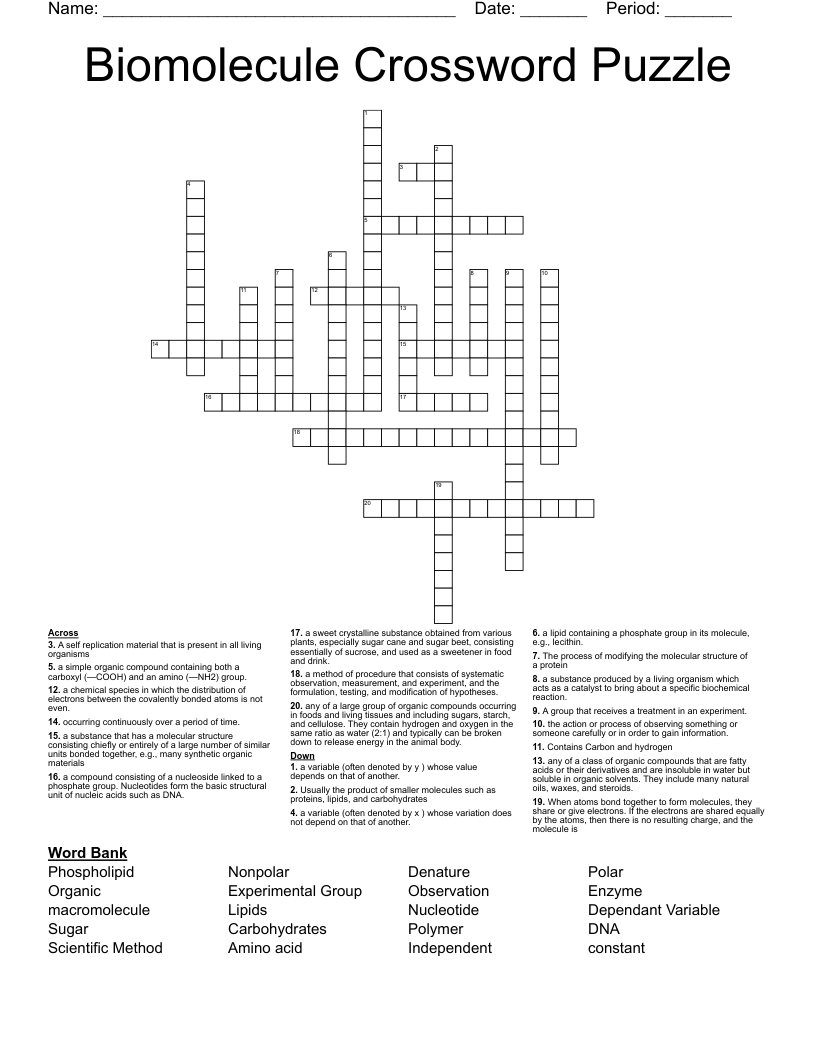
Biomolecule Crossword Puzzle
This printable crossword puzzle on the topic of Organic Chemistry & Biochemistry has 20 clues. Answers range from 3 to 17 letters long. This crossword is also available to download as a Microsoft Word document or a PDF.
Description
Contains Carbon and hydrogen
Usually the product of smaller molecules such as proteins, lipids, and carbohydrates
A self replication material that is present in all living organisms
The process of modifying the molecular structure of a protein
a simple organic compound containing both a carboxyl (—COOH) and an amino (—NH2) group.
any of a large group of organic compounds occurring in foods and living tissues and including sugars, starch, and cellulose. They contain hydrogen and oxygen in the same ratio as water (2:1) and typically can be broken down to release energy in the animal body.
a substance that has a molecular structure consisting chiefly or entirely of a large number of similar units bonded together, e.g., many synthetic organic materials
a sweet crystalline substance obtained from various plants, especially sugar cane and sugar beet, consisting essentially of sucrose, and used as a sweetener in food and drink.
a method of procedure that consists of systematic observation, measurement, and experiment, and the formulation, testing, and modification of hypotheses.
any of a class of organic compounds that are fatty acids or their derivatives and are insoluble in water but soluble in organic solvents. They include many natural oils, waxes, and steroids.
a substance produced by a living organism which acts as a catalyst to bring about a specific biochemical reaction.
a compound consisting of a nucleoside linked to a phosphate group. Nucleotides form the basic structural unit of nucleic acids such as DNA.
a chemical species in which the distribution of electrons between the covalently bonded atoms is not even.
When atoms bond together to form molecules, they share or give electrons. If the electrons are shared equally by the atoms, then there is no resulting charge, and the molecule is
a variable (often denoted by x ) whose variation does not depend on that of another.
a variable (often denoted by y ) whose value depends on that of another.
A group that receives a treatment in an experiment.
a lipid containing a phosphate group in its molecule, e.g., lecithin.
the action or process of observing something or someone carefully or in order to gain information.
occurring continuously over a period of time.