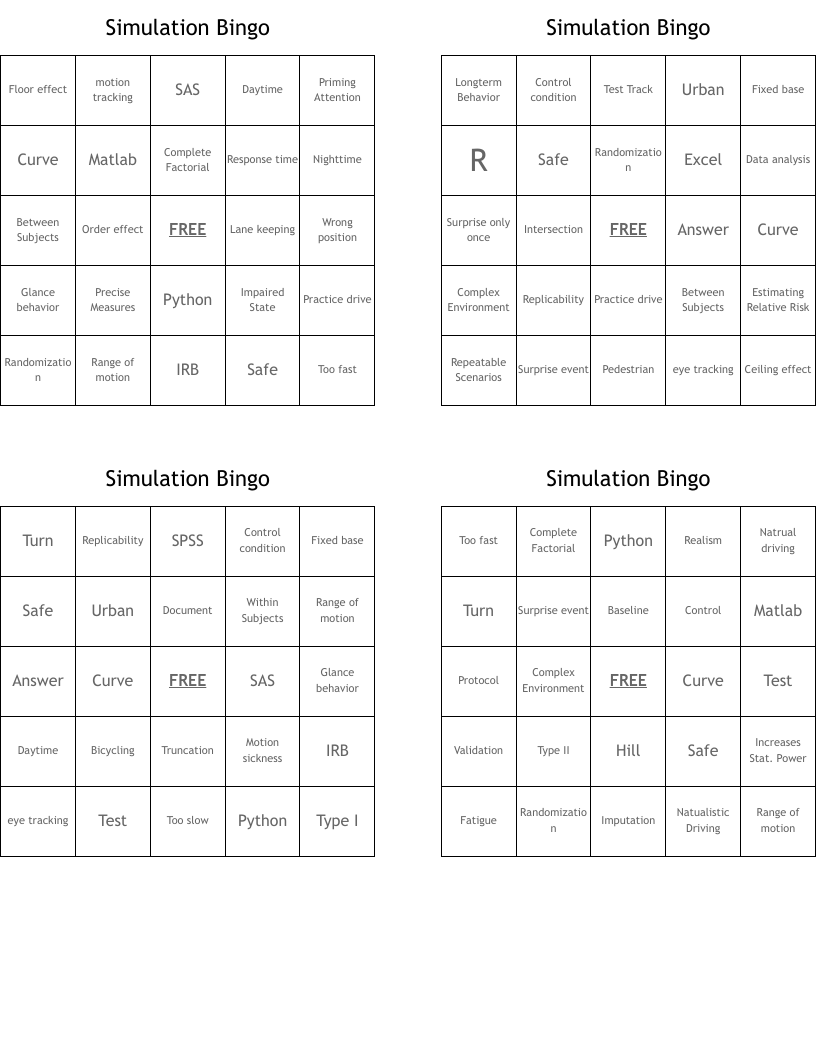
Simulation Bingo

Description

Answer
motion tracking
eye tracking
Biometrics
Control
Replicability
Safe
Realism
Priming Attention
Surprise only once
Video Game
Test Track
Natualistic Driving
Identifying Causation
Dangerous Situations
Impaired State
Precise Measures
Repeatable Scenarios
Estimating Relative Risk
Natrual driving
Complex Environment
Estimating Absolute Risk
Longterm Behavior
Pedestrian
Driving
Bicycling
Fixed base
Only forward view
Head-Mounted display
Range of motion
Fatigue
Motion sickness
Between Subjects
Within Subjects
Independent Var.
Dependent Var.
Increases Stat. Power
Surprise event
Lane keeping
Response time
Glance behavior
Control condition
Baseline
Order effect
Complete Factorial
Latin Square
Sample Size
Type I
Type II
Floor effect
Ceiling effect
Randomization
Urban
Rural
Daytime
Nighttime
Curve
Intersection
Turn
Hill
Practice drive
Validation
Too slow
Too fast
Wrong position
IRB
Document
Test
Protocol
Data analysis
Truncation
Special Code
Imputation
Visualization
Excel
Matlab
R
Python
SAS
SPSS
Customize
Add, edit, delete clues, and customize this puzzle.

Track and Field

Word Search

Cyber Security

Crossword

Force & Motion

Word Search

Sound Crossword

Crossword

Language of Film

Word Search

I/O Units

Word Search

Robotics

Crossword

Frequently Asked Questions

What is Bingo?

Since its invention in the 1920’s, bingo has been and continues to be one of the oldest and most loved games that you can find all over the world. Bingo is a game of chance where numbers are drawn between 1 and 75 or 90 (depending on where in the world you are).

All of the players all have a bingo card with at least 16 different numbers on it. Depending on where you are located, the game may have slightly different rules or structure because different jurisdictions have evolved their own version of the game.

The basic premise is that players will mark off each number that they can match on their bingo card. How bingo works is, when a player has a row, column, or diagonal completely covered, they will call out “bingo!”

Who can play Bingo?

If you’re wondering who bingo is good for, the answer is everyone! People of all generations love bingo, and the teachers who use WordMint to create their bingo templates find that their students love it.

Bingo can be played with numbers or with words, so there are literally countless combinations that you can create for templates, and it is easy to customise the template to the age or learning level of your students.

How do I create a bingo template?

A bingo card template in word can be a bit difficult to work with. For the easiest bingo card templates, WordMint is the way to go! With over 1000 existing bingo card templates to choose from you could find the perfect card already existing, or you can create your own!

Simply log in to your account and use our template builders to create your own custom bingo templates.

What is WordMint?

WordMint is your go to website for creating quick and easy templates for word searches, crosswords, bingo and countless other puzzles. With over 300,000 pre-made puzzles, you can select one of our existing templates, or create your own.

Do you have printable bingo templates?

Absolutely! All of our templates can be easily print, or you can save your work as a PDF to print for the entire class. Your cards get saved into your account for easy access and printing in the future, so you don’t need to worry about saving them at work or at home!

Do you have bingo templates in other languages?

Yes! We have full support for bingo templates in Spanish, French and Japanese with diacritics. You can use other languages just for your titles and instructions, or create a bingo puzzle completely with words instead of numbers.

Can I convert my bingo template into other puzzles?

With WordMint you can create a template and then use it to convert into a variety of other executions - word searches, word scramble, crosswords or many more.

Is Bingo good for kids?

The teachers that use WordMint love that they are able to create bingo templates that challenge their students cognitive abilities, and bring them together in a fun social environment.

You can theme your bingo games, and the ability to use different languages means that you can work language learning into your lessons as well. Because WordMint templates are totally custom, you can create a bingo template for kids that suits their age and education level.