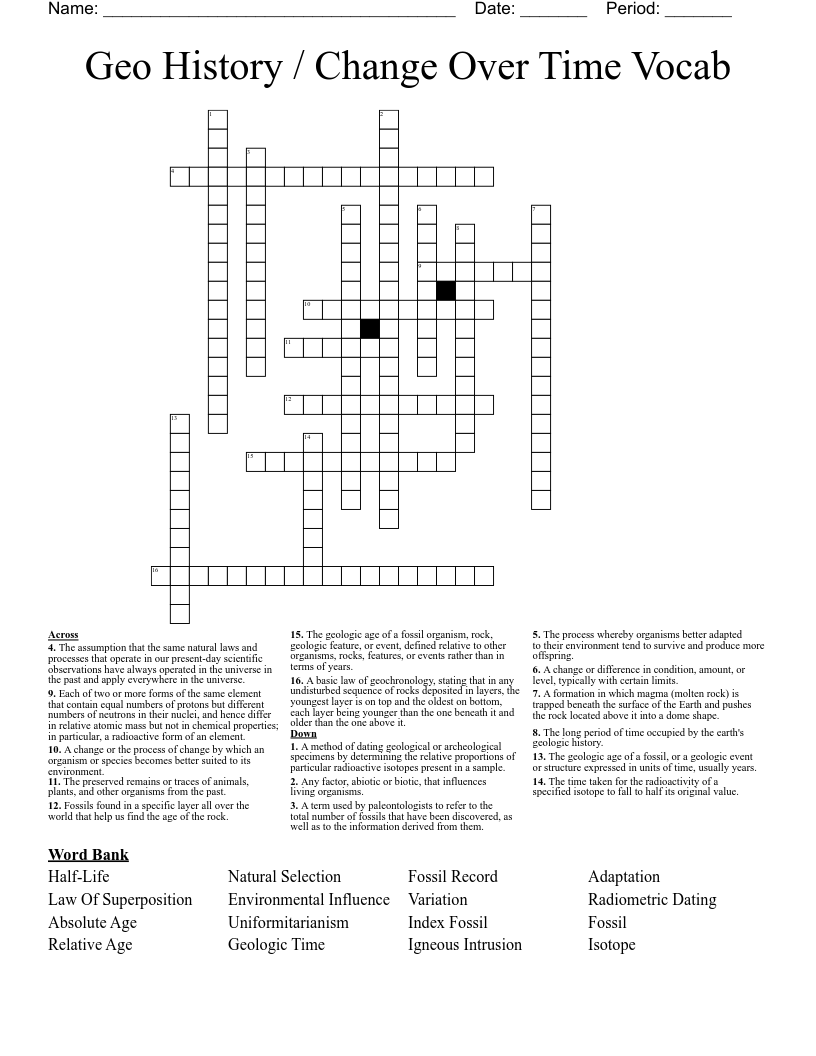
Geo History / Change Over Time Vocab Crossword
This printable crossword puzzle on the topic of Ecology & Evolution has 16 clues. Answers range from 6 to 22 letters long. This crossword is also available to download as a Microsoft Word document or a PDF.
Description
The long period of time occupied by the earth's geologic history.
The preserved remains or traces of animals, plants, and other organisms from the past.
A term used by paleontologists to refer to the total number of fossils that have been discovered, as well as to the information derived from them.
The assumption that the same natural laws and processes that operate in our present-day scientific observations have always operated in the universe in the past and apply everywhere in the universe.
The process whereby organisms better adapted to their environment tend to survive and produce more offspring.
A change or difference in condition, amount, or level, typically with certain limits.
A change or the process of change by which an organism or species becomes better suited to its environment.
Any factor, abiotic or biotic, that influences living organisms.
The geologic age of a fossil organism, rock, geologic feature, or event, defined relative to other organisms, rocks, features, or events rather than in terms of years.
A basic law of geochronology, stating that in any undisturbed sequence of rocks deposited in layers, the youngest layer is on top and the oldest on bottom, each layer being younger than the one beneath it and older than the one above it.
Fossils found in a specific layer all over the world that help us find the age of the rock.
A formation in which magma (molten rock) is trapped beneath the surface of the Earth and pushes the rock located above it into a dome shape.
The geologic age of a fossil, or a geologic event or structure expressed in units of time, usually years.
Each of two or more forms of the same element that contain equal numbers of protons but different numbers of neutrons in their nuclei, and hence differ in relative atomic mass but not in chemical properties; in particular, a radioactive form of an element.
The time taken for the radioactivity of a specified isotope to fall to half its original value.
A method of dating geological or archeological specimens by determining the relative proportions of particular radioactive isotopes present in a sample.