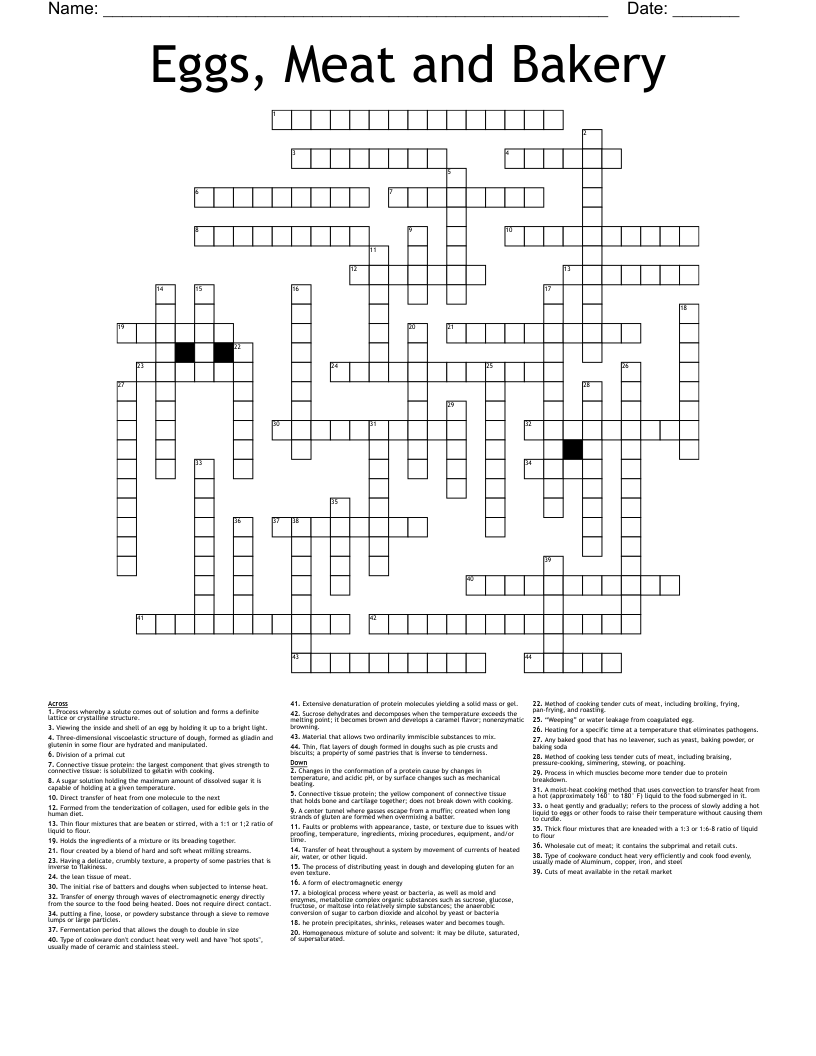
Eggs, Meat and Bakery Crossword
This printable crossword puzzle on the topic of Nutrition & Food Safety has 44 clues. Answers range from 4 to 15 letters long. This crossword is also available to download as a Microsoft Word document or a PDF.
Description
flour created by a blend of hard and soft wheat milling streams.
Process in which muscles become more tender due to protein breakdown.
Holds the ingredients of a mixture or its breading together.
Viewing the inside and shell of an egg by holding it up to a bright light.
Extensive denaturation of protein molecules yielding a solid mass or gel.
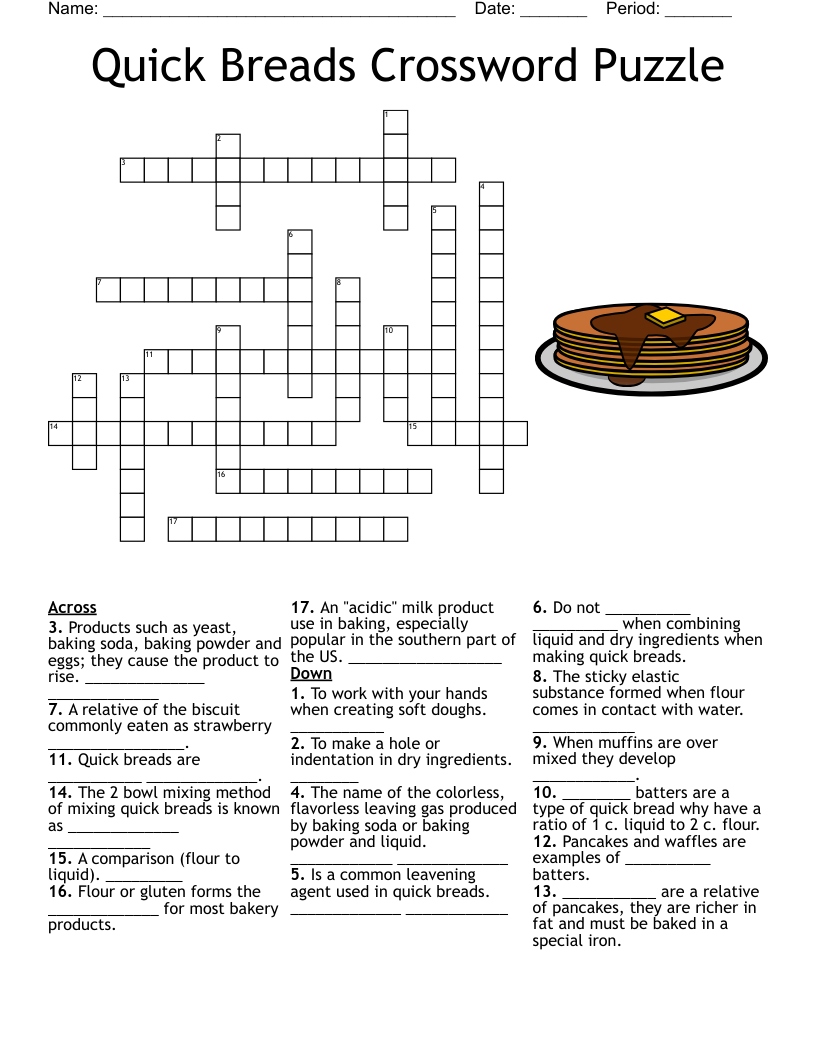
Thin flour mixtures that are beaten or stirred, with a 1:1 or 1;2 ratio of liquid to flour.
Connective tissue protein: the largest component that gives strength to connective tissue: is solubilized to gelatin with cooking.
he protein precipitates, shrinks, releases water and becomes tough.
Method of cooking tender cuts of meat, including broiling, frying, pan-frying, and roasting.
Formed from the tenderization of collagen, used for edible gels in the human diet.
Sucrose dehydrates and decomposes when the temperature exceeds the melting point; it becomes brown and develops a caramel flavor; nonenzymatic browning.
Method of cooking less tender cuts of meat, including braising, pressure-cooking, simmering, stewing, or poaching.
the lean tissue of meat.
Wholesale cut of meat; it contains the subprimal and retail cuts.
Cuts of meat available in the retail market
Division of a primal cut
Connective tissue protein; the yellow component of connective tissue that holds bone and cartilage together; does not break down with cooking.
Process whereby a solute comes out of solution and forms a definite lattice or crystalline structure.
Faults or problems with appearance, taste, or texture due to issues with proofing, temperature, ingredients, mixing procedures, equipment, and/or time.
Thick flour mixtures that are kneaded with a 1:3 or 1:6-8 ratio of liquid to flour
a biological process where yeast or bacteria, as well as mold and enzymes, metabolize complex organic substances such as sucrose, glucose, fructose, or maltose into relatively simple substances; the anaerobic conversion of sugar to carbon dioxide and alcohol by yeast or bacteria
Thin, flat layers of dough formed in doughs such as pie crusts and biscuits; a property of some pastries that is inverse to tenderness.
Three-dimensional viscoelastic structure of dough, formed as gliadin and glutenin in some flour are hydrated and manipulated.
The process of distributing yeast in dough and developing gluten for an even texture.
The initial rise of batters and doughs when subjected to intense heat.
A center tunnel where gasses escape from a muffin; created when long strands of gluten are formed when overmixing a batter.
Fermentation period that allows the dough to double in size
A sugar solution holding the maximum amount of dissolved sugar it is capable of holding at a given temperature.
putting a fine, loose, or powdery substance through a sieve to remove lumps or large particles.
Homogeneous mixture of solute and solvent: it may be dilute, saturated, of supersaturated.
Having a delicate, crumbly texture, a property of some pastries that is inverse to flakiness.
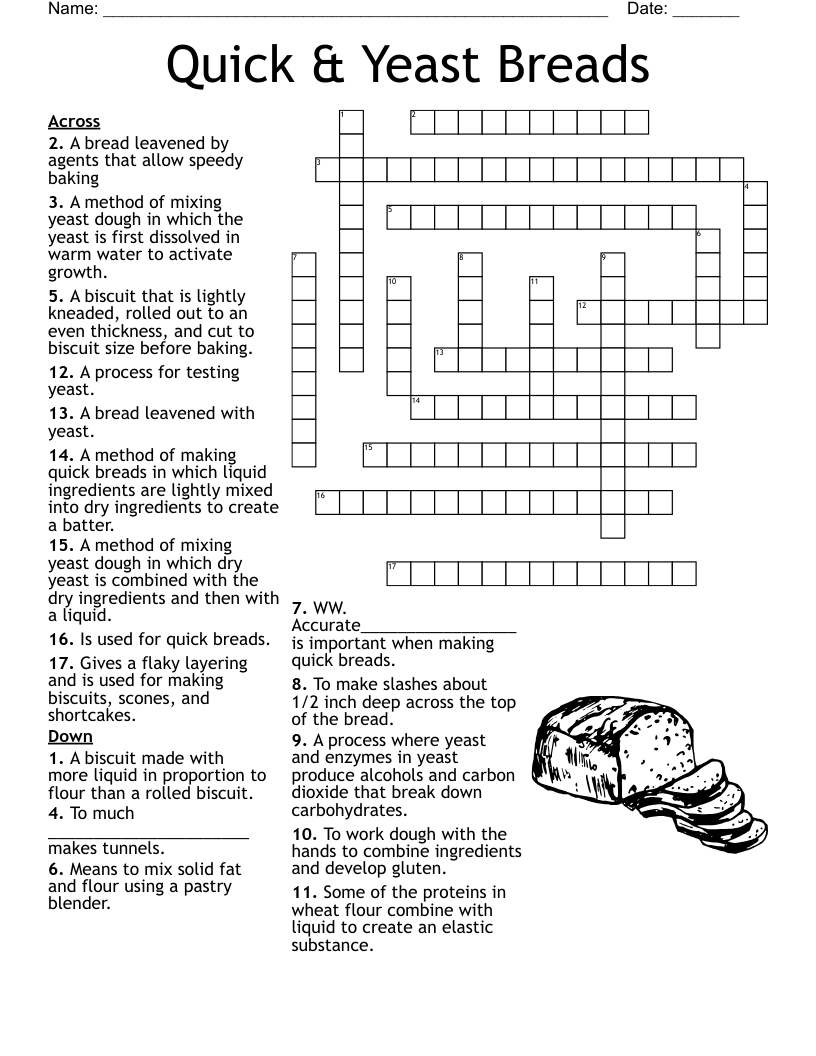
Any baked good that has no leavener, such as yeast, baking powder, or baking soda
Changes in the conformation of a protein cause by changes in temperature, and acidic pH, or by surface changes such as mechanical beating.
Material that allows two ordinarily immiscible substances to mix.
Heating for a specific time at a temperature that eliminates pathogens.
“Weeping” or water leakage from coagulated egg.
o heat gently and gradually; refers to the process of slowly adding a hot liquid to eggs or other foods to raise their temperature without causing them to curdle.
A moist-heat cooking method that uses convection to transfer heat from a hot (approximately 160° to 180° F) liquid to the food submerged in it.
Transfer of heat throughout a system by movement of currents of heated air, water, or other liquid.
Direct transfer of heat from one molecule to the next
Transfer of energy through waves of electromagnetic energy directly from the source to the food being heated. Does not require direct contact.
A form of electromagnetic energy
Type of cookware conduct heat very efficiently and cook food evenly, usually made of Aluminum, copper, iron, and steel
Type of cookware don't conduct heat very well and have "hot spots", usually made of ceramic and stainless steel.