CLINICAL SUBSPECIALTIES IN ANESTHESIA Crossword
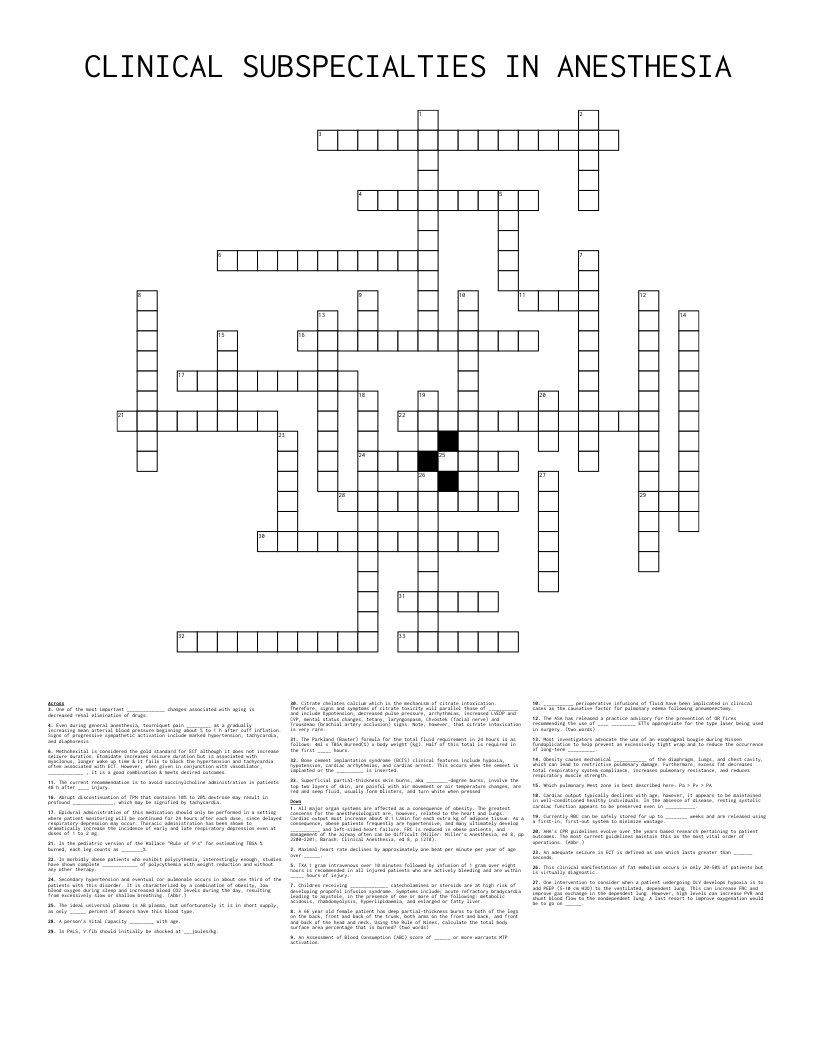
This printable crossword puzzle on the topic of Nursing & Healthcare Careers has 33 clues. Answers range from 3 to 15 letters long. This crossword is also available to download as a Microsoft Word document or a PDF.
Description
Abrupt discontinuation of TPN that contains 10% to 20% dextrose may result in profound _______________, which may be signified by tachycardia.
Most investigators advocate the use of an esophageal bougie during Nissen fundoplication to help prevent an excessively tight wrap and to reduce the occurrence of long-term __________.
Secondary hypertension and eventual cor pulmonale occurs in about one third of the patients with this disorder. It is characterized by a combination of obesity, low blood oxygen during sleep and increased blood CO2 levels during the day, resulting from excessively slow or shallow breathing. (Abbr.)
AHA's CPR guidelines evolve over the years based research pertaining to patient outcomes. The most current guidelines maintain this as the most vital order of operations. (Abbr.)
All major organ systems are affected as a consequence of obesity. The greatest concerns for the anesthesiologist are, however, related to the heart and lungs. Cardiac output must increase about 0.1 L/min for each extra kg of adipose tissue. As a consequence, obese patients frequently are hypertensive, and many ultimately develop ___________ and left-sided heart failure. FRC is reduced in obese patients, and management of the airway often can be difficult (Miller: Miller’s Anesthesia, ed 8, pp 2200–2201; Barash: Clinical Anesthesia, ed 8, p 1278).
An adequate seizure in ECT is defined as one which lasts greater than _______ seconds.
Methohexital is considered the gold standard for ECT although it does not increase seizure duration. Etomidate increases seizure duration but is associated with myoclonus, longer wake up time & it fails to block the hypertension and tachycardia often associated with ECT. However, when given in conjunction with vasodilator, _____________ , it is a good combination & meets desired outcomes.
Superficial partial-thickness skin burns, aka ________-degree burns, involve the top two layers of skin, are painful with air movement or air temperature changes, are red and seep fluid, usually form blisters, and turn white when pressed
A 66 year old female patient has deep partial-thickness burns to both of the legs on the back, front and back of the trunk, both arms on the front and back, and front and back of the head and neck. Using the Rule of Nines, calculate the total body surface area percentage that is burned? (two words)
The Parkland (Baxter) formula for the total fluid requirement in 24 hours is as follows: 4ml x TBSA Burned(%) x body weight (kg). Half of this total is required in the first _____ hours.
In the pediatric version of the Wallace "Rule of 9's" for estimating TBSA % burned, each leg counts as ________%.
Maximal heart rate declines by approximately one beat per minute per year of age over ______.
Cardiac output typically declines with age, however, it appears to be maintained in well-conditioned healthy individuals. In the absence of disease, resting systolic cardiac function appears to be preserved even in ___________.
Epidural administration of this medication should only be performed in a setting where patient monitoring will be continued for 24 hours after each dose, since delayed respiratory depression may occur. Thoracic administration has been shown to dramatically increase the incidence of early and late respiratory depression even at doses of 1 to 2 mg.
Which pulmonary West zone is best described here: Pa > Pv > PA
Children receiving ______________ catecholamines or steroids are at high risk of developing propofol infusion syndrome. Symptoms include; acute refractory bradycardia leading to asystole, in the presence of one or more of the following: metabolic acidosis, rhabdomyolysis, hyperlipidaemia, and enlarged or fatty liver.
Even during general anesthesia, tourniquet pain _________ as a gradually increasing mean arterial blood pressure beginning about ¾ to 1 h after cuff inflation. Signs of progressive sympathetic activation include marked hypertension, tachycardia, and diaphoresis.
One intervention to consider when a patient undergoing OLV develops hypoxia is to add PEEP (5-10 cm H2O) to the ventilated, dependent lung. This can increase FRC and improve gas exchange in the dependent lung. However, high levels can increase PVR and shunt blood flow to the nondependent lung. A last resort to improve oxygenation would be to go on ______.
In morbidly obese patients who exhibit polycythemia, interestingly enough, studies have shown complete _____________ of polycythemia with weight reduction and without any other therapy.
In PALS, V.fib should initially be shocked at ___joules/kg.
___________ perioperative infusions of fluid have been implicated in clinical cases as the causative factor for pulmonary edema following pneumonectomy.
The ASA has released a practice advisory for the prevention of OR fires recommending the use of ____ _________ ETTs appropriate for the type laser being used in surgery. (two words)
A person's Vital Capacity _________ with age.
One of the most important ______________ changes associated with aging is decreased renal elimination of drugs.
This clinical manifestation of fat embolism occurs in only 20-50% of patients but is virtually diagnostic.
Currently RBC can be safely stored for up to ________ weeks and are released using a first-in, first-out system to minimize wastage.
The ideal universal plasma is AB plasma, but unfortunately it is in short supply, as only ______ percent of donors have this blood type.
An Assessment of Blood Consumption (ABC) score of ______ or more warrants MTP activation.
TXA 1 gram intravenous over 10 minutes followed by infusion of 1 gram over eight hours is recommended in all injured patients who are actively bleeding and are within _____ hours of injury.
Obesity causes mechanical ____________ of the diaphragm, lungs, and chest cavity, which can lead to restrictive pulmonary damage. Furthermore, excess fat decreases total respiratory system compliance, increases pulmonary resistance, and reduces respiratory muscle strength.
Citrate chelates calcium which is the mechanism of citrate intoxication. Therefore, signs and symptoms of citrate toxicity will parallel those of ___________ and include hypotension, decreased pulse pressure, arrhythmias, increased LVEDP and CVP, mental status changes, tetany, laryngospasm, Chvostek (facial nerve) and Trousseau (brachial artery occlusion) signs. Note, however, that citrate intoxication is very rare.
The current recommendation is to avoid succinylcholine administration in patients 48 h after ____ injury.
Bone cement implantation syndrome (BCIS) clinical features include hypoxia, hypotension, cardiac arrhythmias, and cardiac arrest. This occurs when the cement is implanted or the __________ is inserted.