The Roman Government Crossword
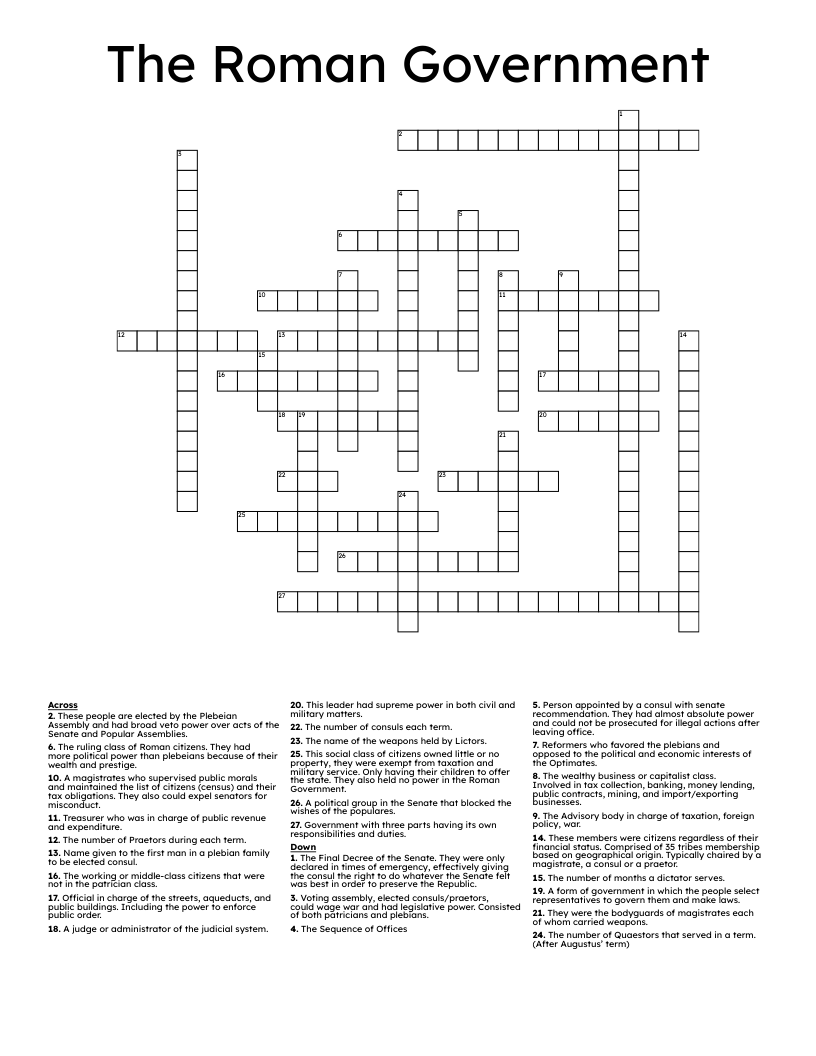
This printable crossword puzzle on the topic of Ancient Civilizations has 27 clues. Answers range from 3 to 25 letters long. This crossword is also available to download as a Microsoft Word document or a PDF.
Description
This leader had supreme power in both civil and military matters.
A judge or administrator of the judicial system.
Treasurer who was in charge of public revenue and expenditure.
Official in charge of the streets, aqueducts, and public buildings. Including the power to enforce public order.
The Sequence of Offices
The Advisory body in charge of taxation, foreign policy, war.
These people are elected by the Plebeian Assembly and had broad veto power over acts of the Senate and Popular Assemblies.
The ruling class of Roman citizens. They had more political power than plebeians because of their wealth and prestige.
The working or middle-class citizens that were not in the patrician class.
A political group in the Senate that blocked the wishes of the populares.
Reformers who favored the plebians and opposed to the political and economic interests of the Optimates.
Name given to the first man in a plebian family to be elected consul.
These members were citizens regardless of their financial status. Comprised of 35 tribes membership based on geographical origin. Typically chaired by a magistrate, a consul or a praetor.
Person appointed by a consul with senate recommendation. They had almost absolute power and could not be prosecuted for illegal actions after leaving office.
The Final Decree of the Senate. They were only declared in times of emergency, effectively giving the consul the right to do whatever the Senate felt was best in order to preserve the Republic.
The wealthy business or capitalist class. Involved in tax collection, banking, money lending, public contracts, mining, and import/exporting businesses.
A magistrates who supervised public morals and maintained the list of citizens (census) and their tax obligations. They also could expel senators for misconduct.
This social class of citizens owned little or no property, they were exempt from taxation and military service. Only having their children to offer the state. They also held no power in the Roman Government.
They were the bodyguards of magistrates each of whom carried weapons.
The name of the weapons held by Lictors.
Voting assembly, elected consuls/praetors, could wage war and had legislative power. Consisted of both patricians and plebians.
A form of government in which the people select representatives to govern them and make laws.
Government with three parts having its own responsibilities and duties.
The number of consuls each term.
The number of Praetors during each term.
The number of months a dictator serves.
The number of Quaestors that served in a term. (After Augustus’ term)