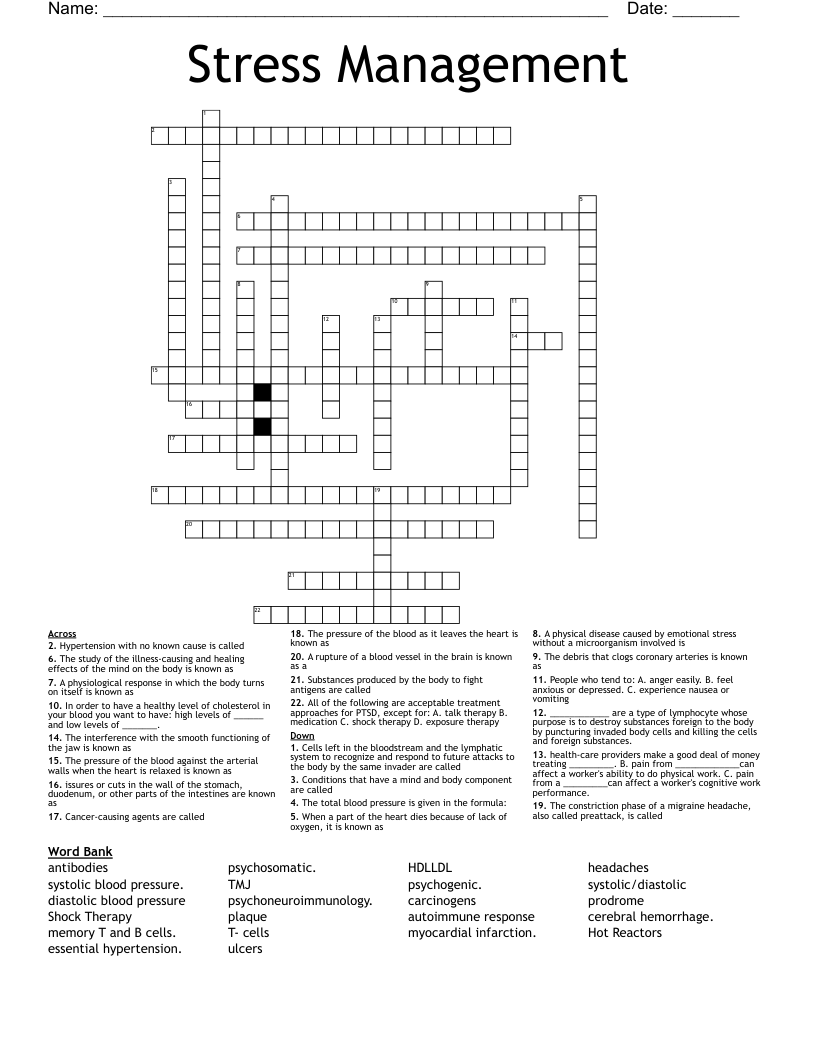
Stress Management Crossword
This printable crossword puzzle on the topic of Mental Health & Counseling has 22 clues. Answers range from 3 to 22 letters long. This crossword is also available to download as a Microsoft Word document or a PDF.
Description
People who tend to: A. anger easily.
B. feel anxious or depressed.
C. experience nausea or vomiting
The total blood pressure is given in the formula:
Cancer-causing agents are called
A physical disease caused by emotional stress without a microorganism involved is
The pressure of the blood as it leaves the heart is known as
When a part of the heart dies because of lack of oxygen, it is known as
In order to have a healthy level of cholesterol in your blood you want to have: high levels of ______ and low levels of _______.
Substances produced by the body to fight antigens are called
Conditions that have a mind and body component are called
Hypertension with no known cause is called
health-care providers make a good deal of money treating _________.
B. pain from _____________can affect a worker's ability to do physical work.
C. pain from a _________can affect a worker's cognitive work performance.
Cells left in the bloodstream and the lymphatic system to recognize and respond to future attacks to the body by the same invader are called
A physiological response in which the body turns on itself is known as
The pressure of the blood against the arterial walls when the heart is relaxed is known as
The study of the illness-causing and healing effects of the mind on the body is known as
The debris that clogs coronary arteries is known as
issures or cuts in the wall of the stomach, duodenum, or other parts of the intestines are known as
A rupture of a blood vessel in the brain is known as a
____________ are a type of lymphocyte whose purpose is to destroy substances foreign to the body by puncturing invaded body cells and killing the cells and foreign substances.
The constriction phase of a migraine headache, also called preattack, is called
The interference with the smooth functioning of the jaw is known as
All of the following are acceptable treatment approaches for PTSD, except for:
A. talk therapy
B. medication
C. shock therapy
D. exposure therapy