Banking Terms Worksheet
This printable matching worksheet on the topic of Money & Personal Finance has 20 questions and answers to match. This matching worksheet is also available to download as a Microsoft Word document or a PDF.
Description
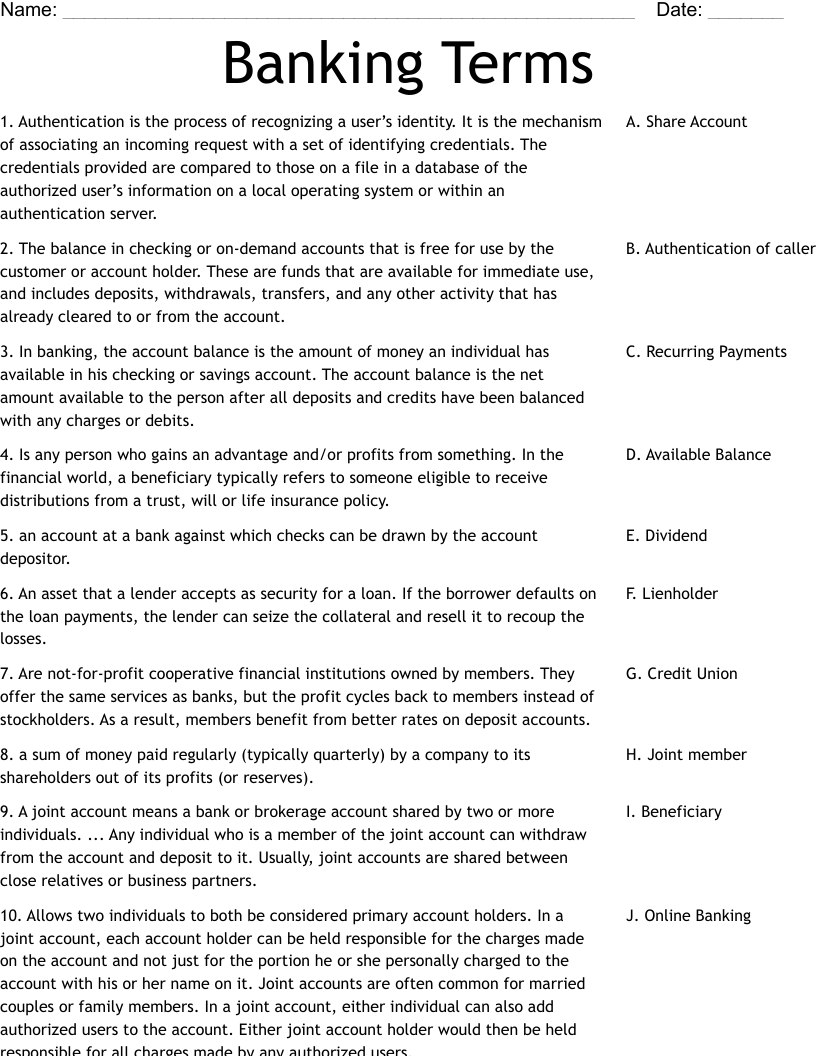
Authentication is the process of recognizing a user’s identity. It is the mechanism of associating an incoming request with a set of identifying credentials. The credentials provided are compared to those on a file in a database of the authorized user’s information on a local operating system or within an authentication server.
The balance in checking or on-demand accounts that is free for use by the customer or account holder. These are funds that are available for immediate use, and includes deposits, withdrawals, transfers, and any other activity that has already cleared to or from the account.
In banking, the account balance is the amount of money an individual has available in his checking or savings account. The account balance is the net amount available to the person after all deposits and credits have been balanced with any charges or debits.
Is any person who gains an advantage and/or profits from something. In the financial world, a beneficiary typically refers to someone eligible to receive distributions from a trust, will or life insurance policy.
an account at a bank against which checks can be drawn by the account depositor.
An asset that a lender accepts as security for a loan. If the borrower defaults on the loan payments, the lender can seize the collateral and resell it to recoup the losses.
Are not-for-profit cooperative financial institutions owned by members. They offer the same services as banks, but the profit cycles back to members instead of stockholders. As a result, members benefit from better rates on deposit accounts.
a sum of money paid regularly (typically quarterly) by a company to its shareholders out of its profits (or reserves).
A joint account means a bank or brokerage account shared by two or more individuals. ... Any individual who is a member of the joint account can withdraw from the account and deposit to it. Usually, joint accounts are shared between close relatives or business partners.
Allows two individuals to both be considered primary account holders. In a joint account, each account holder can be held responsible for the charges made on the account and not just for the portion he or she personally charged to the account with his or her name on it. Joint accounts are often common for married couples or family members. In a joint account, either individual can also add authorized users to the account. Either joint account holder would then be held responsible for all charges made by any authorized users.
An amount of money loaned at interest by a bank to a borrower, usually on collateral security, for a certain period of time.
The bank, finance company, credit union, other financial institution, or individual with whom you signed an agreement to borrow money using a particular asset, such as a car, as collateral.
Mobile banking is the act of making financial transactions on a mobile device (cell phone, tablet, etc.). This activity can be as simple as a bank sending fraud or usage activity to a client’s cell phone or as complex as a client paying bills or sending money abroad. Advantages to mobile banking include the ability to bank anywhere and at any time. Disadvantages include security concerns and a limited range of capabilities when compared to banking in person or on a computer.
Total amount of money in a financial account, calculated by adding all deposits to the initial deposit and deducting all disbursements or payments made. Net cash balance can be positive, if money is available or negative if the account has been overdrawn.
The system customers use to view accounts, make transfers, access bill payment, and perform other online tasks.
The party in an exchange who receives payment. A payee is paid in cash, check or other transfer medium by a payer, with the payer receiving a good or service in return.
The individual who is legally responsible for charges made to credit or debit card account. They are the person who applies for the account, and it is their financial profile that is considered for account approval. With most financial accounts, the primary account holder has the option to allow for the issuance of additional cards to authorized users. With authorized users, the primary account holder is still fully liable for all charges on the account, including charges made by both the primary account holder and any authorized users.
Automatic payments where you authorize, for example: Time Warner Cable, to collect the total charges from your credit card or bank account every month. This amount is deducted on the due date of every billing cycle, so that you never have to worry about late fees.
A bank account that earns interest.
An account at a credit union, which could be a checking or savings account.