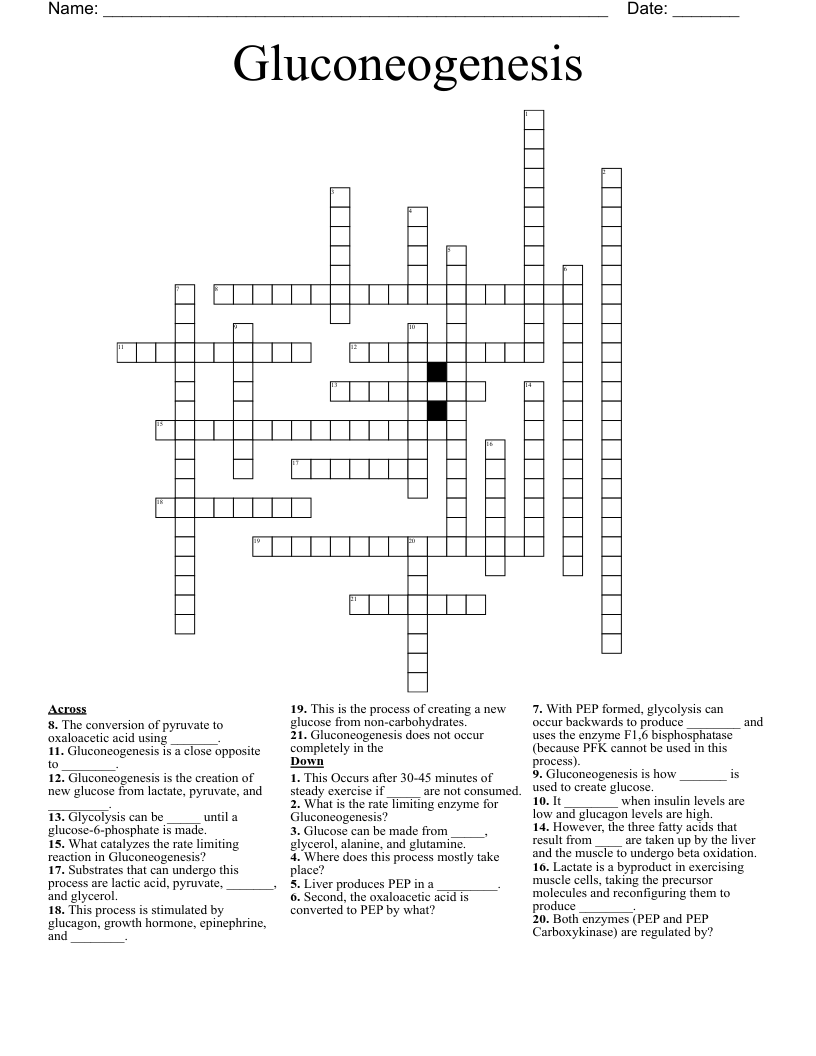
Gluconeogenesis Crossword
This printable crossword puzzle on the topic of Organic Chemistry & Biochemistry has 21 clues. Answers range from 5 to 26 letters long. This crossword is also available to download as a Microsoft Word document or a PDF.
Description
This is the process of creating a new glucose from non-carbohydrates.
Glucose can be made from _____, glycerol, alanine, and glutamine.
Where does this process mostly take place?
Gluconeogenesis is a close opposite to ________.
Gluconeogenesis does not occur completely in the
Liver produces PEP in a _________.
The conversion of pyruvate to oxaloacetic acid using _______.
Second, the oxaloacetic acid is converted to PEP by what?
Both enzymes (PEP and PEP Carboxykinase) are regulated by?
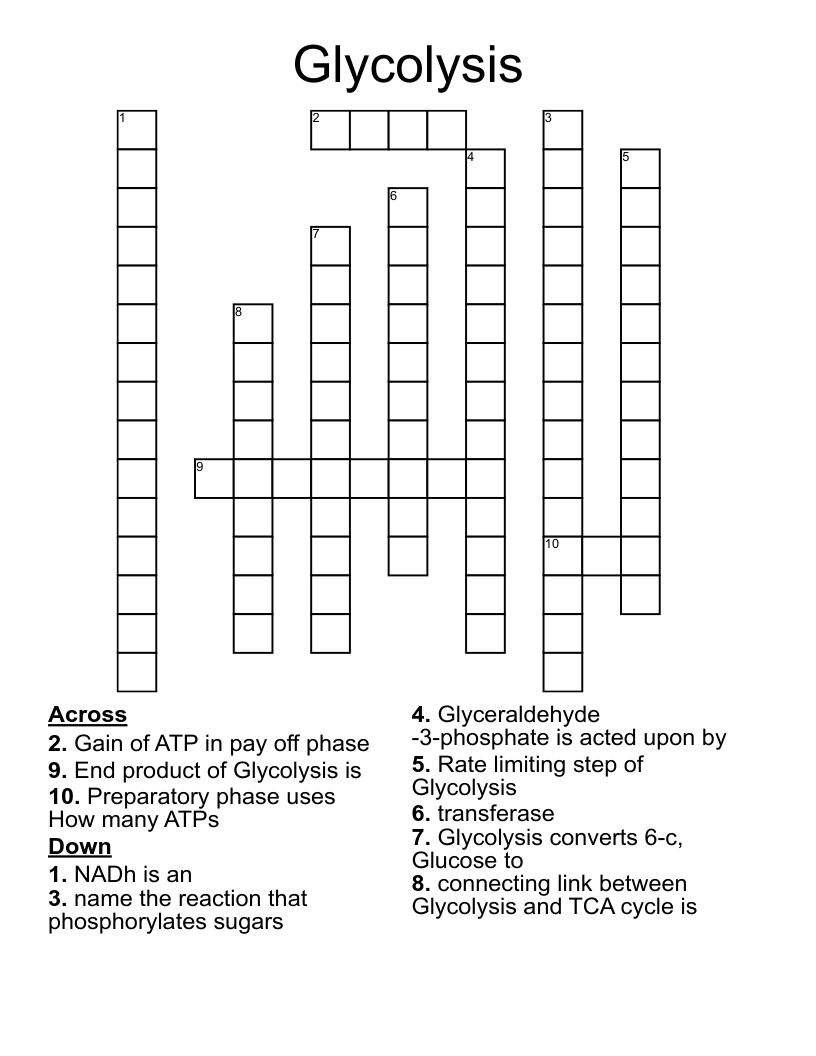
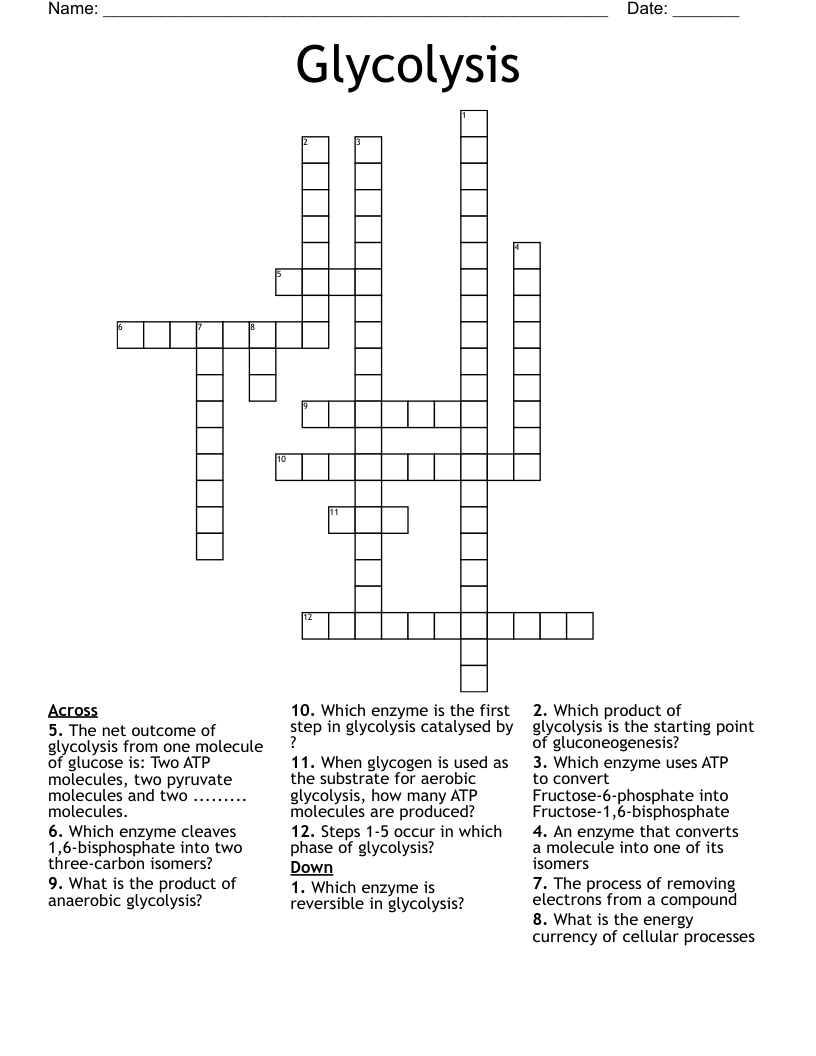
With PEP formed, glycolysis can occur backwards to produce ________ and uses the enzyme F1,6 bisphosphatase (because PFK cannot be used in this process).
Glycolysis can be _____ until a glucose-6-phosphate is made.
Substrates that can undergo this process are lactic acid, pyruvate, _______, and glycerol.
It ________ when insulin levels are low and glucagon levels are high.
This Occurs after 30-45 minutes of steady exercise if _____ are not consumed.
However, the three fatty acids that result from ____ are taken up by the liver and the muscle to undergo beta oxidation.
Gluconeogenesis is how _______ is used to create glucose.
Gluconeogenesis is the creation of new glucose from lactate, pyruvate, and _________.
Lactate is a byproduct in exercising muscle cells, taking the precursor molecules and reconfiguring them to produce ________.
This process is stimulated by glucagon, growth hormone, epinephrine, and ________.
What catalyzes the rate limiting reaction in Gluconeogenesis?
What is the rate limiting enzyme for Gluconeogenesis?