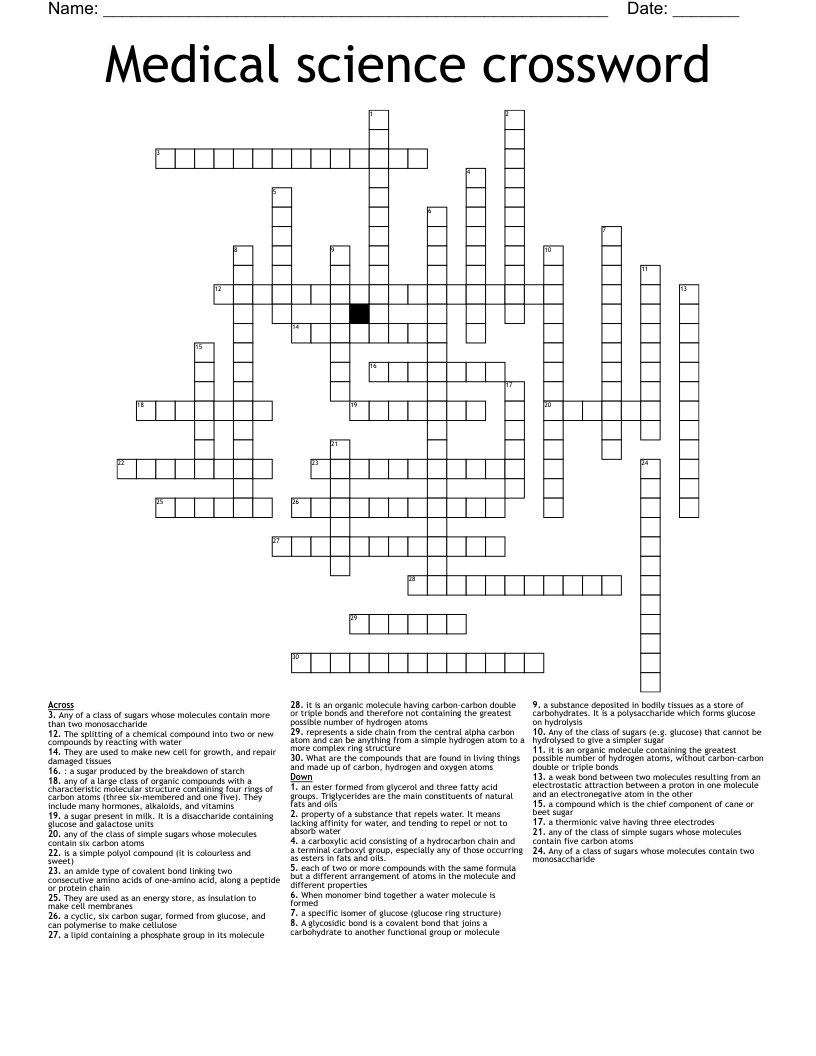
Medical science crossword
This printable crossword puzzle on the topic of Organic Chemistry & Biochemistry has 30 clues. Answers range from 6 to 20 letters long. This crossword is also available to download as a Microsoft Word document or a PDF.
Description
What are the compounds that are found in living things and made up of carbon, hydrogen and oxygen atoms
They are used as an energy store, as insulation to make cell membranes
They are used to make new cell for growth, and repair damaged tissues
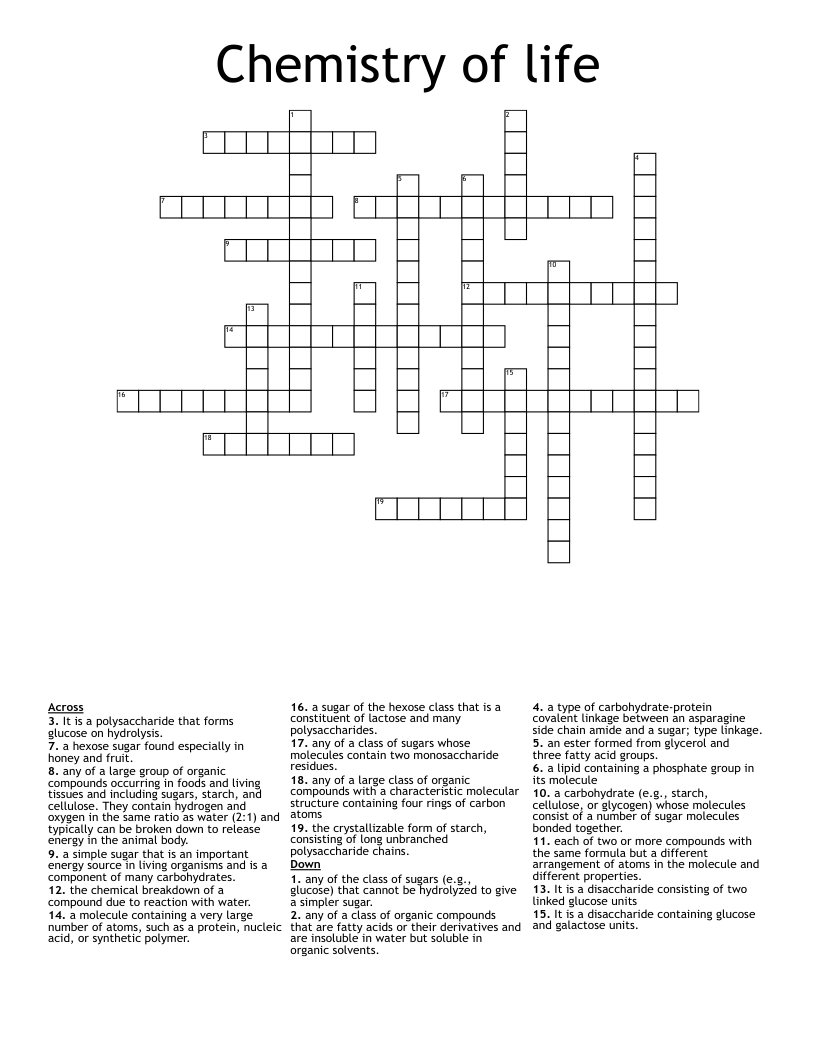
Any of the class of sugars (e.g. glucose) that cannot be hydrolysed to give a simpler sugar
Any of a class of sugars whose molecules contain two monosaccharide
Any of a class of sugars whose molecules contain more than two monosaccharide
a thermionic valve having three electrodes
any of the class of simple sugars whose molecules contain five carbon atoms
any of the class of simple sugars whose molecules contain six carbon atoms
a compound which is the chief component of cane or beet sugar
: a sugar produced by the breakdown of starch
a sugar present in milk. It is a disaccharide containing glucose and galactose units
a substance deposited in bodily tissues as a store of carbohydrates. It is a polysaccharide which forms glucose on hydrolysis
a specific isomer of glucose (glucose ring structure)
a cyclic, six carbon sugar, formed from glucose, and can polymerise to make cellulose
an ester formed from glycerol and three fatty acid groups. Triglycerides are the main constituents of natural fats and oils
a lipid containing a phosphate group in its molecule
any of a large class of organic compounds with a characteristic molecular structure containing four rings of carbon atoms (three six-membered and one five). They include many hormones, alkaloids, and vitamins
it is an organic molecule containing the greatest possible number of hydrogen atoms, without carbon–carbon double or triple bonds
it is an organic molecule having carbon–carbon double or triple bonds and therefore not containing the greatest possible number of hydrogen atoms
is a simple polyol compound (it is colourless and sweet)
a carboxylic acid consisting of a hydrocarbon chain and a terminal carboxyl group, especially any of those occurring as esters in fats and oils.
represents a side chain from the central alpha carbon atom and can be anything from a simple hydrogen atom to a more complex ring structure
property of a substance that repels water. It means lacking affinity for water, and tending to repel or not to absorb water
a weak bond between two molecules resulting from an electrostatic attraction between a proton in one molecule and an electronegative atom in the other
an amide type of covalent bond linking two consecutive amino acids of one-amino acid, along a peptide or protein chain
A glycosidic bond is a covalent bond that joins a carbohydrate to another functional group or molecule
When monomer bind together a water molecule is formed
The splitting of a chemical compound into two or new compounds by reacting with water
each of two or more compounds with the same formula but a different arrangement of atoms in the molecule and different properties