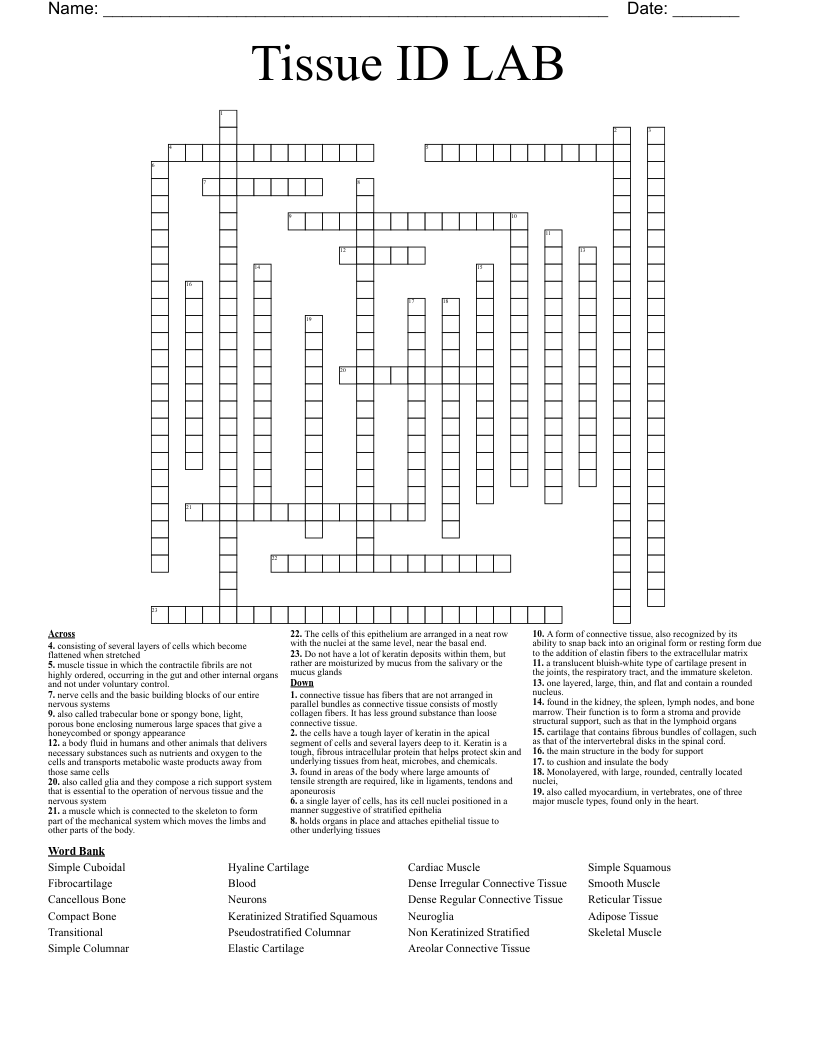
Tissue ID LAB Crossword
This printable crossword puzzle on the topic of Anatomy has 23 clues. Answers range from 5 to 30 letters long. This crossword is also available to download as a Microsoft Word document or a PDF.
Description
muscle tissue in which the contractile fibrils are not highly ordered, occurring in the gut and other internal organs and not under voluntary control.
also called myocardium, in vertebrates, one of three major muscle types, found only in the heart.
a muscle which is connected to the skeleton to form part of the mechanical system which moves the limbs and other parts of the body.
nerve cells and the basic building blocks of our entire nervous systems
also called glia and they compose a rich support system that is essential to the operation of nervous tissue and the nervous system
one layered, large, thin, and flat and contain a rounded nucleus.
Monolayered, with large, rounded, centrally located nuclei,
The cells of this epithelium are arranged in a neat row with the nuclei at the same level, near the basal end.
a single layer of cells, has its cell nuclei positioned in a manner suggestive of stratified epithelia
the cells have a tough layer of keratin in the apical segment of cells and several layers deep to it. Keratin is a tough, fibrous intracellular protein that helps protect skin and underlying tissues from heat, microbes, and chemicals.
Do not have a lot of keratin deposits within them, but rather are moisturized by mucus from the salivary or the mucus glands
consisting of several layers of cells which become flattened when stretched
a body fluid in humans and other animals that delivers necessary substances such as nutrients and oxygen to the cells and transports metabolic waste products away from those same cells
also called trabecular bone or spongy bone, light, porous bone enclosing numerous large spaces that give a honeycombed or spongy appearance
the main structure in the body for support
A form of connective tissue, also recognized by its ability to snap back into an original form or resting form due to the addition of elastin fibers to the extracellular matrix
a translucent bluish-white type of cartilage present in the joints, the respiratory tract, and the immature skeleton.
cartilage that contains fibrous bundles of collagen, such as that of the intervertebral disks in the spinal cord.
found in areas of the body where large amounts of tensile strength are required, like in ligaments, tendons and aponeurosis
connective tissue has fibers that are not arranged in parallel bundles as connective tissue consists of mostly collagen fibers. It has less ground substance than loose connective tissue.
to cushion and insulate the body
holds organs in place and attaches epithelial tissue to other underlying tissues
found in the kidney, the spleen, lymph nodes, and bone marrow. Their function is to form a stroma and provide structural support, such as that in the lymphoid organs