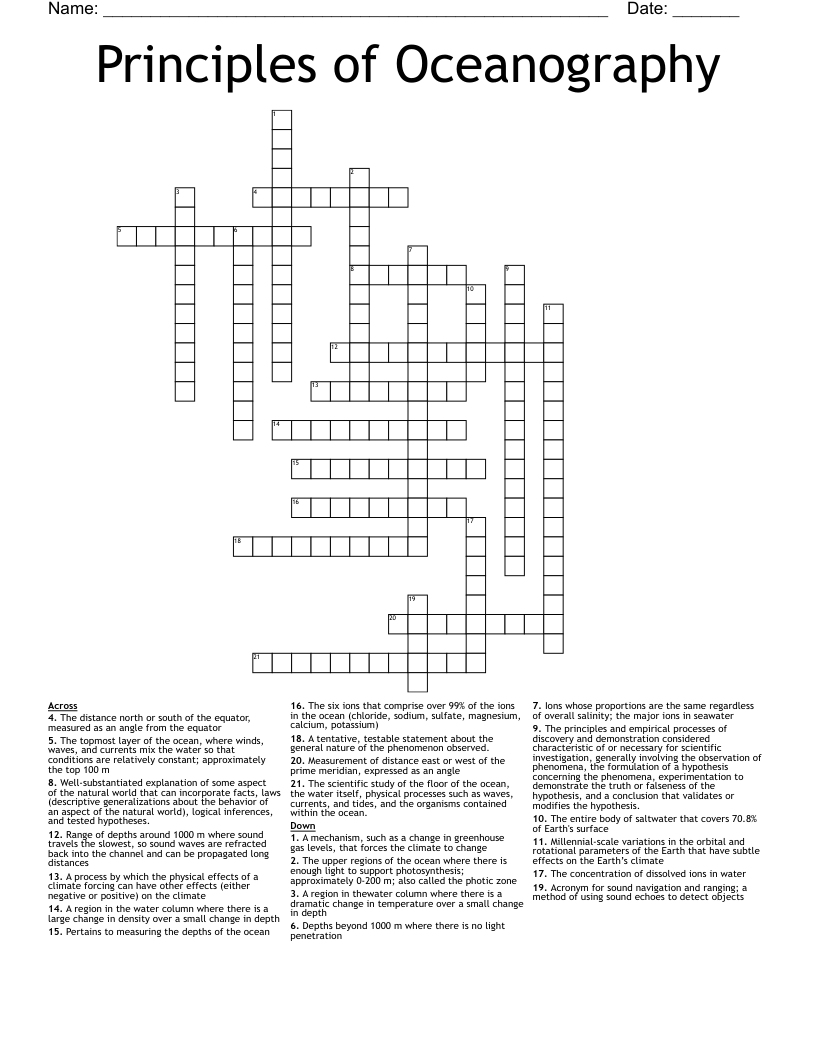
Principles of Oceanography Crossword
This printable crossword puzzle on the topic of Oceans & Water has 21 clues. Answers range from 5 to 18 letters long. This crossword is also available to download as a Microsoft Word document or a PDF.
Description
The entire body of saltwater that covers 70.8% of Earth's surface
The scientific study of the floor of the ocean, the water itself, physical processes such as waves, currents, and tides, and the organisms contained within the ocean.
The principles and empirical processes of discovery and demonstration considered characteristic of or necessary for scientific investigation, generally involving the observation of phenomena, the formulation of a hypothesis concerning the phenomena, experimentation to demonstrate the truth or falseness of the hypothesis, and a conclusion that validates or modifies the hypothesis.
A tentative, testable statement about the general nature of the phenomenon observed.
Well-substantiated explanation of some aspect of the natural world that can incorporate facts, laws (descriptive generalizations about the behavior of an aspect of the natural world), logical inferences, and tested hypotheses.
A mechanism, such as a change in greenhouse gas levels, that forces the climate to change
A process by which the physical effects of a climate forcing can have other effects (either negative or positive) on the climate
Millennial-scale variations in the orbital and rotational parameters of the Earth that have subtle effects on the Earth’s climate
The topmost layer of the ocean, where winds, waves, and currents mix the water so that conditions are relatively constant; approximately the top 100 m
A region in thewater column where there is a dramatic change in temperature over a small change in depth
A region in the water column where there is a large change in density over a small change in depth
The concentration of dissolved ions in water
The six ions that comprise over 99% of the ions in the ocean (chloride, sodium, sulfate, magnesium, calcium, potassium)
Ions whose proportions are the same regardless of overall salinity; the major ions in seawater
Pertains to measuring the depths of the ocean
Acronym for sound navigation and ranging; a method of using sound echoes to detect objects
Range of depths around 1000 m where sound travels the slowest, so sound waves are refracted back into the channel and can be propagated long distances
The upper regions of the ocean where there is enough light to support photosynthesis; approximately 0-200 m; also called the photic zone
Depths beyond 1000 m where there is no light penetration
The distance north or south of the equator, measured as an angle from the equator
Measurement of distance east or west of the prime meridian, expressed as an angle