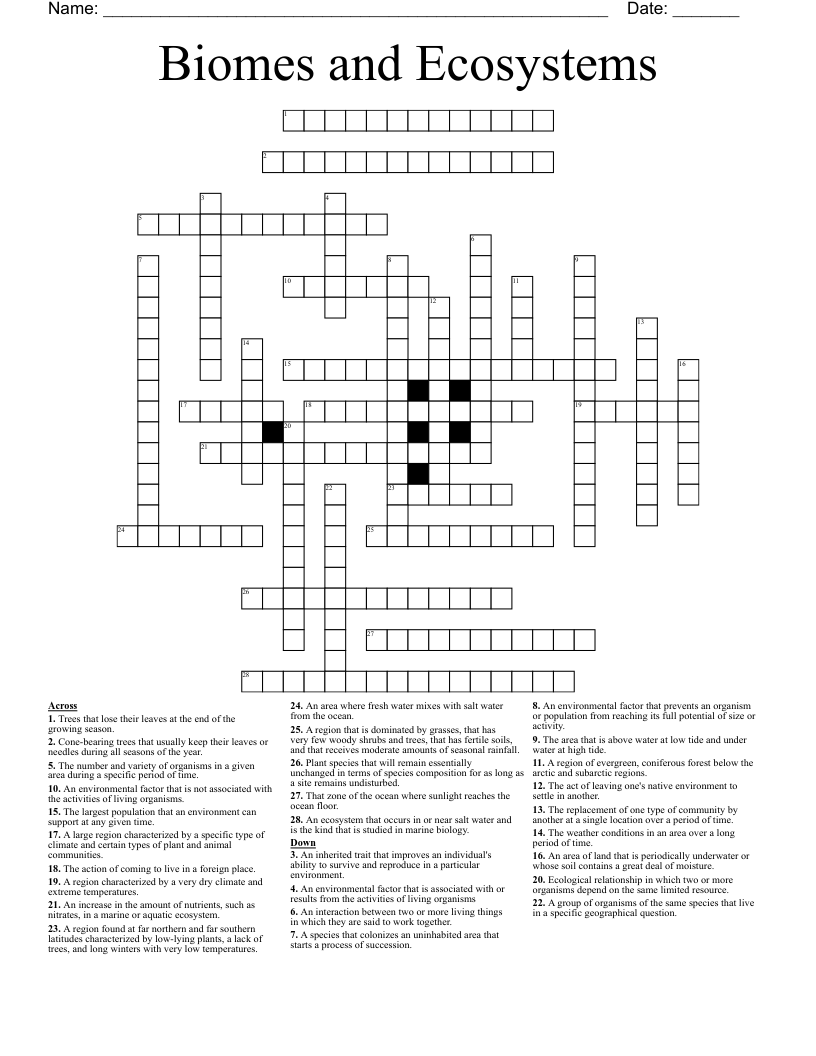
Biomes and Ecosystems Crossword
This printable crossword puzzle on the topic of Ecology & Evolution has 28 clues. Answers range from 5 to 16 letters long. This crossword is also available to download as a Microsoft Word document or a PDF.
Description
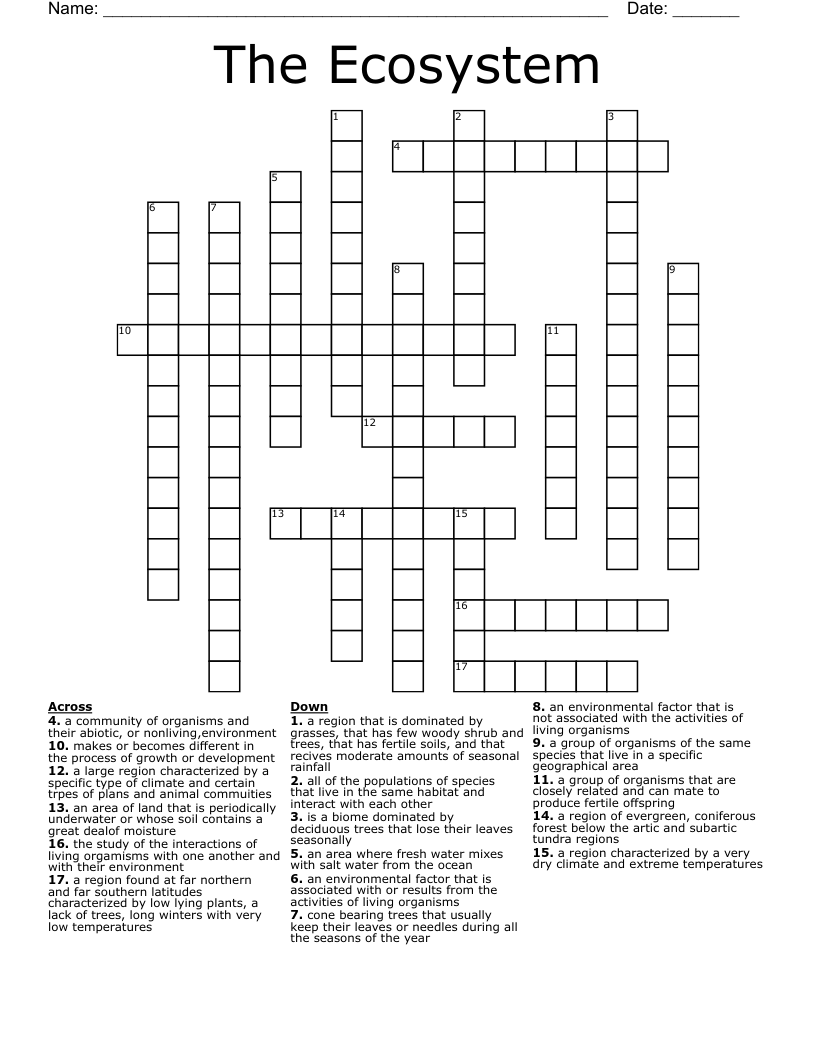
An environmental factor that is not associated with the activities of living organisms.
An environmental factor that is associated with or results from the activities of living organisms
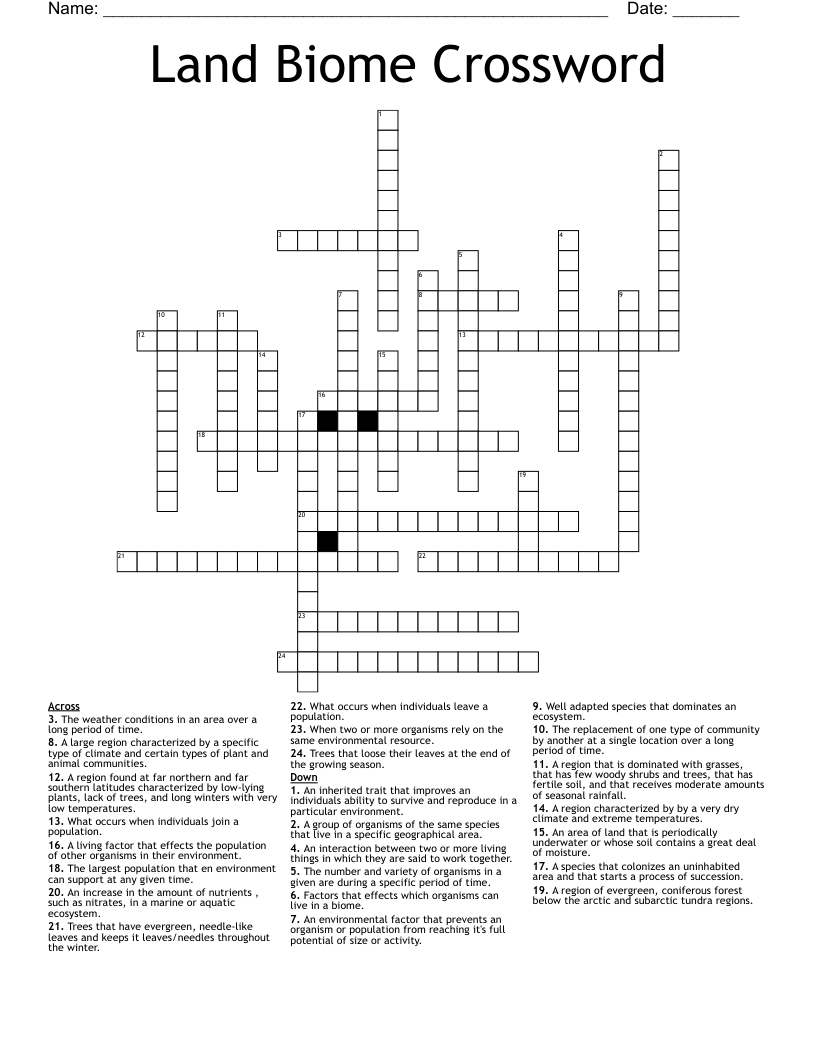
An inherited trait that improves an individual's ability to survive and reproduce in a particular environment.
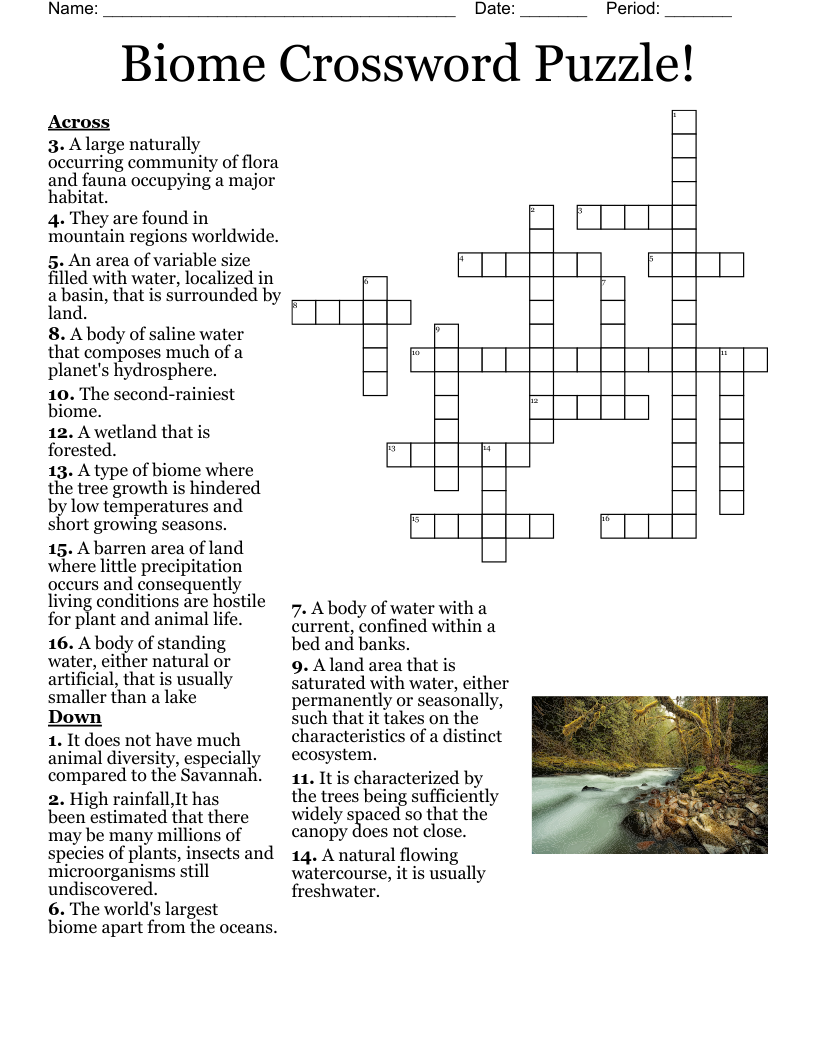
A large region characterized by a specific type of climate and certain types of plant and animal communities.
The weather conditions in an area over a long period of time.
A region found at far northern and far southern latitudes characterized by low-lying plants, a lack of trees, and long winters with very low temperatures.
A region of evergreen, coniferous forest below the arctic and subarctic regions.
Cone-bearing trees that usually keep their leaves or needles during all seasons of the year.
A region characterized by a very dry climate and extreme temperatures.
A region that is dominated by grasses, that has very few woody shrubs and trees, that has fertile soils, and that receives moderate amounts of seasonal rainfall.
Trees that lose their leaves at the end of the growing season.
An area of land that is periodically underwater or whose soil contains a great deal of moisture.
An area where fresh water mixes with salt water from the ocean.
The area that is above water at low tide and under water at high tide.
That zone of the ocean where sunlight reaches the ocean floor.
An ecosystem that occurs in or near salt water and is the kind that is studied in marine biology.
A group of organisms of the same species that live in a specific geographical question.
The largest population that an environment can support at any given time.
An environmental factor that prevents an organism or population from reaching its full potential of size or activity.
Ecological relationship in which two or more organisms depend on the same limited resource.
An interaction between two or more living things in which they are said to work together.
The action of coming to live in a foreign place.
The act of leaving one's native environment to settle in another.
An increase in the amount of nutrients, such as nitrates, in a marine or aquatic ecosystem.
The replacement of one type of community by another at a single location over a period of time.
A species that colonizes an uninhabited area that starts a process of succession.
The number and variety of organisms in a given area during a specific period of time.
Plant species that will remain essentially unchanged in terms of species composition for as long as a site remains undisturbed.