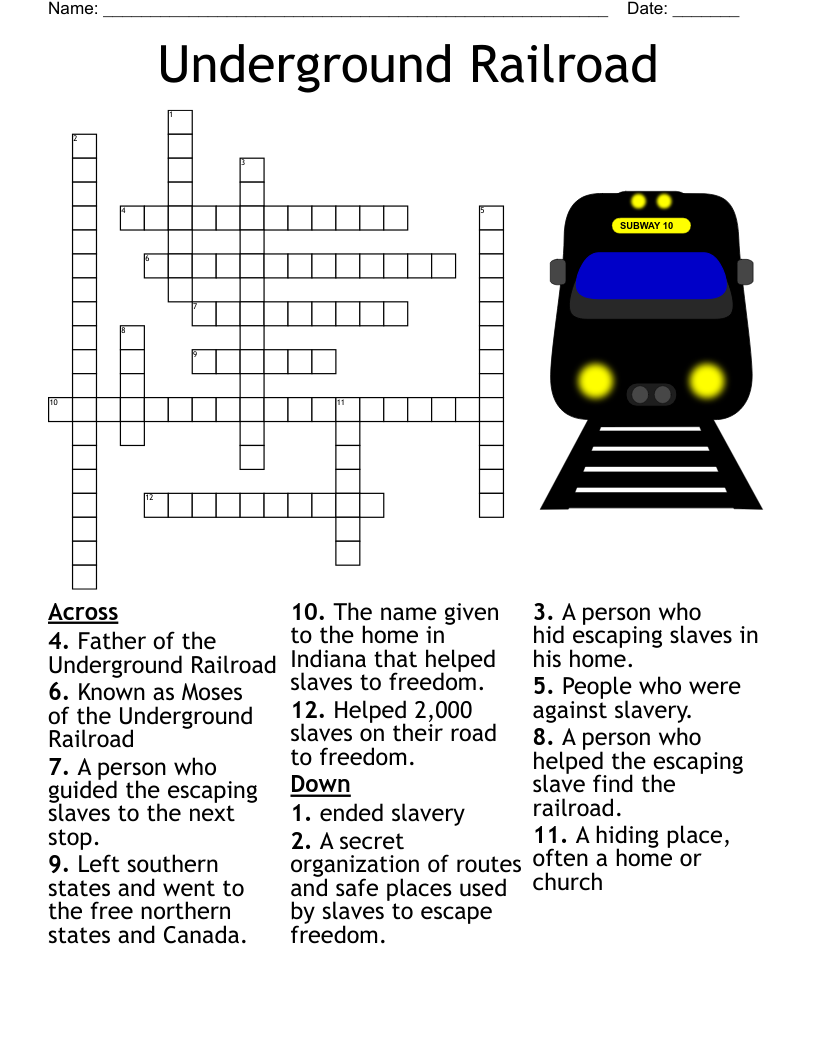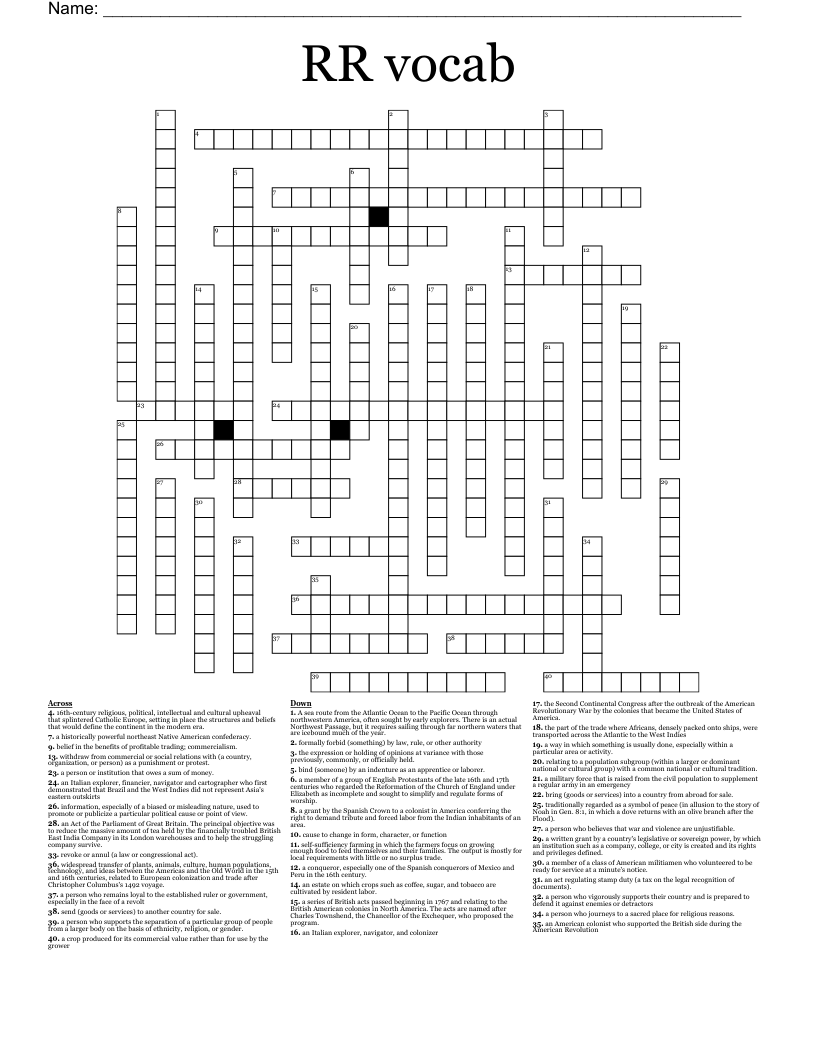
RR vocab Crossword
This printable crossword puzzle on the topic of American Revolution & Colonial Era has 40 clues. Answers range from 4 to 21 letters long. This crossword is also available to download as a Microsoft Word document or a PDF.
Description
an Italian explorer, navigator, and colonizer
an Italian explorer, financier, navigator and cartographer who first demonstrated that Brazil and the West Indies did not represent Asia's eastern outskirts
a conqueror, especially one of the Spanish conquerors of Mexico and Peru in the 16th century.
a grant by the Spanish Crown to a colonist in America conferring the right to demand tribute and forced labor from the Indian inhabitants of an area.
an estate on which crops such as coffee, sugar, and tobacco are cultivated by resident labor.
16th-century religious, political, intellectual and cultural upheaval that splintered Catholic Europe, setting in place the structures and beliefs that would define the continent in the modern era.
A sea route from the Atlantic Ocean to the Pacific Ocean through northwestern America, often sought by early explorers. There is an actual Northwest Passage, but it requires sailing through far northern waters that are icebound much of the year.
belief in the benefits of profitable trading; commercialism.
widespread transfer of plants, animals, culture, human populations, technology, and ideas between the Americas and the Old World in the 15th and 16th centuries, related to European colonization and trade after Christopher Columbus's 1492 voyage.
a written grant by a country's legislative or sovereign power, by which an institution such as a company, college, or city is created and its rights and privileges defined.
a member of a group of English Protestants of the late 16th and 17th centuries who regarded the Reformation of the Church of England under Elizabeth as incomplete and sought to simplify and regulate forms of worship.
a person who journeys to a sacred place for religious reasons.
the expression or holding of opinions at variance with those previously, commonly, or officially held.
a person who supports the separation of a particular group of people from a larger body on the basis of ethnicity, religion, or gender.
a person who believes that war and violence are unjustifiable.
relating to a population subgroup (within a larger or dominant national or cultural group) with a common national or cultural tradition.
bind (someone) by an indenture as an apprentice or laborer.
a person or institution that owes a sum of money.
self-sufficiency farming in which the farmers focus on growing enough food to feed themselves and their families. The output is mostly for local requirements with little or no surplus trade.
the part of the trade where Africans, densely packed onto ships, were transported across the Atlantic to the West Indies
a crop produced for its commercial value rather than for use by the grower
bring (goods or services) into a country from abroad for sale.
send (goods or services) to another country for sale.
cause to change in form, character, or function
a historically powerful northeast Native American confederacy.
a military force that is raised from the civil population to supplement a regular army in an emergency
formally forbid (something) by law, rule, or other authority
a way in which something is usually done, especially within a particular area or activity.
revoke or annul (a law or congressional act).
an act regulating stamp duty (a tax on the legal recognition of documents).
a series of British acts passed beginning in 1767 and relating to the British American colonies in North America. The acts are named after Charles Townshend, the Chancellor of the Exchequer, who proposed the program.
an Act of the Parliament of Great Britain. The principal objective was to reduce the massive amount of tea held by the financially troubled British East India Company in its London warehouses and to help the struggling company survive.
withdraw from commercial or social relations with (a country, organization, or person) as a punishment or protest.
information, especially of a biased or misleading nature, used to promote or publicize a particular political cause or point of view.
an American colonist who supported the British side during the American Revolution
a person who remains loyal to the established ruler or government, especially in the face of a revolt
a person who vigorously supports their country and is prepared to defend it against enemies or detractors
a member of a class of American militiamen who volunteered to be ready for service at a minute's notice.
the Second Continental Congress after the outbreak of the American Revolutionary War by the colonies that became the United States of America.
traditionally regarded as a symbol of peace (in allusion to the story of Noah in Gen. 8:1, in which a dove returns with an olive branch after the Flood).