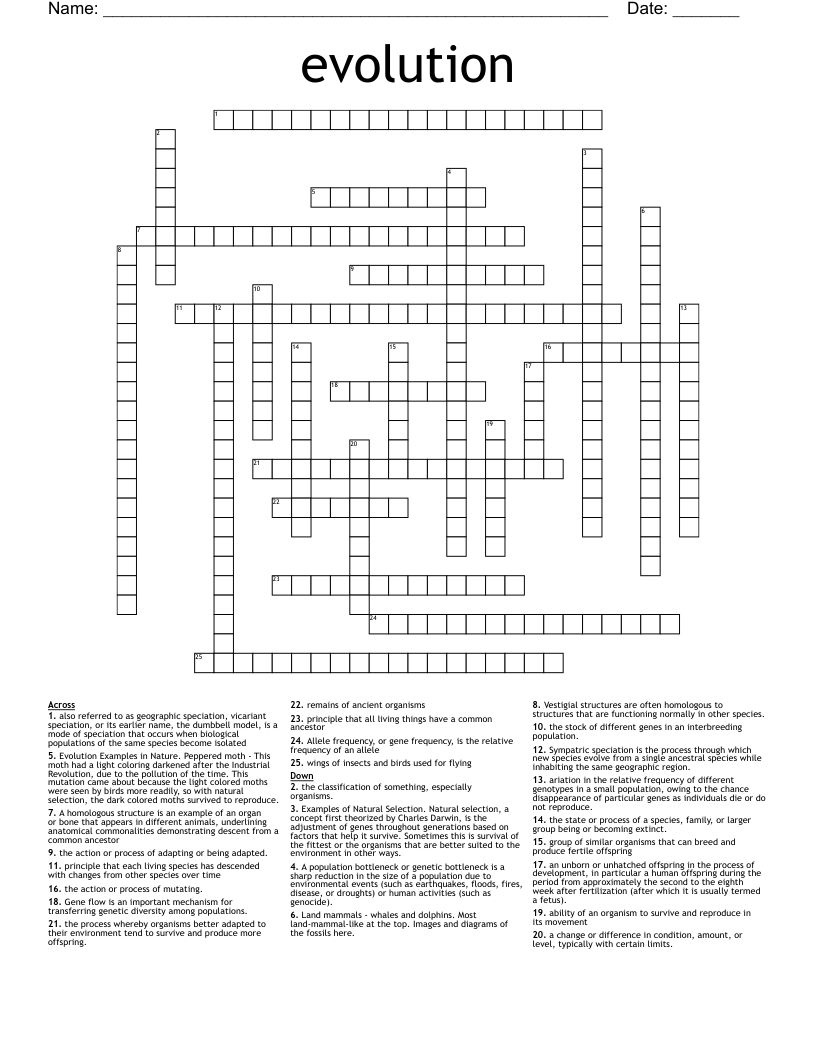
evolution Crossword
This printable crossword puzzle on the topic of Ecology & Evolution has 25 clues. Answers range from 6 to 23 letters long. This crossword is also available to download as a Microsoft Word document or a PDF.
Description
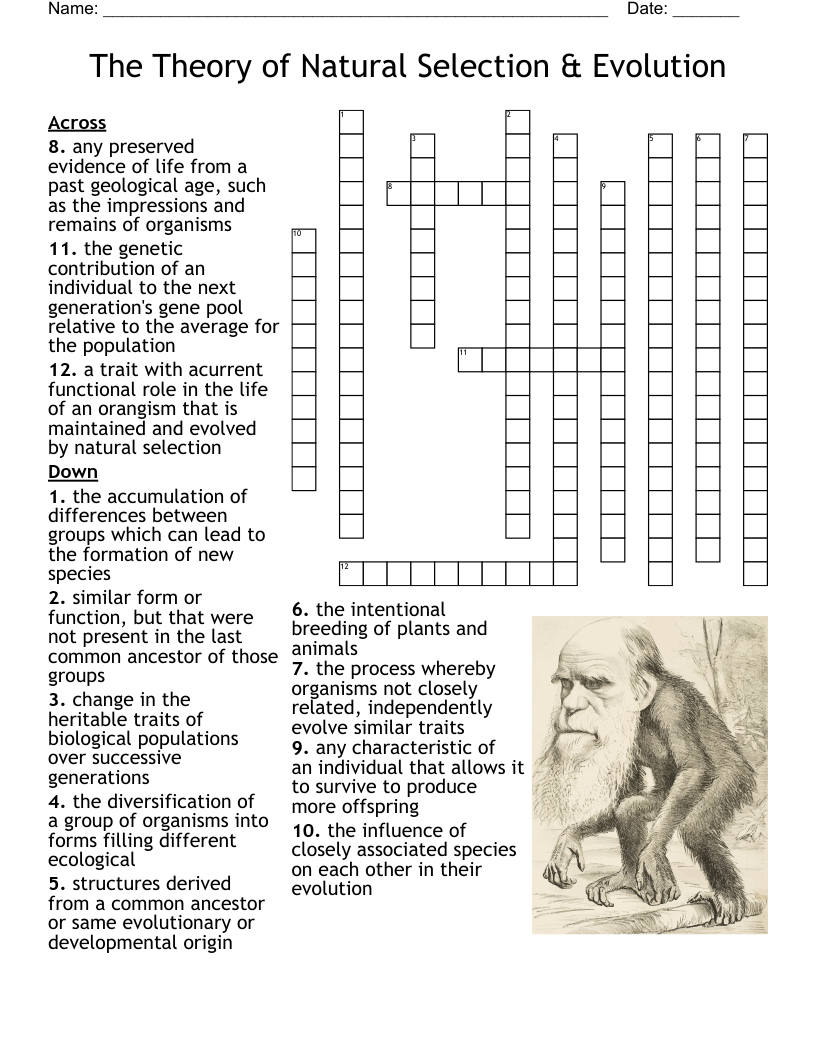
remains of ancient organisms
wings of insects and birds used for flying
ability of an organism to survive and reproduce in its movement
principle that all living things have a common ancestor
principle that each living species has descended with changes from other species over time
the classification of something, especially organisms.
Allele frequency, or gene frequency, is the relative frequency of an allele
the state or process of a species, family, or larger group being or becoming extinct.
the action or process of mutating.
ariation in the relative frequency of different genotypes in a small population, owing to the chance disappearance of particular genes as individuals die or do not reproduce.
Gene flow is an important mechanism for transferring genetic diversity among populations.
the process whereby organisms better adapted to their environment tend to survive and produce more offspring.
Land mammals - whales and dolphins. Most land-mammal-like at the top. Images and diagrams of the fossils here.
a change or difference in condition, amount, or level, typically with certain limits.
A homologous structure is an example of an organ or bone that appears in different animals, underlining anatomical commonalities demonstrating descent from a common ancestor
Vestigial structures are often homologous to structures that are functioning normally in other species.
the action or process of adapting or being adapted.
group of similar organisms that can breed and produce fertile offspring
Sympatric speciation is the process through which new species evolve from a single ancestral species while inhabiting the same geographic region.
also referred to as geographic speciation, vicariant speciation, or its earlier name, the dumbbell model, is a mode of speciation that occurs when biological populations of the same species become isolated
Evolution Examples in Nature. Peppered moth - This moth had a light coloring darkened after the Industrial Revolution, due to the pollution of the time. This mutation came about because the light colored moths were seen by birds more readily, so with natural selection, the dark colored moths survived to reproduce.
Examples of Natural Selection. Natural selection, a concept first theorized by Charles Darwin, is the adjustment of genes throughout generations based on factors that help it survive. Sometimes this is survival of the fittest or the organisms that are better suited to the environment in other ways.
an unborn or unhatched offspring in the process of development, in particular a human offspring during the period from approximately the second to the eighth week after fertilization (after which it is usually termed a fetus).
the stock of different genes in an interbreeding population.
A population bottleneck or genetic bottleneck is a sharp reduction in the size of a population due to environmental events (such as earthquakes, floods, fires, disease, or droughts) or human activities (such as genocide).