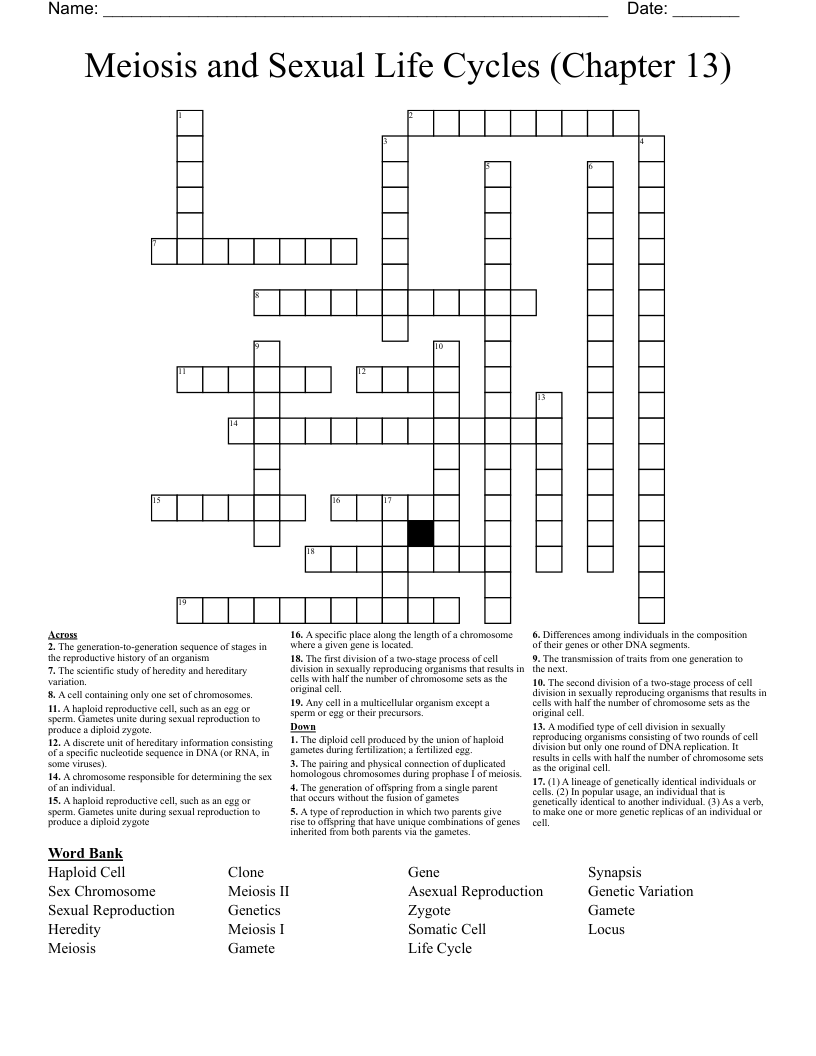
Meiosis and Sexual Life Cycles (Chapter 13) Crossword
This printable crossword puzzle on the topic of Cell Biology has 19 clues. Answers range from 4 to 19 letters long. This crossword is also available to download as a Microsoft Word document or a PDF.
Description
Any cell in a multicellular organism except a sperm or egg or their precursors.
The scientific study of heredity and hereditary variation.
The diploid cell produced by the union of haploid gametes during fertilization; a fertilized egg.
The second division of a two-stage process of cell division in sexually reproducing organisms that results in cells with half the number of chromosome sets as the original cell.
(1) A lineage of genetically identical individuals or cells. (2) In popular usage, an individual that is genetically identical to another individual. (3) As a verb, to make one or more genetic replicas of an individual or cell.
A haploid reproductive cell, such as an egg or sperm. Gametes unite during sexual reproduction to produce a diploid zygote
The first division of a two-stage process of cell division in sexually reproducing organisms that results in cells with half the number of chromosome sets as the original cell.
The generation-to-generation sequence of stages in the reproductive history of an organism
A specific place along the length of a chromosome where a given gene is located.
A cell containing only one set of chromosomes.
The transmission of traits from one generation to the next.
Differences among individuals in the composition of their genes or other DNA segments.
The generation of offspring from a single parent that occurs without the fusion of gametes
A type of reproduction in which two parents give rise to offspring that have unique combinations of genes inherited from both parents via the gametes.
A modified type of cell division in sexually reproducing organisms consisting of two rounds of cell division but only one round of DNA replication. It results in cells with half the number of chromosome sets as the original cell.
A discrete unit of hereditary information consisting of a specific nucleotide sequence in DNA (or RNA, in some viruses).
A haploid reproductive cell, such as an egg or sperm. Gametes unite during sexual reproduction to produce a diploid zygote.
A chromosome responsible for determining the sex of an individual.
The pairing and physical connection of duplicated homologous chromosomes during prophase I of meiosis.