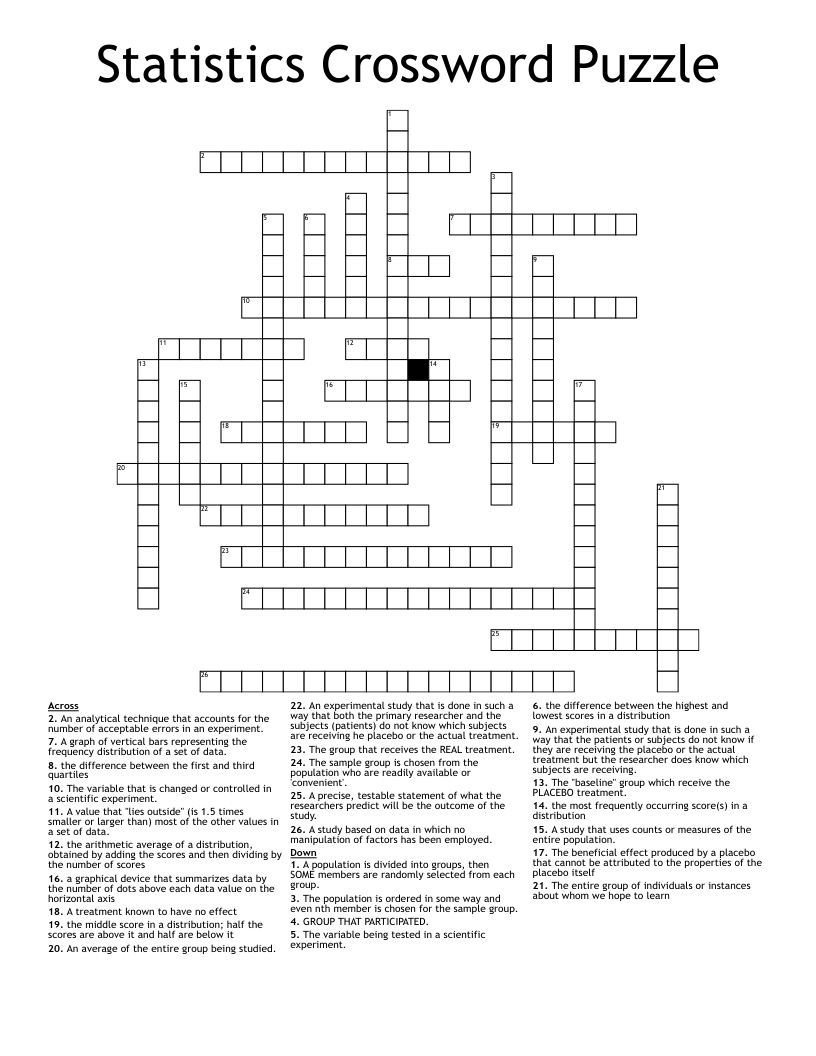
Statistics Crossword Puzzle
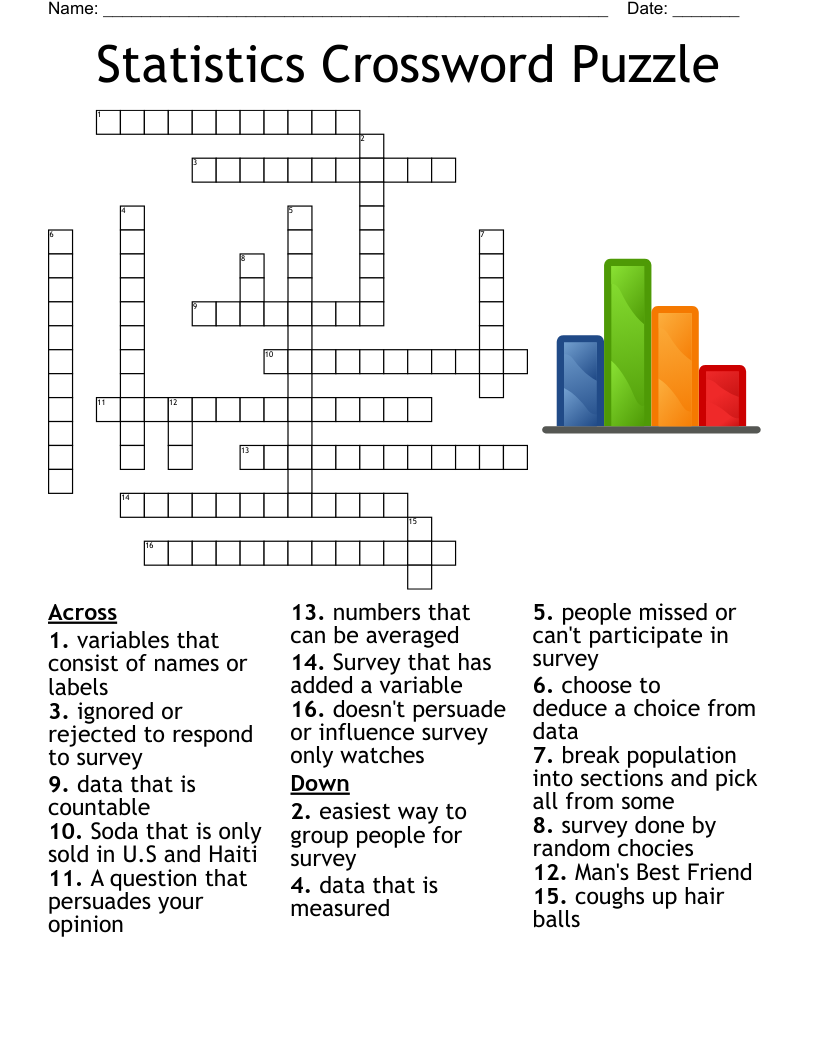
This printable crossword puzzle on the topic of Statistics & Probability has 26 clues. Answers range from 3 to 19 letters long. This crossword is also available to download as a Microsoft Word document or a PDF.
Description
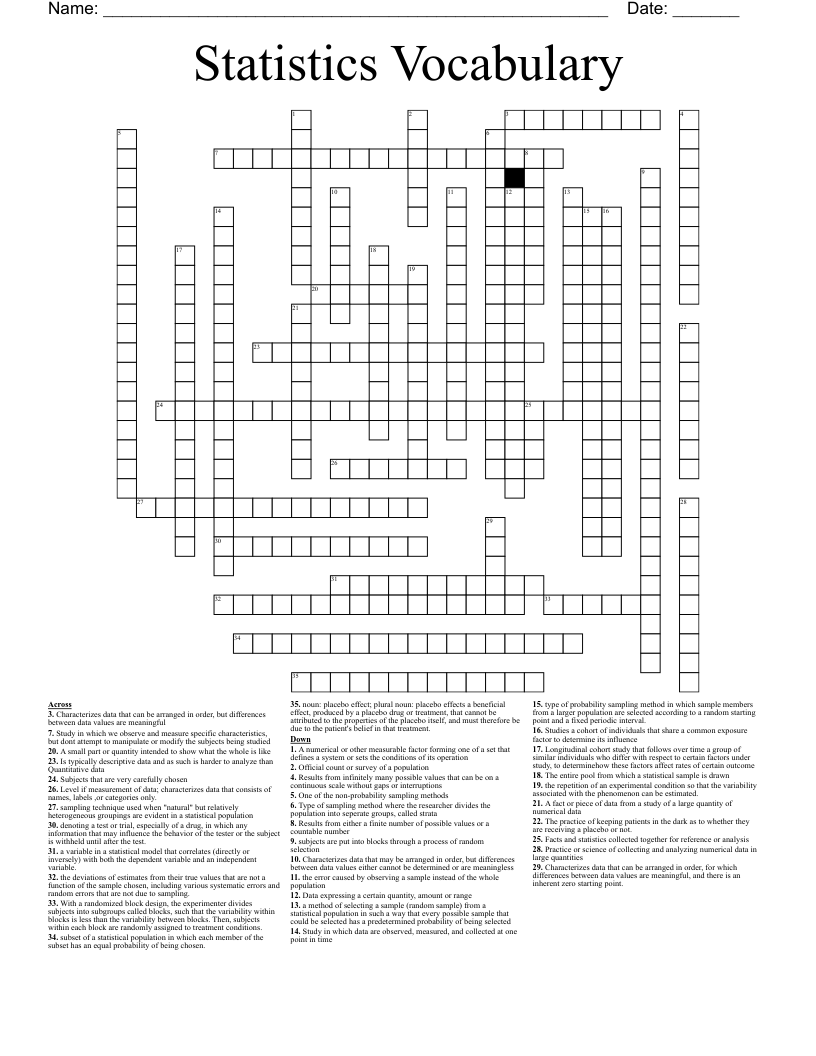
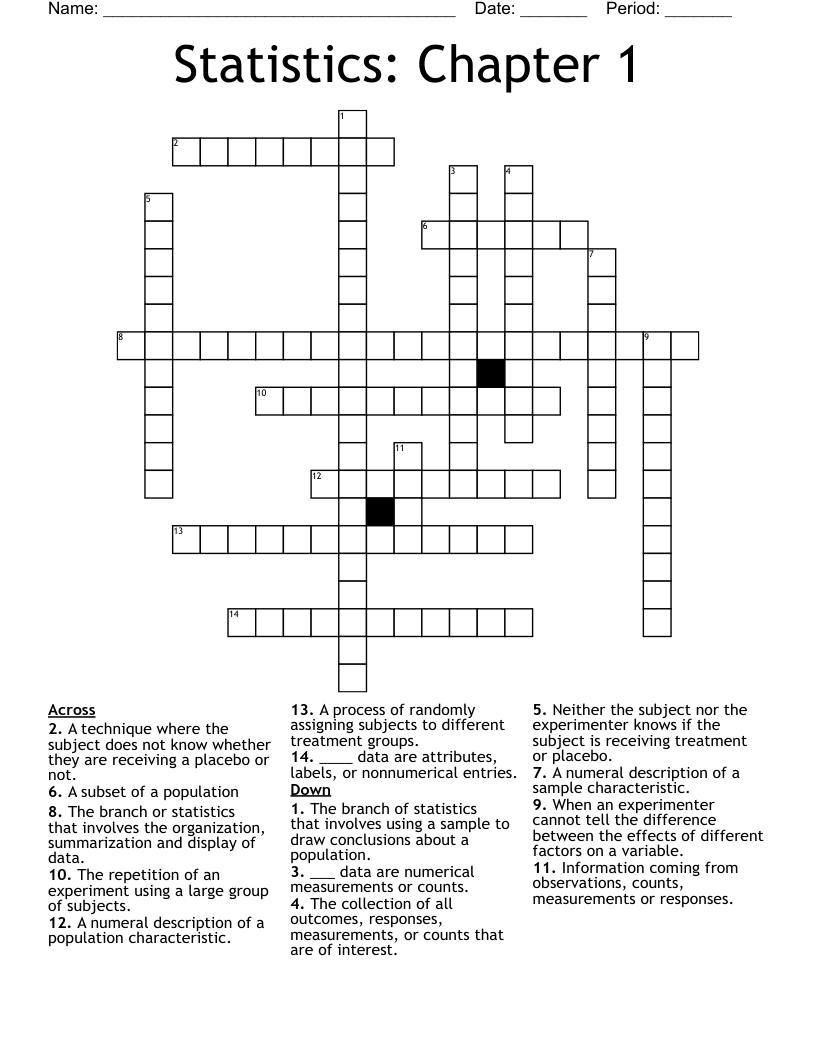
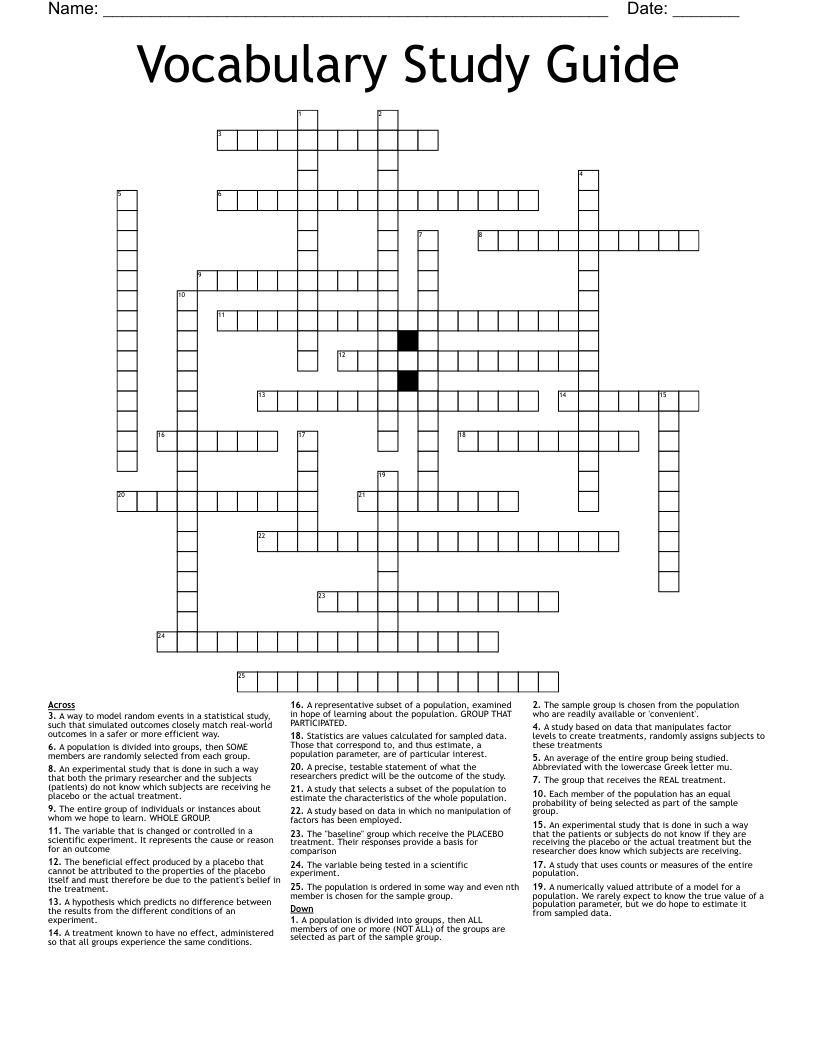
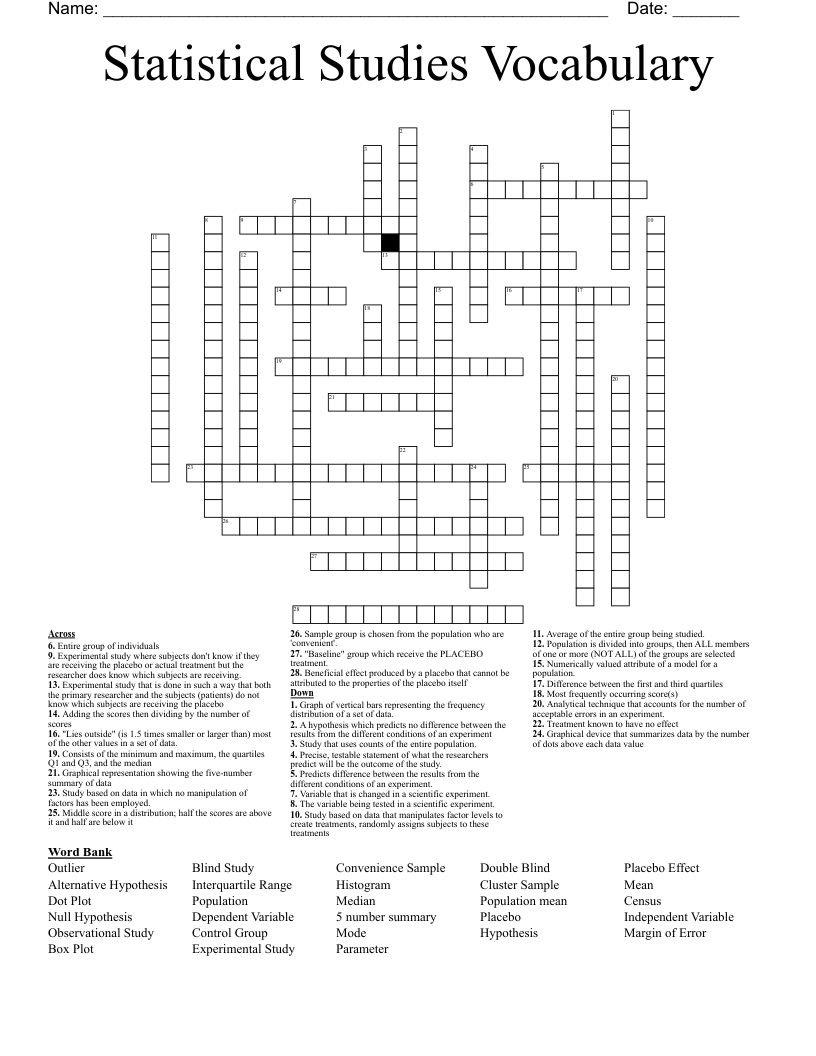
The entire group of individuals or instances about whom we hope to learn
GROUP THAT PARTICIPATED.
A population is divided into groups, then SOME members are randomly selected from each group.
The population is ordered in some way and even nth member is chosen for the sample group.
The sample group is chosen from the population who are readily available or 'convenient'.
A study based on data in which no manipulation of factors has been employed.
The group that receives the REAL treatment.
A treatment known to have no effect
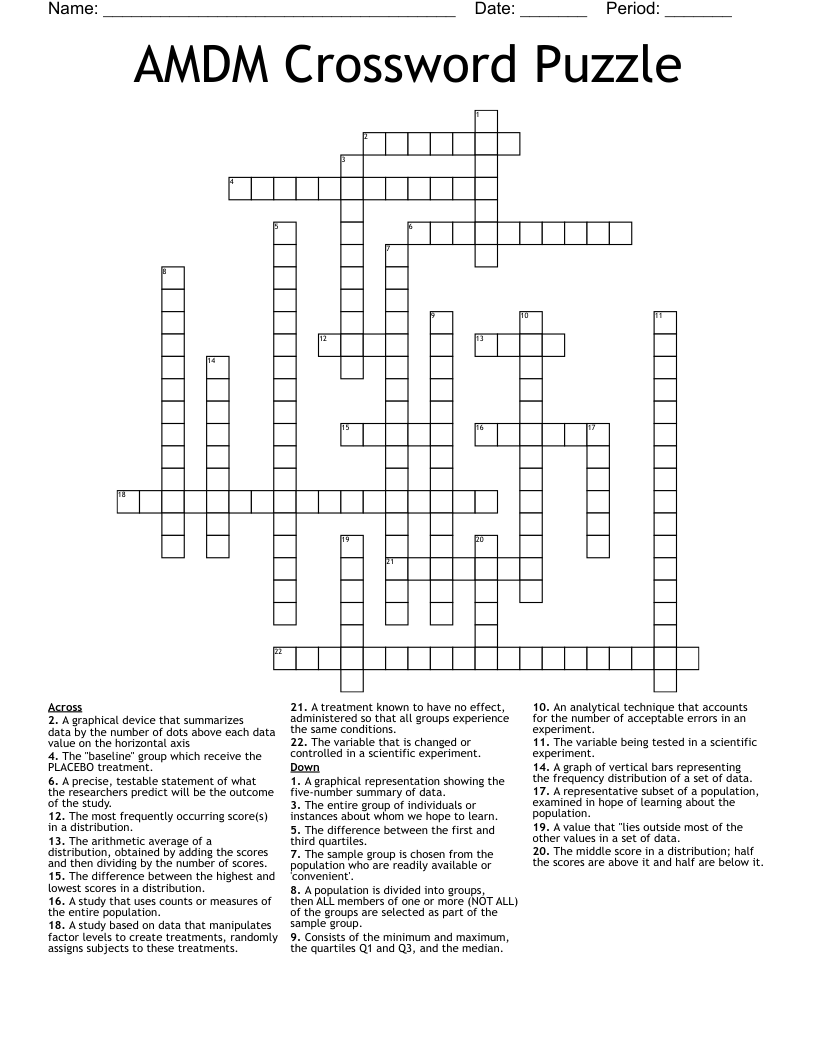
The "baseline" group which receive the PLACEBO treatment.
A study that uses counts or measures of the entire population.
The variable that is changed or controlled in a scientific experiment.
The variable being tested in a scientific experiment.
A precise, testable statement of what the researchers predict will be the outcome of the study.
the arithmetic average of a distribution, obtained by adding the scores and then dividing by the number of scores
the middle score in a distribution; half the scores are above it and half are below it
the most frequently occurring score(s) in a distribution
the difference between the highest and lowest scores in a distribution
A graph of vertical bars representing the frequency distribution of a set of data.
the difference between the first and third quartiles
a graphical device that summarizes data by the number of dots above each data value on the horizontal axis
A value that "lies outside" (is 1.5 times smaller or larger than) most of the other values in a set of data.
An analytical technique that accounts for the number of acceptable errors in an experiment.
An average of the entire group being studied.
The beneficial effect produced by a placebo that cannot be attributed to the properties of the placebo itself
An experimental study that is done in such a way that both the primary researcher and the subjects (patients) do not know which subjects are receiving he placebo or the actual treatment.
An experimental study that is done in such a way that the patients or subjects do not know if they are receiving the placebo or the actual treatment but the researcher does know which subjects are receiving.