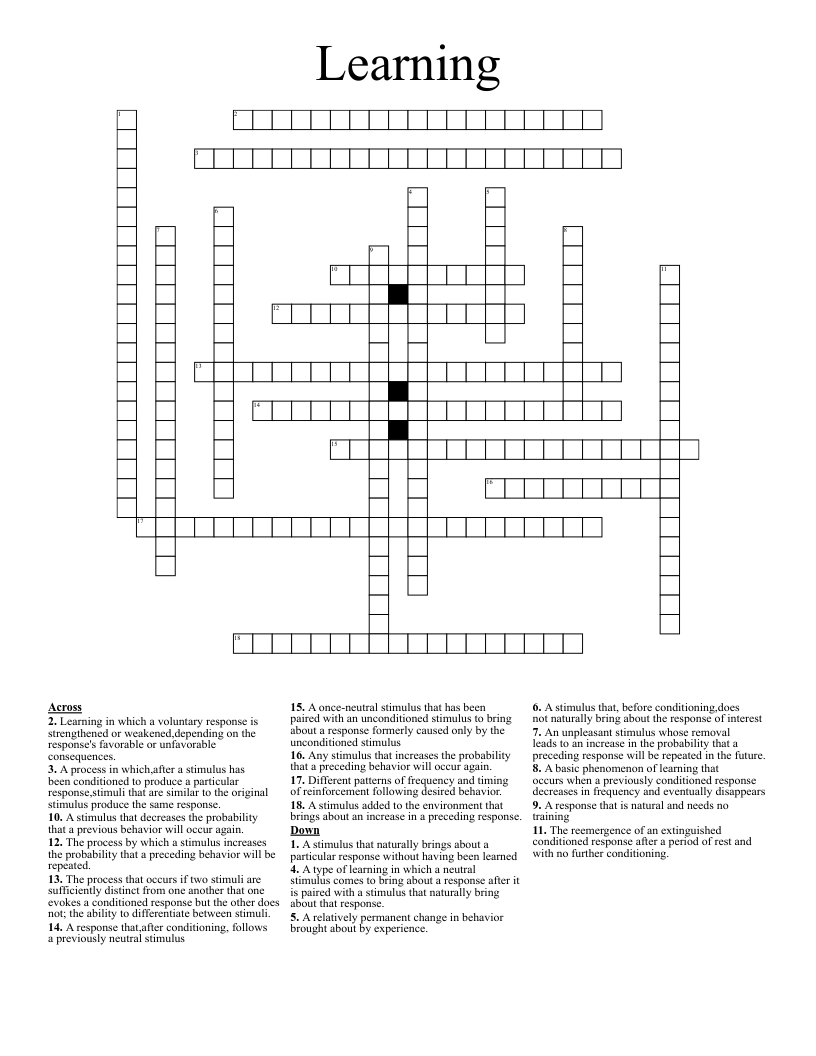
Learning Crossword
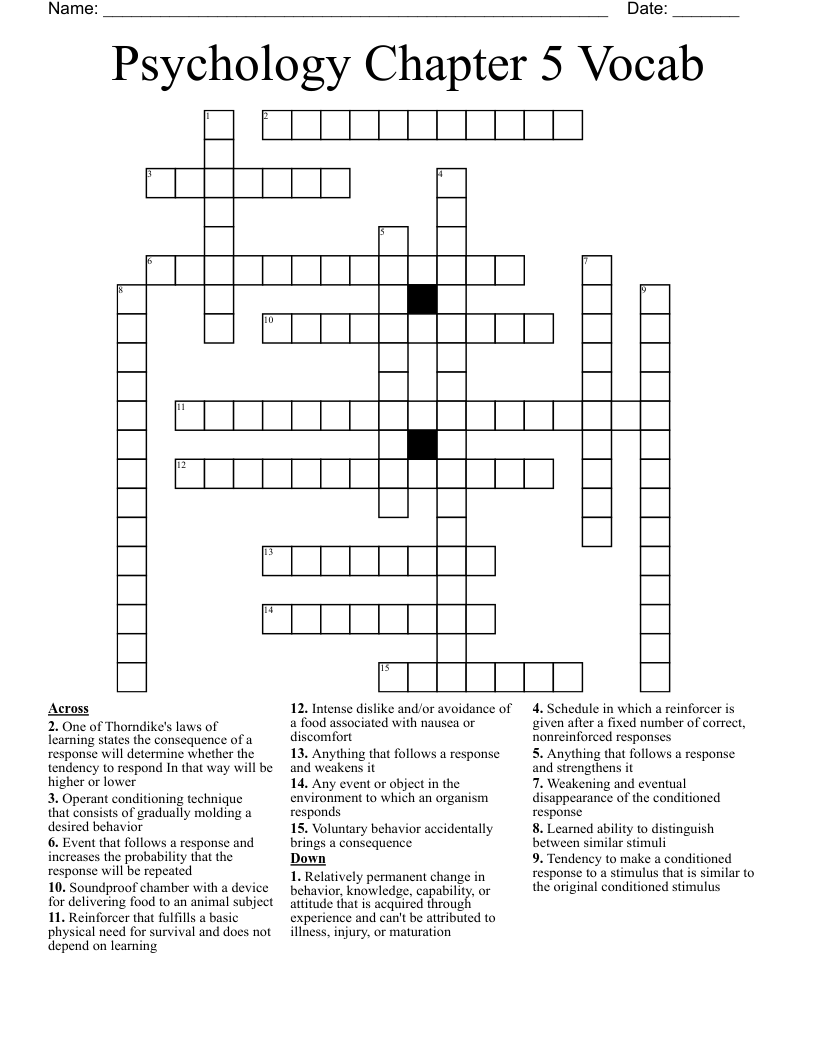
This printable crossword puzzle on the topic of Psychology & Sociology has 18 clues. Answers range from 8 to 24 letters long. This crossword is also available to download as a Microsoft Word document or a PDF.
Description
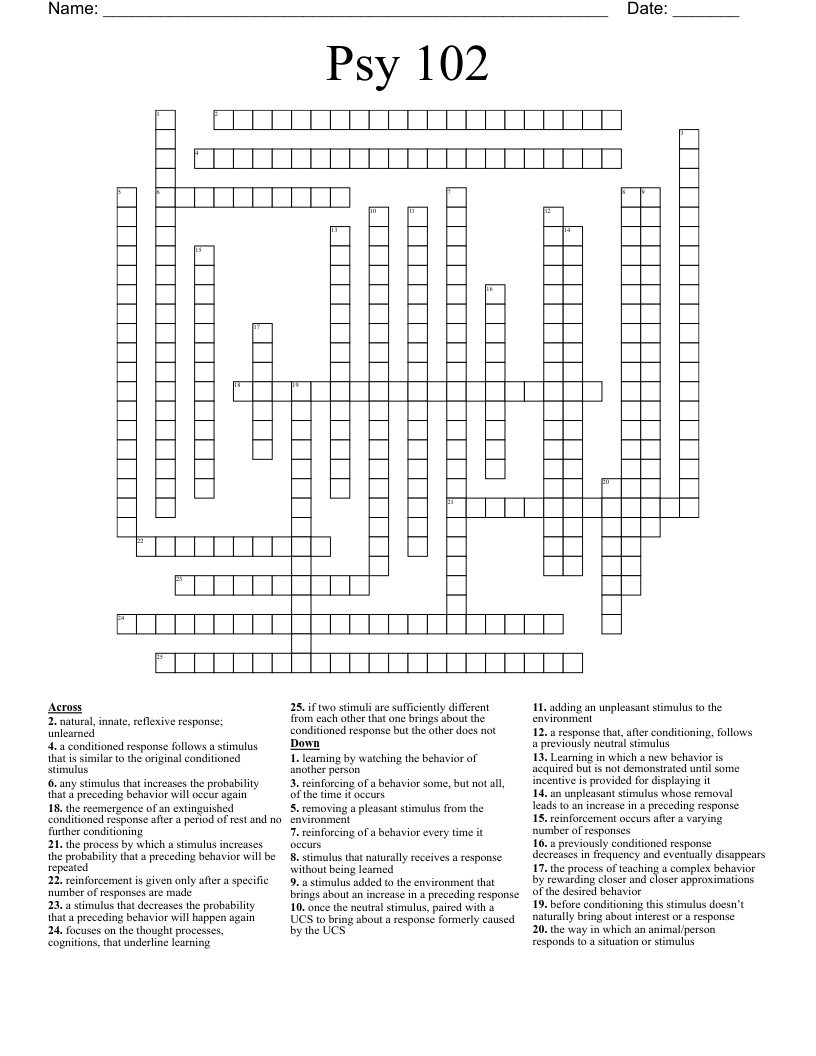
A relatively permanent change in behavior brought about by experience.
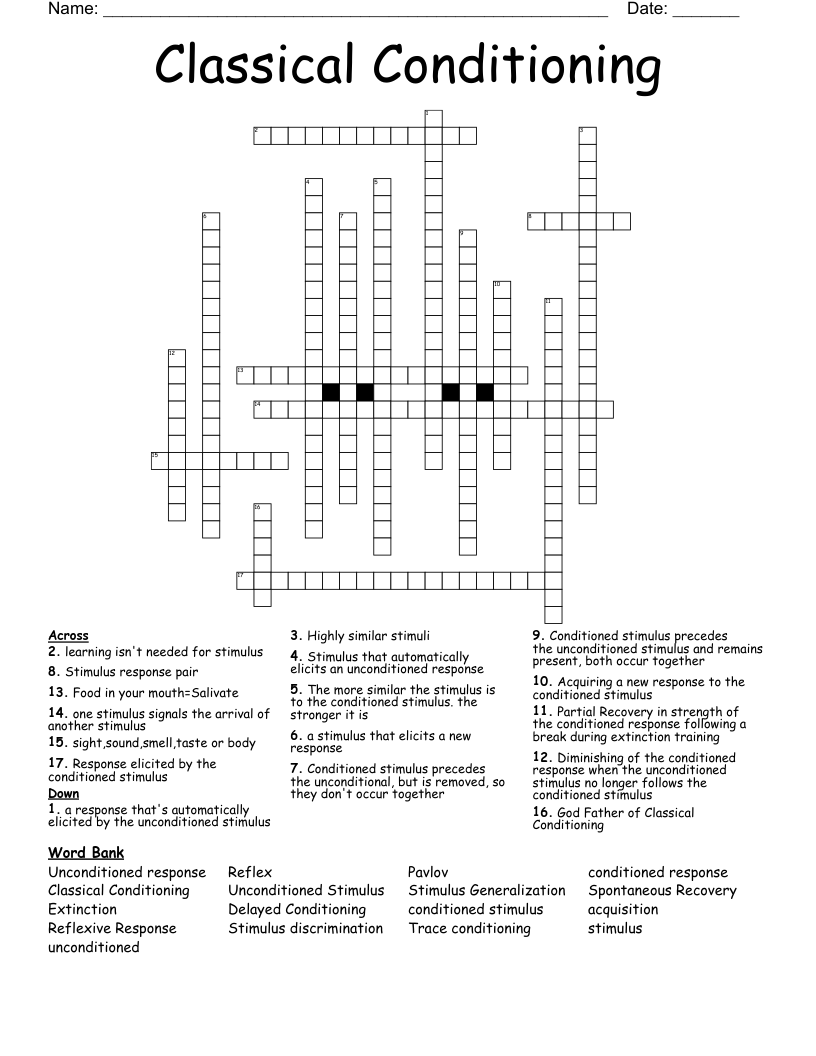
A type of learning in which a neutral stimulus comes to bring about a response after it is paired with a stimulus that naturally bring about that response.
A stimulus that, before conditioning,does not naturally bring about the response of interest
A stimulus that naturally brings about a particular response without having been learned
A response that is natural and needs no training
A once-neutral stimulus that has been paired with an unconditioned stimulus to bring about a response formerly caused only by the unconditioned stimulus
A response that,after conditioning, follows a previously neutral stimulus
A basic phenomenon of learning that occurs when a previously conditioned response decreases in frequency and eventually disappears
The reemergence of an extinguished conditioned response after a period of rest and with no further conditioning.
A process in which,after a stimulus has been conditioned to produce a particular response,stimuli that are similar to the original stimulus produce the same response.
The process that occurs if two stimuli are sufficiently distinct from one another that one evokes a conditioned response but the other does not; the ability to differentiate between stimuli.
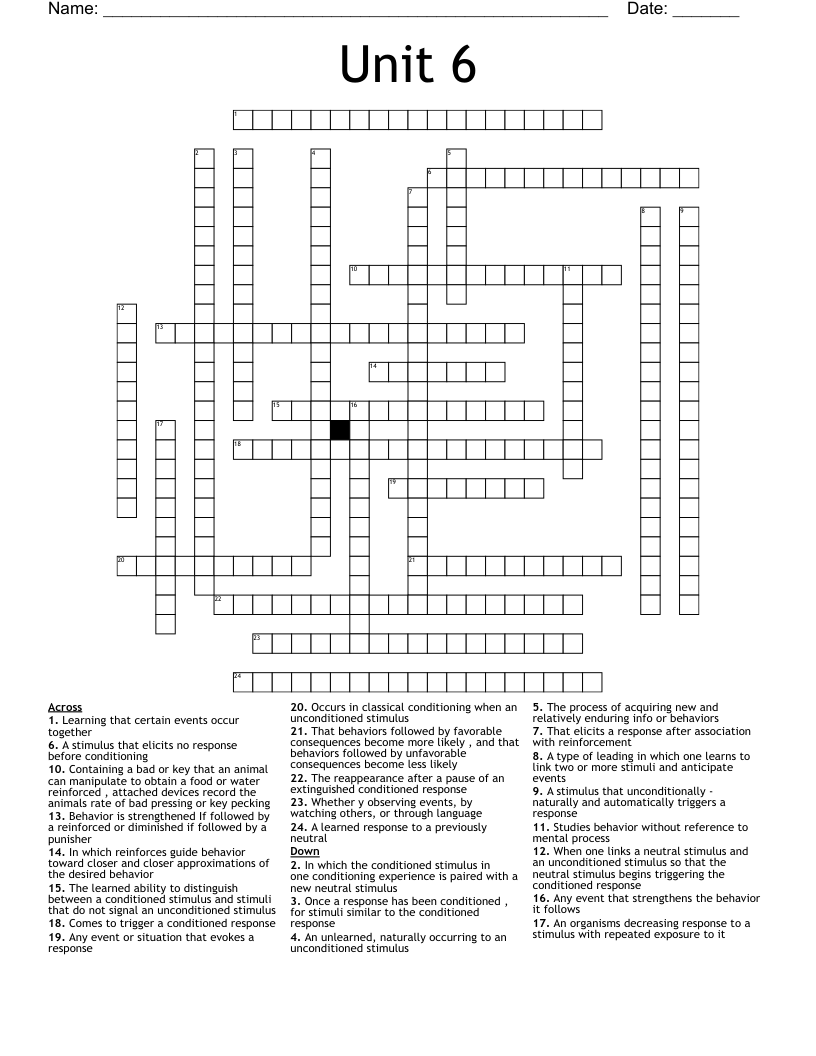
Learning in which a voluntary response is strengthened or weakened,depending on the response's favorable or unfavorable consequences.
The process by which a stimulus increases the probability that a preceding behavior will be repeated.
Any stimulus that increases the probability that a preceding behavior will occur again.
A stimulus added to the environment that brings about an increase in a preceding response.
An unpleasant stimulus whose removal leads to an increase in the probability that a preceding response will be repeated in the future.
A stimulus that decreases the probability that a previous behavior will occur again.
Different patterns of frequency and timing of reinforcement following desired behavior.