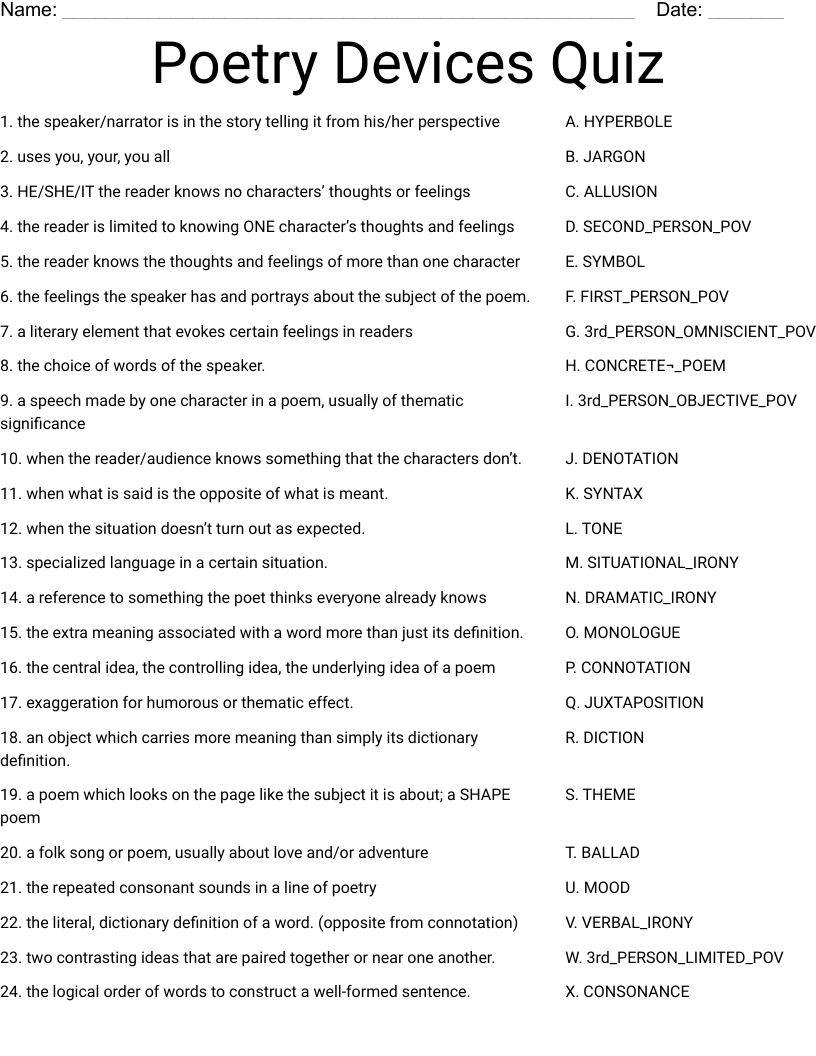
Poetry Devices Quiz Worksheet
This printable matching worksheet on the topic of Figurative Language & Literary Devices has 24 questions and answers to match. This matching worksheet is also available to download as a Microsoft Word document or a PDF.
Description
the speaker/narrator is in the story telling it from his/her perspective
uses you, your, you all
HE/SHE/IT the reader knows no characters’ thoughts or feelings
the reader is limited to knowing ONE character’s thoughts and feelings
the reader knows the thoughts and feelings of more than one character
the feelings the speaker has and portrays about the subject of the poem.
a literary element that evokes certain feelings in readers
the choice of words of the speaker.
a speech made by one character in a poem, usually of thematic significance
when the reader/audience knows something that the characters don’t.
when what is said is the opposite of what is meant.
when the situation doesn’t turn out as expected.
specialized language in a certain situation.
a reference to something the poet thinks everyone already knows
the extra meaning associated with a word more than just its definition.
the central idea, the controlling idea, the underlying idea of a poem
exaggeration for humorous or thematic effect.
an object which carries more meaning than simply its dictionary definition.
a poem which looks on the page like the subject it is about; a SHAPE poem
a folk song or poem, usually about love and/or adventure
the repeated consonant sounds in a line of poetry
the literal, dictionary definition of a word. (opposite from connotation)
two contrasting ideas that are paired together or near one another.
the logical order of words to construct a well-formed sentence.