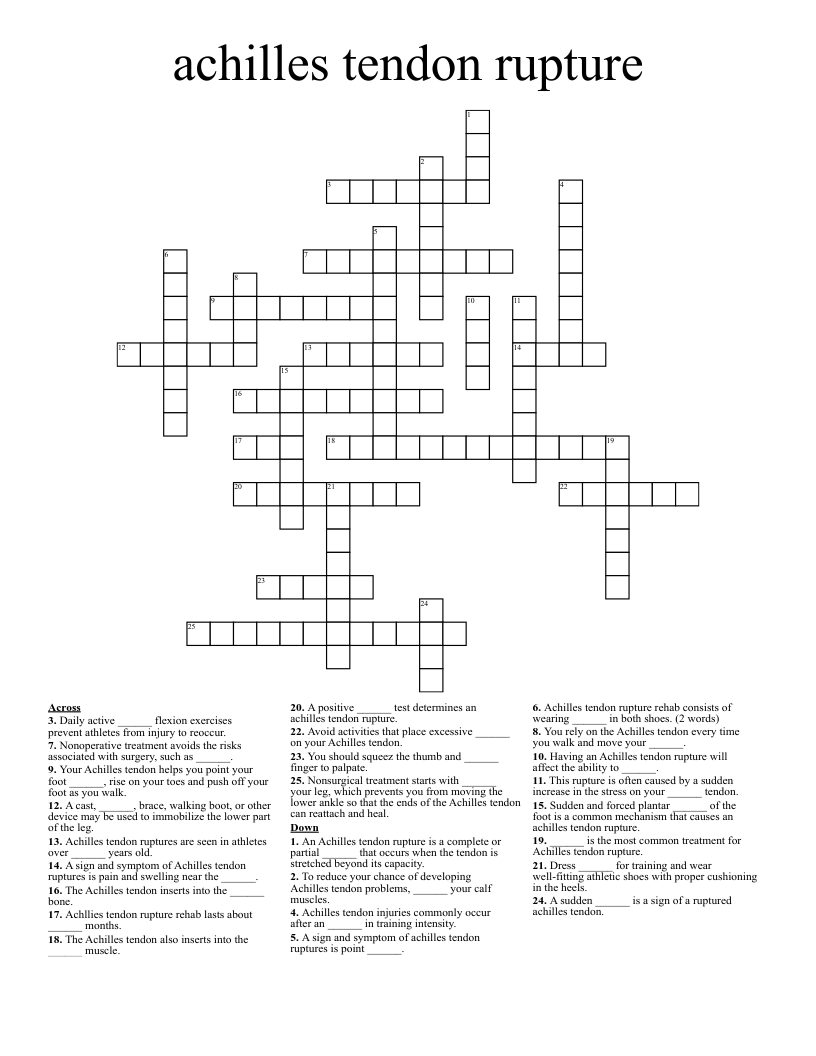
achilles tendon rupture Crossword
This printable crossword puzzle on the topic of Anatomy has 25 clues. Answers range from 3 to 13 letters long. This crossword is also available to download as a Microsoft Word document or a PDF.
Description
The Achilles tendon inserts into the ______ bone.
You should squeez the thumb and ______ finger to palpate.
A positive ______ test determines an achilles tendon rupture.
Achllies tendon rupture rehab lasts about ______ months.
Achilles tendon rupture rehab consists of wearing ______ in both shoes. (2 words)
Daily active ______ flexion exercises prevent athletes from injury to reoccur.
Sudden and forced plantar ______ of the foot is a common mechanism that causes an achilles tendon rupture.
A sign and symptom of achilles tendon ruptures is point ______.
Achilles tendon ruptures are seen in athletes over ______ years old.
A sudden ______ is a sign of a ruptured achilles tendon.
A sign and symptom of Achilles tendon ruptures is pain and swelling near the ______.
An Achilles tendon rupture is a complete or partial ______ that occurs when the tendon is stretched beyond its capacity.
Having an Achilles tendon rupture will affect the ability to ______.
This rupture is often caused by a sudden increase in the stress on your ______ tendon.
To reduce your chance of developing Achilles tendon problems, ______ your calf muscles.
Dress ______ for training and wear well-fitting athletic shoes with proper cushioning in the heels.
Achilles tendon injuries commonly occur after an ______ in training intensity.
Avoid activities that place excessive ______ on your Achilles tendon.
Your Achilles tendon helps you point your foot ______, rise on your toes and push off your foot as you walk.
You rely on the Achilles tendon every time you walk and move your ______.
______ is the most common treatment for Achilles tendon rupture.
Nonsurgical treatment starts with ______ your leg, which prevents you from moving the lower ankle so that the ends of the Achilles tendon can reattach and heal.
A cast, ______, brace, walking boot, or other device may be used to immobilize the lower part of the leg.
The Achilles tendon also inserts into the ______ muscle.
Nonoperative treatment avoids the risks associated with surgery, such as ______.