March 22, 2020 Crossword
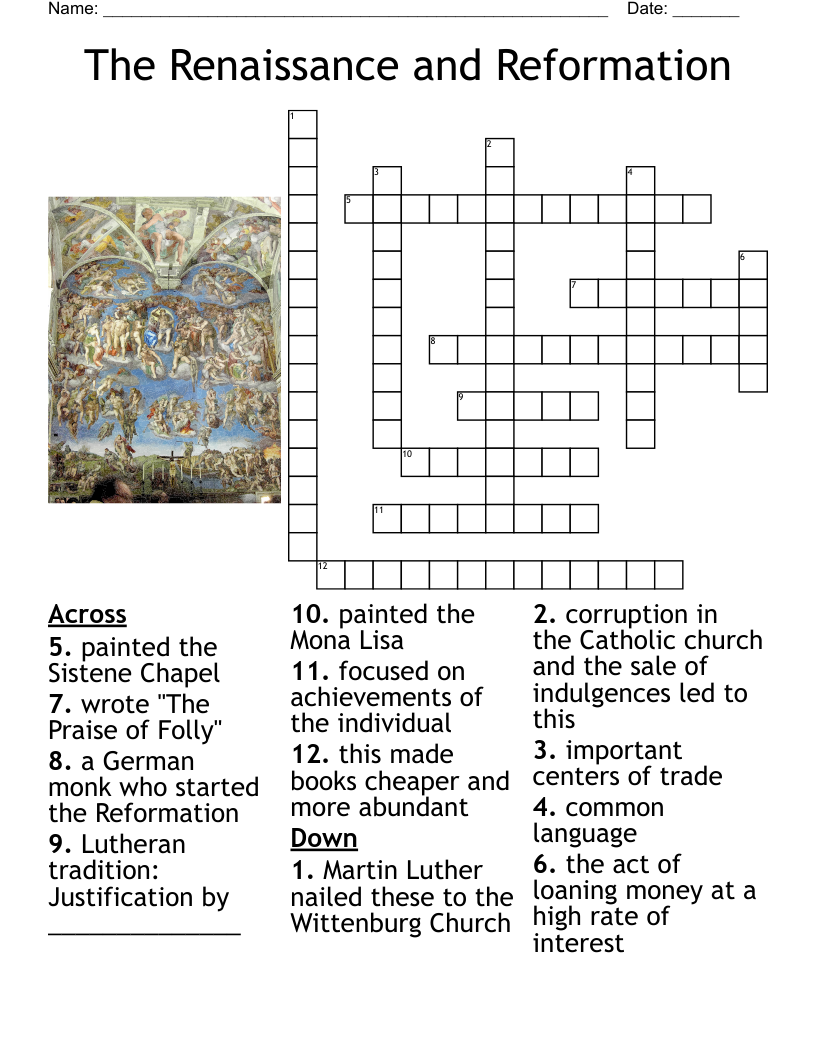
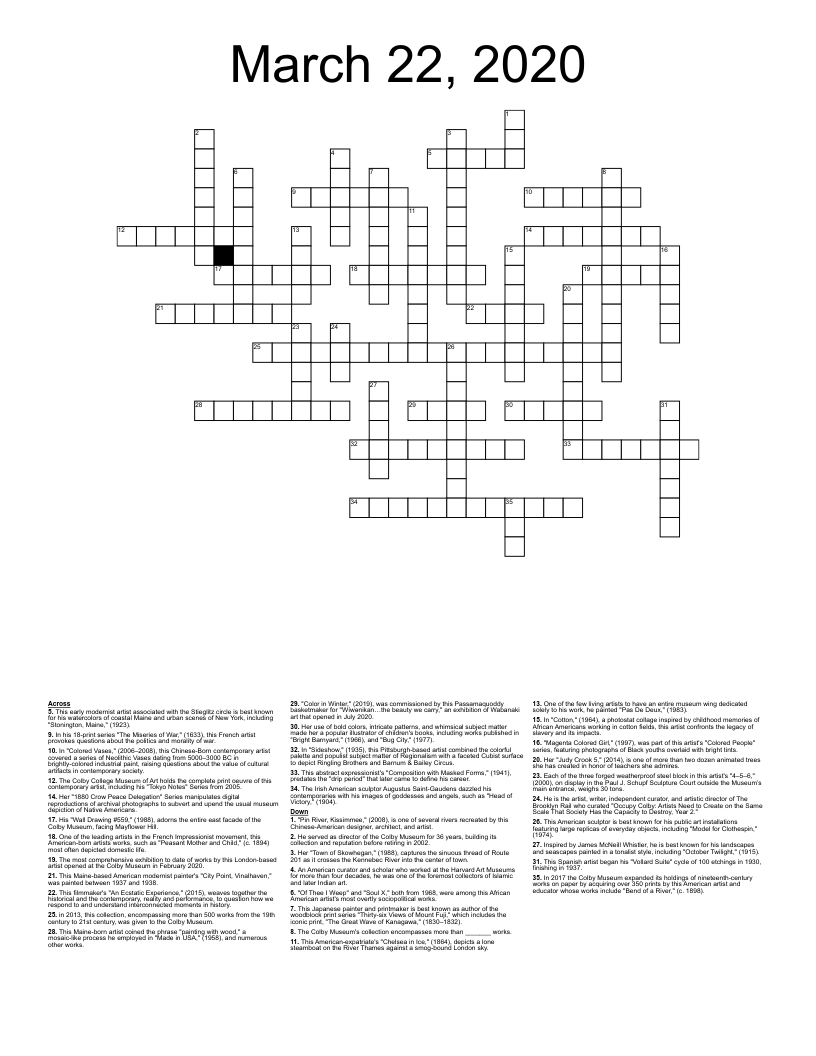
This printable crossword puzzle on the topic of Visual Arts has 35 clues. Answers range from 3 to 19 letters long. This crossword is also available to download as a Microsoft Word document or a PDF.
Description
This Maine-born artist coined the phrase "painting with wood," a mosaic-like process he employed in "Made in USA," (1958), and numerous other works.
One of the few living artists to have an entire museum wing dedicated solely to his work, he painted "Pas De Deux," (1983).
"Magenta Colored Girl," (1997), was part of this artist's "Colored People" series, featuring photographs of Black youths overlaid with bright tints.
This Spanish artist began his "Vollard Suite" cycle of 100 etchings in 1930, finishing in 1937.
The most comprehensive exhibition to date of works by this London-based artist opened at the Colby Museum in February 2020.
An American curator and scholar who worked at the Harvard Art Museums for more than four decades, he was one of the foremost collectors of Islamic and later Indian art.
This American-expatriate's "Chelsea in Ice," (1864), depicts a lone steamboat on the River Thames against a smog-bound London sky.
The Colby Museum's collection encompasses more than _______ works.
His "Wall Drawing #559," (1988), adorns the entire east facade of the Colby Museum, facing Mayflower Hill.
"Pin River, Kissimmee," (2008), is one of several rivers recreated by this Chinese-American designer, architect, and artist.
Her "1880 Crow Peace Delegation" Series manipulates digital reproductions of archival photographs to subvert and upend the usual museum depiction of Native Americans.
"Color in Winter," (2019), was commissioned by this Passamaquoddy basketmaker for "Wíwənikan…the beauty we carry," an exhibition of Wabanaki art that opened in July 2020.
This filmmaker's "An Ecstatic Experience," (2015), weaves together the historical and the contemporary, reality and performance, to question how we respond to and understand interconnected moments in history.
"Of Thee I Weep" and "Soul X," both from 1968, were among this African American artist's most overtly sociopolitical works.
Her use of bold colors, intricate patterns, and whimsical subject matter made her a popular illustrator of children's books, including works published in "Bright Barnyard," (1966), and "Bug City," (1977).
He served as director of the Colby Museum for 36 years, building its collection and reputation before retiring in 2002.
in 2013, this collection, encompassing more than 500 works from the 19th century to 21st century, was given to the Colby Museum.
Her "Town of Skowhegan," (1988), captures the sinuous thread of Route 201 as it crosses the Kennebec River into the center of town.
This early modernist artist associated with the Stieglitz circle is best known for his watercolors of coastal Maine and urban scenes of New York, including "Stonington, Maine," (1923).
Each of the three forged weatherproof steel block in this artist's "4–5–6," (2000), on display in the Paul J. Schupf Sculpture Court outside the Museum’s main entrance, weighs 30 tons.
This Maine-based American modernist painter's "City Point, Vinalhaven," was painted between 1937 and 1938.
The Colby College Museum of Art holds the complete print oeuvre of this contemporary artist, including his "Tokyo Notes" Series from 2005.
One of the leading artists in the French Impressionist movement, this American-born artists works, such as "Peasant Mother and Child," (c. 1894) most often depicted domestic life.
This abstract expressionist's "Composition with Masked Forms," (1941), predates the "drip period" that later came to define his career.
This Japanese painter and printmaker is best known as author of the woodblock print series "Thirty-six Views of Mount Fuji," which includes the iconic print, "The Great Wave of Kanagawa," (1830–1832).
In "Colored Vases," (2006–2008), this Chinese-Born contemporary artist covered a series of Neolithic Vases dating from 5000–3000 BC in brightly-colored industrial paint, raising questions about the value of cultural artifacts in contemporary society.
In 2017 the Colby Museum expanded its holdings of nineteenth-century works on paper by acquiring over 350 prints by this American artist and educator whose works include "Bend of a River," (c. 1898).
In "Cotton," (1964), a photostat collage inspired by childhood memories of African Americans working in cotton fields, this artist confronts the legacy of slavery and its impacts.
In his 18-print series "The Miseries of War," (1633), this French artist provokes questions about the politics and morality of war.
Her "Judy Crook 5," (2014), is one of more than two dozen animated trees she has created in honor of teachers she admires.
He is the artist, writer, independent curator, and artistic director of The Brooklyn Rail who curated "Occupy Colby: Artists Need to Create on the Same Scale That Society Has the Capacity to Destroy, Year 2."
Inspired by James McNeill Whistler, he is best known for his landscapes and seascapes painted in a tonalist style, including "October Twilight," (1915).
In "Sideshow," (1935), this Pittsburgh-based artist combined the colorful palette and populist subject matter of Regionalism with a faceted Cubist surface to depict Ringling Brothers and Barnum & Bailey Circus.
The Irish American sculptor Augustus Saint-Gaudens dazzled his contemporaries with his images of goddesses and angels, such as "Head of Victory," (1904).
This American sculptor is best known for his public art installations featuring large replicas of everyday objects, including "Model for Clothespin," (1974).