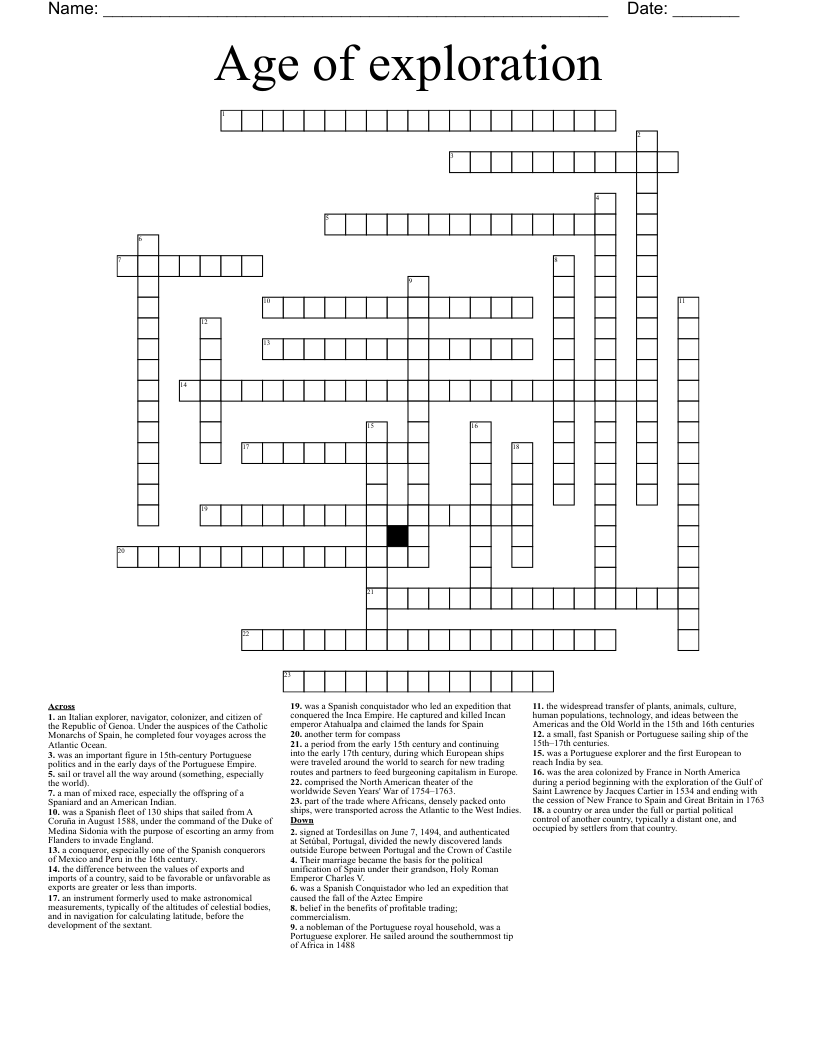
Age of exploration Crossword
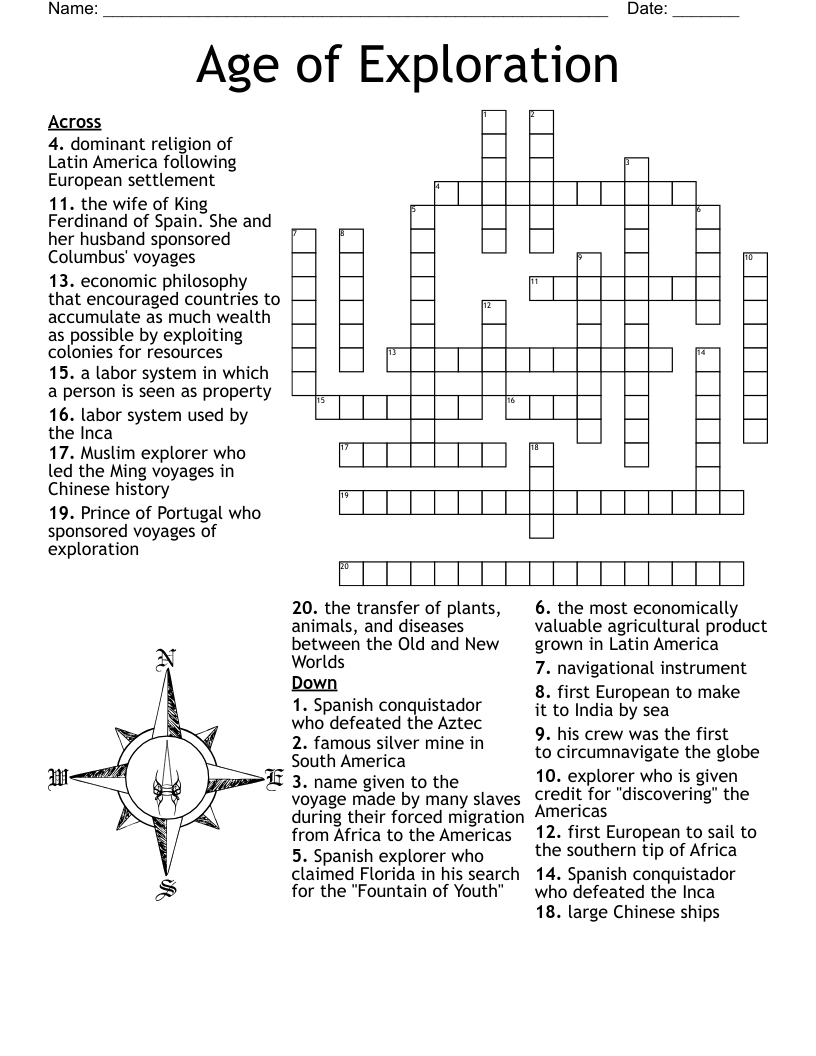
This printable crossword puzzle on the topic of World History (General) has 23 clues. Answers range from 6 to 23 letters long. This crossword is also available to download as a Microsoft Word document or a PDF.
Description
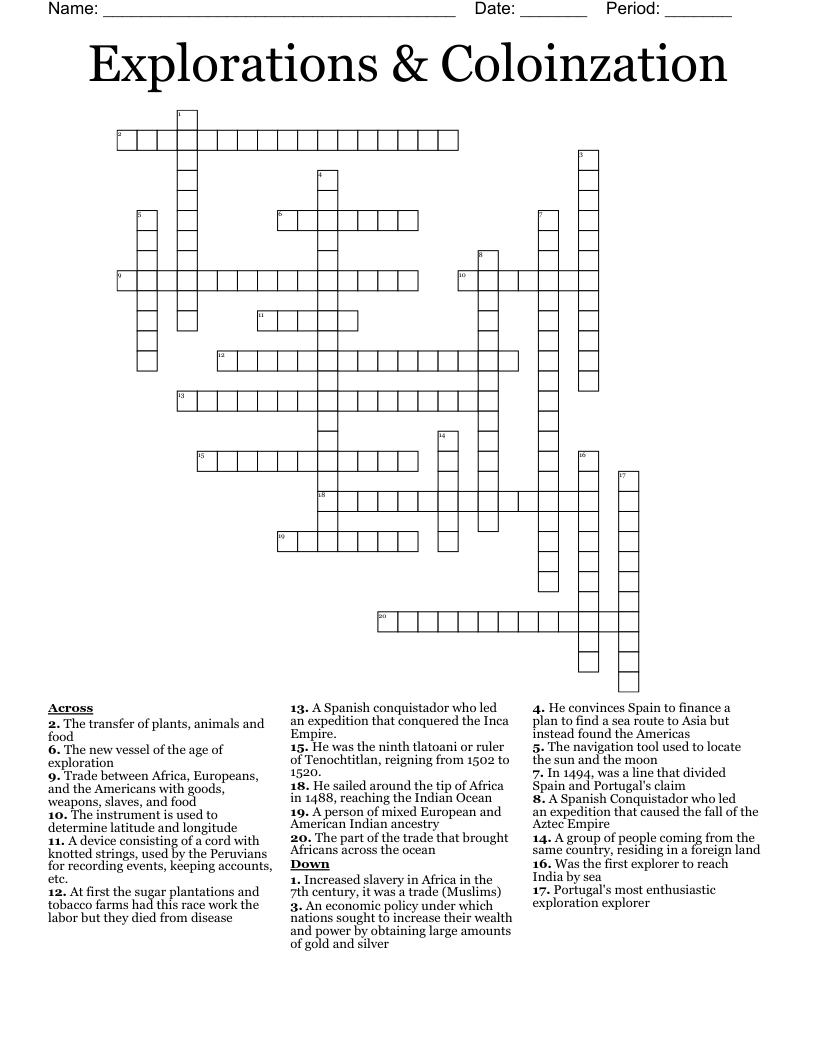
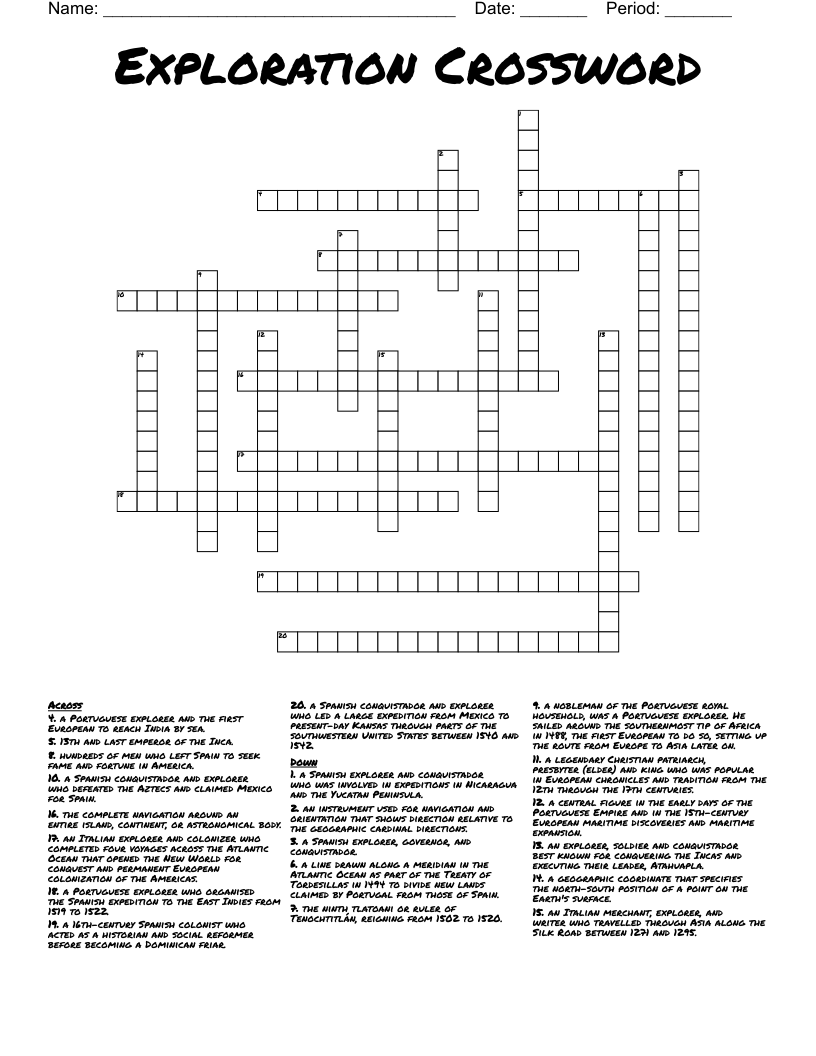
a nobleman of the Portuguese royal household, was a Portuguese explorer. He sailed around the southernmost tip of Africa in 1488
was an important figure in 15th-century Portuguese politics and in the early days of the Portuguese Empire.
was a Portuguese explorer and the first European to reach India by sea.
signed at Tordesillas on June 7, 1494, and authenticated at Setúbal, Portugal, divided the newly discovered lands outside Europe between Portugal and the Crown of Castile
an Italian explorer, navigator, colonizer, and citizen of the Republic of Genoa. Under the auspices of the Catholic Monarchs of Spain, he completed four voyages across the Atlantic Ocean.
Their marriage became the basis for the political unification of Spain under their grandson, Holy Roman Emperor Charles V.
a country or area under the full or partial political control of another country, typically a distant one, and occupied by settlers from that country.
was a Spanish Conquistador who led an expedition that caused the fall of the Aztec Empire
a conqueror, especially one of the Spanish conquerors of Mexico and Peru in the 16th century.
was a Spanish conquistador who led an expedition that conquered the Inca Empire. He captured and killed Incan emperor Atahualpa and claimed the lands for Spain
a man of mixed race, especially the offspring of a Spaniard and an American Indian.
was the area colonized by France in North America during a period beginning with the exploration of the Gulf of Saint Lawrence by Jacques Cartier in 1534 and ending with the cession of New France to Spain and Great Britain in 1763
was a Spanish fleet of 130 ships that sailed from A Coruña in August 1588, under the command of the Duke of Medina Sidonia with the purpose of escorting an army from Flanders to invade England.
comprised the North American theater of the worldwide Seven Years' War of 1754–1763.
sail or travel all the way around (something, especially the world).
a small, fast Spanish or Portuguese sailing ship of the 15th–17th centuries.
part of the trade where Africans, densely packed onto ships, were transported across the Atlantic to the West Indies.
the widespread transfer of plants, animals, culture, human populations, technology, and ideas between the Americas and the Old World in the 15th and 16th centuries
an instrument formerly used to make astronomical measurements, typically of the altitudes of celestial bodies, and in navigation for calculating latitude, before the development of the sextant.
a period from the early 15th century and continuing into the early 17th century, during which European ships were traveled around the world to search for new trading routes and partners to feed burgeoning capitalism in Europe.
belief in the benefits of profitable trading; commercialism.
the difference between the values of exports and imports of a country, said to be favorable or unfavorable as exports are greater or less than imports.
another term for compass