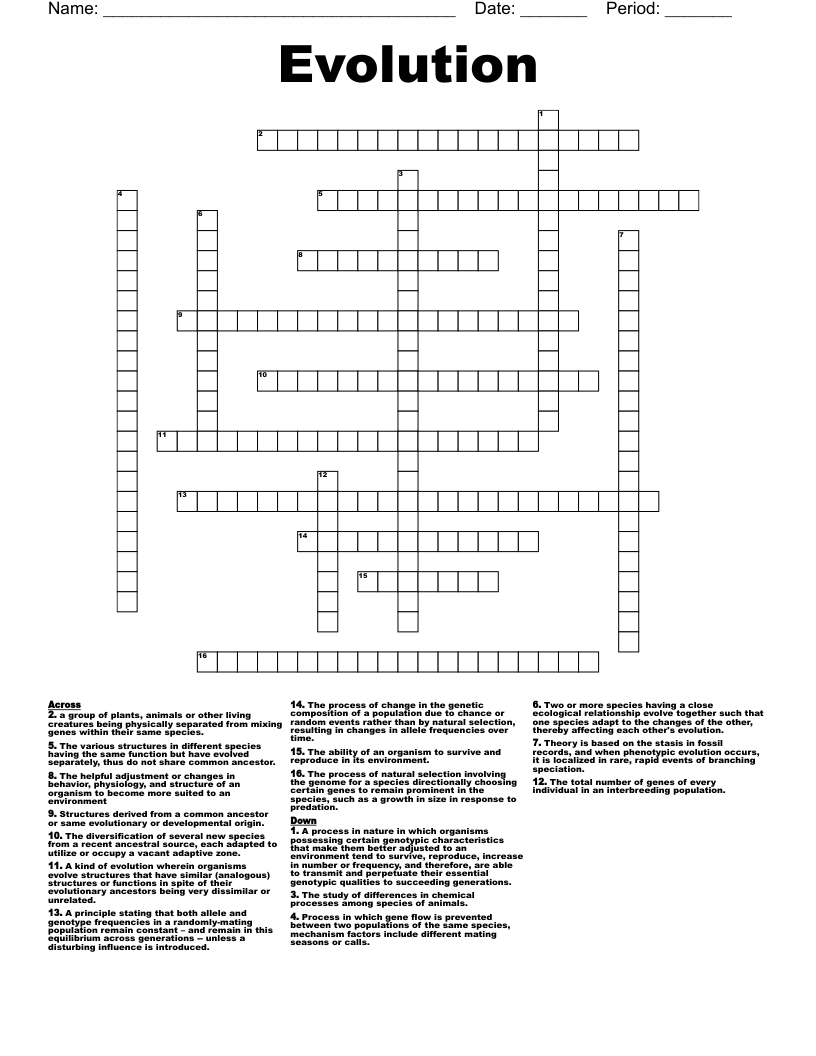
Evolution Crossword
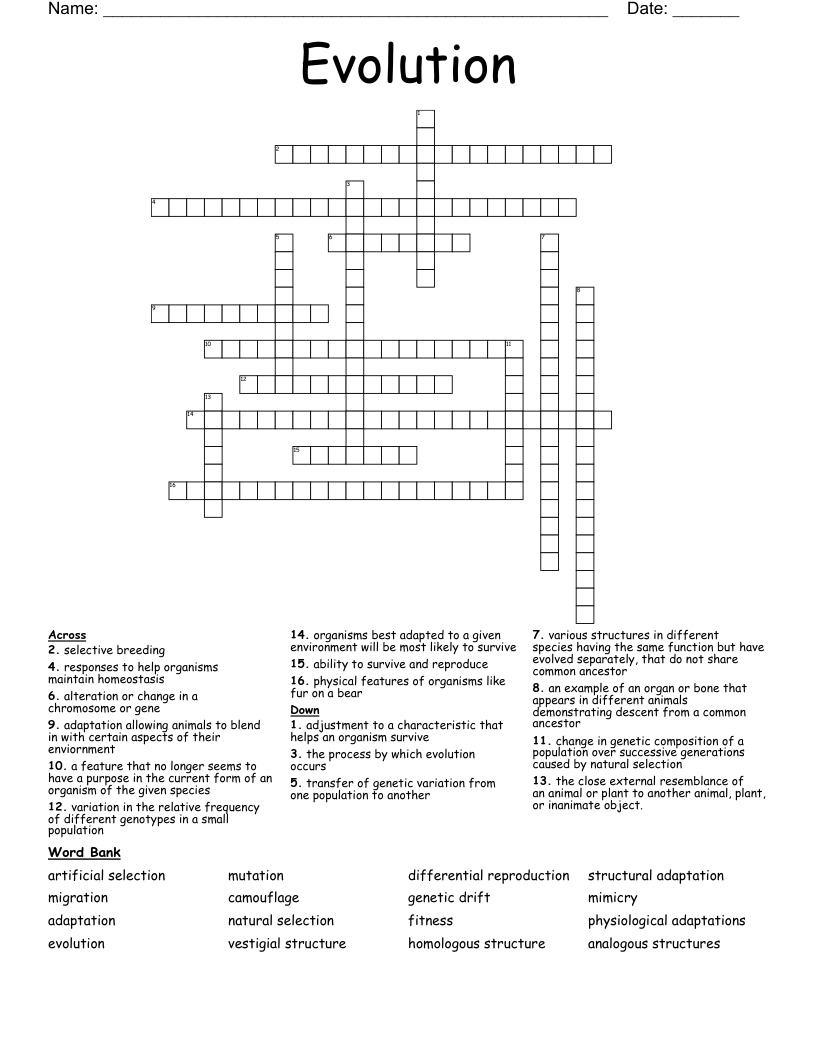
This printable crossword puzzle on the topic of Ecology & Evolution has 16 clues. Answers range from 7 to 25 letters long. This crossword is also available to download as a Microsoft Word document or a PDF.
Description
The diversification of several new species from a recent ancestral source, each adapted to utilize or occupy a vacant adaptive zone.
The helpful adjustment or changes in behavior, physiology, and structure of an organism to become more suited to an environment
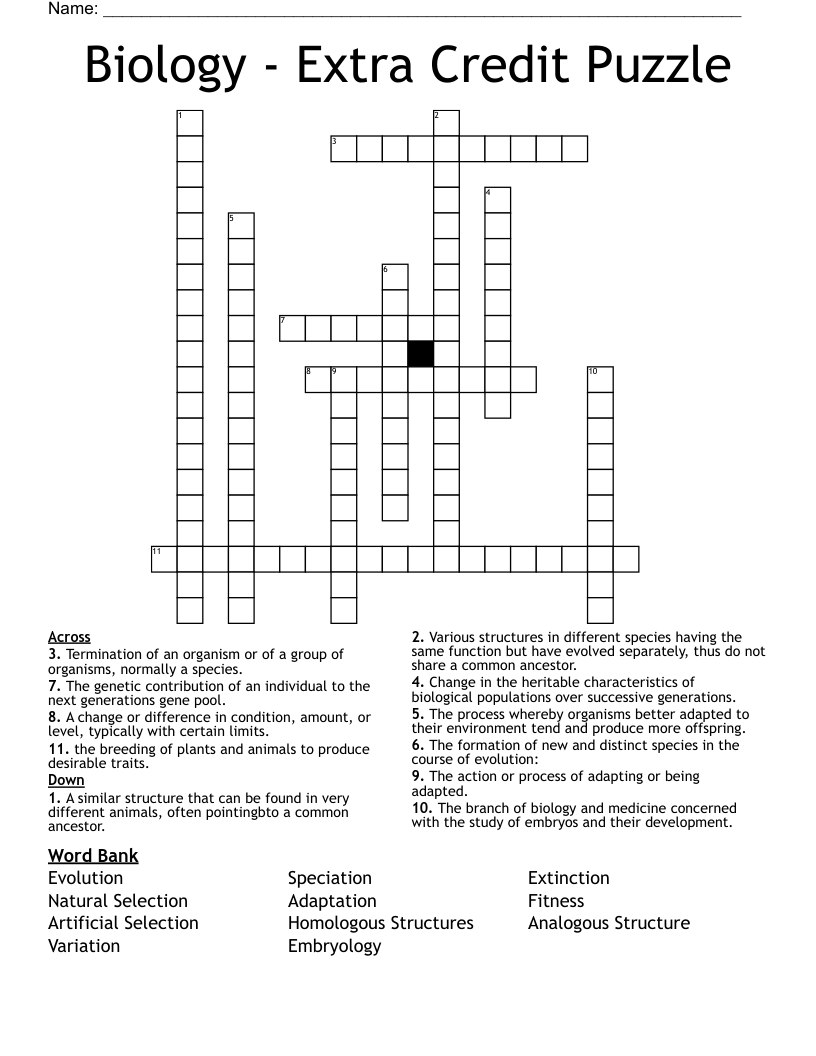
The various structures in different species having the same function but have evolved separately, thus do not share common ancestor.
Two or more species having a close ecological relationship evolve together such that one species adapt to the changes of the other, thereby affecting each other's evolution.
The study of differences in chemical processes among species of animals.
A kind of evolution wherein organisms evolve structures that have similar (analogous) structures or functions in spite of their evolutionary ancestors being very dissimilar or unrelated.
The process of natural selection involving the genome for a species directionally choosing certain genes to remain prominent in the species, such as a growth in size in response to predation.
The ability of an organism to survive and reproduce in its environment.
The total number of genes of every individual in an interbreeding population.
The process of change in the genetic composition of a population due to chance or random events rather than by natural selection, resulting in changes in allele frequencies over time.
a group of plants, animals or other living creatures being physically separated from mixing genes within their same species.
A principle stating that both allele and genotype frequencies in a randomly-mating population remain constant – and remain in this equilibrium across generations -- unless a disturbing influence is introduced.
Structures derived from a common ancestor or same evolutionary or developmental origin.
A process in nature in which organisms possessing certain genotypic characteristics that make them better adjusted to an environment tend to survive, reproduce, increase in number or frequency, and therefore, are able to transmit and perpetuate their essential genotypic qualities to succeeding generations.
Theory is based on the stasis in fossil records, and when phenotypic evolution occurs, it is localized in rare, rapid events of branching speciation.
Process in which gene flow is prevented between two populations of the same species, mechanism factors include different mating seasons or calls.