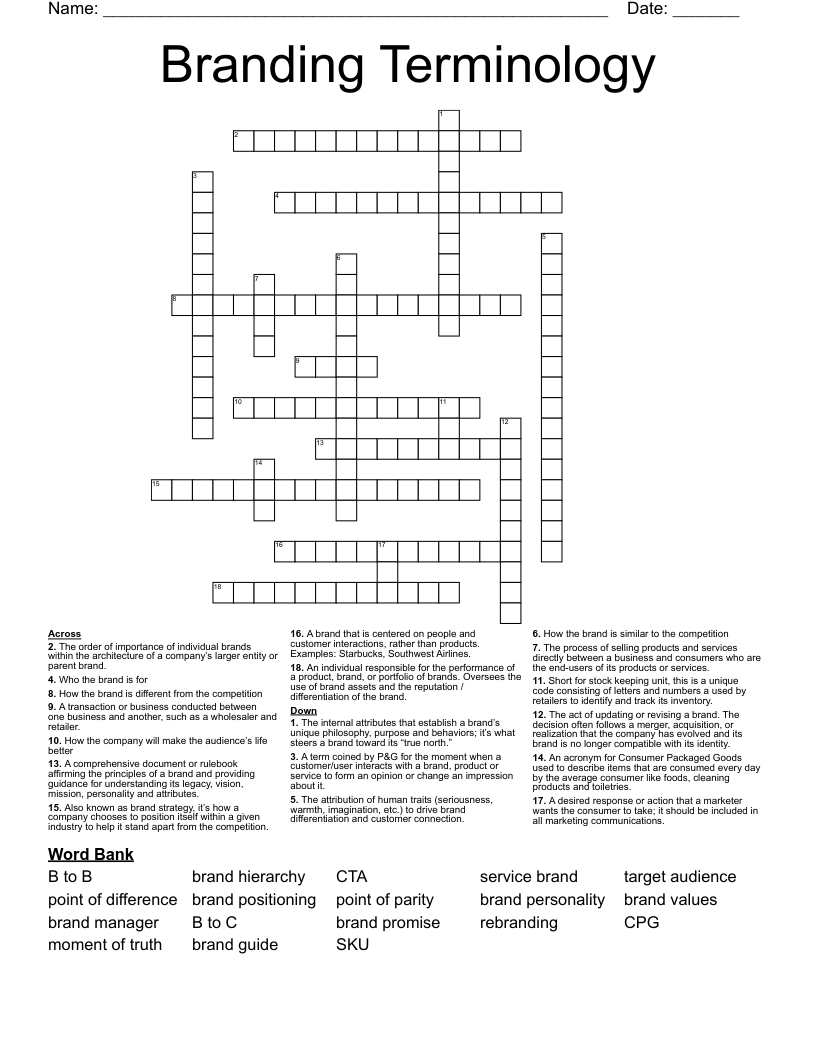
Branding Terminology Crossword
This printable crossword puzzle on the topic of Economics & Business has 18 clues. Answers range from 3 to 17 letters long. This crossword is also available to download as a Microsoft Word document or a PDF.
Description
A comprehensive document or rulebook affirming the principles of a brand and providing guidance for understanding its legacy, vision, mission, personality and attributes.
The order of importance of individual brands within the architecture of a company’s larger entity or parent brand.
An individual responsible for the performance of a product, brand, or portfolio of brands. Oversees the use of brand assets and the reputation / differentiation of the brand.
The attribution of human traits (seriousness, warmth, imagination, etc.) to drive brand differentiation and customer connection.
Also known as brand strategy, it’s how a company chooses to position itself within a given industry to help it stand apart from the competition.
Who the brand is for
How the company will make the audience’s life better
How the brand is similar to the competition
How the brand is different from the competition
The internal attributes that establish a brand’s unique philosophy, purpose and behaviors; it’s what steers a brand toward its “true north.”
A transaction or business conducted between one business and another, such as a wholesaler and retailer.
The process of selling products and services directly between a business and consumers who are the end-users of its products or services.
An acronym for Consumer Packaged Goods used to describe items that are consumed every day by the average consumer like foods, cleaning products and toiletries.
A term coined by P&G for the moment when a customer/user interacts with a brand, product or service to form an opinion or change an impression about it.
The act of updating or revising a brand. The decision often follows a merger, acquisition, or realization that the company has evolved and its brand is no longer compatible with its identity.
A brand that is centered on people and customer interactions, rather than products. Examples: Starbucks, Southwest Airlines.
Short for stock keeping unit, this is a unique code consisting of letters and numbers a used by retailers to identify and track its inventory.
A desired response or action that a marketer wants the consumer to take; it should be included in all marketing communications.