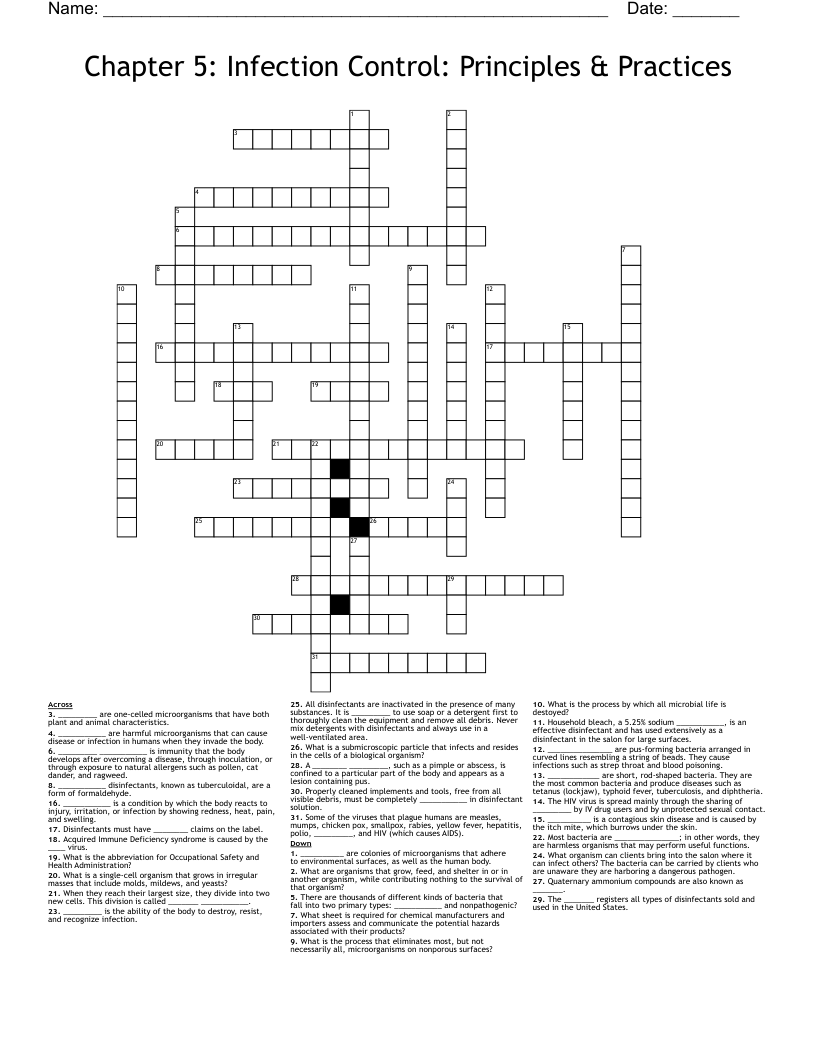
Chapter 5: Infection Control: Principles & Practices Crossword
This printable crossword puzzle on the topic of Nursing & Healthcare Careers has 31 clues. Answers range from 3 to 16 letters long. This crossword is also available to download as a Microsoft Word document or a PDF.
Description
What is the abbreviation for Occupational Safety and Health Administration?
What sheet is required for chemical manufacturers and importers assess and communicate the potential hazards associated with their products?
The _______ registers all types of disinfectants sold and used in the United States.
_________ are one-celled microorganisms that have both plant and animal characteristics.
There are thousands of different kinds of bacteria that fall into two primary types: ___________ and nonpathogenic?
Most bacteria are _______________; in other words, they are harmless organisms that may perform useful functions.
___________ are harmful microorganisms that can cause disease or infection in humans when they invade the body.
_______________ are pus-forming bacteria arranged in curved lines resembling a string of beads. They cause infections such as strep throat and blood poisoning.
____________ are short, rod-shaped bacteria. They are the most common bacteria and produce diseases such as tetanus (lockjaw), typhoid fever, tuberculosis, and diphtheria.
When they reach their largest size, they divide into two new cells. This division is called _______ ___________.
___________ is a condition by which the body reacts to injury, irritation, or infection by showing redness, heat, pain, and swelling.
A ________ _________, such as a pimple or abscess, is confined to a particular part of the body and appears as a lesion containing pus.
What organism can clients bring into the salon where it can infect others? The bacteria can be carried by clients who are unaware they are harboring a dangerous pathogen.
Acquired Immune Deficiency syndrome is caused by the ____ virus.
What is a submicroscopic particle that infects and resides in the cells of a biological organism?
Some of the viruses that plague humans are measles, mumps, chicken pox, smallpox, rabies, yellow fever, hepatitis, polio, _________, and HIV (which causes AIDS).
__________ are colonies of microorganisms that adhere to environmental surfaces, as well as the human body.
The HIV virus is spread mainly through the sharing of _________ by IV drug users and by unprotected sexual contact.
What is a single-cell organism that grows in irregular masses that include molds, mildews, and yeasts?
What are organisms that grow, feed, and shelter in or in another organism, while contributing nothing to the survival of that organism?
__________ is a contagious skin disease and is caused by the itch mite, which burrows under the skin.
_________ is the ability of the body to destroy, resist, and recognize infection.
_________ ___________ is immunity that the body develops after overcoming a disease, through inoculation, or through exposure to natural allergens such as pollen, cat dander, and ragweed.
What is the process by which all microbial life is destoyed?
What is the process that eliminates most, but not necessarily all, microorganisms on nonporous surfaces?
Disinfectants must have ________ claims on the label.
Properly cleaned implements and tools, free from all visible debris, must be completely ___________ in disinfectant solution.
All disinfectants are inactivated in the presence of many substances. It is _________ to use soap or a detergent first to thoroughly clean the equipment and remove all debris. Never mix detergents with disinfectants and always use in a well-ventilated area.
Quaternary ammonium compounds are also known as _______.
___________ disinfectants, known as tuberculoidal, are a form of formaldehyde.
Household bleach, a 5.25% sodium ___________, is an effective disinfectant and has used extensively as a disinfectant in the salon for large surfaces.