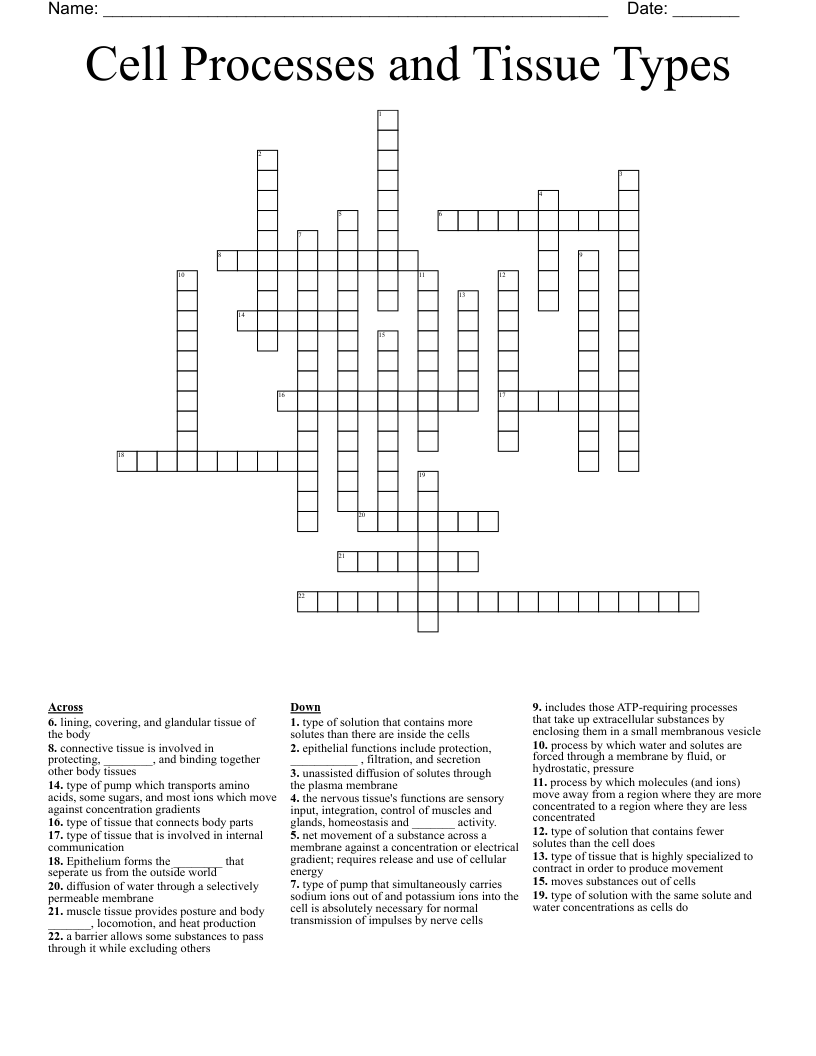
Cell Processes and Tissue Types Crossword
This printable crossword puzzle on the topic of Cell Biology has 22 clues. Answers range from 6 to 20 letters long. This crossword is also available to download as a Microsoft Word document or a PDF.
Description
a barrier allows some substances to pass through it while excluding others
process by which molecules (and ions) move away from a region where they are more concentrated to a region where they are less concentrated
process by which water and solutes are forced through a membrane by fluid, or hydrostatic, pressure
net movement of a substance across a membrane against a concentration or electrical gradient; requires release and use of cellular energy
unassisted diffusion of solutes through the plasma membrane
diffusion of water through a selectively permeable membrane
type of solution with the same solute and water concentrations as cells do
type of solution that contains more solutes than there are inside the cells
type of solution that contains fewer solutes than the cell does
type of pump which transports amino acids, some sugars, and most ions which move against concentration gradients
type of pump that simultaneously carries sodium ions out of and potassium ions into the cell is absolutely necessary for normal transmission of impulses by nerve cells
moves substances out of cells
includes those ATP-requiring processes that take up extracellular substances by enclosing them in a small membranous vesicle
lining, covering, and glandular tissue of the body
Epithelium forms the ________ that seperate us from the outside world
epithelial functions include protection, ___________ , filtration, and secretion
type of tissue that connects body parts
connective tissue is involved in protecting, ________, and binding together other body tissues
type of tissue that is highly specialized to contract in order to produce movement
muscle tissue provides posture and body _______, locomotion, and heat production
type of tissue that is involved in internal communication
the nervous tissue's functions are sensory input, integration, control of muscles and glands, homeostasis and _______ activity.