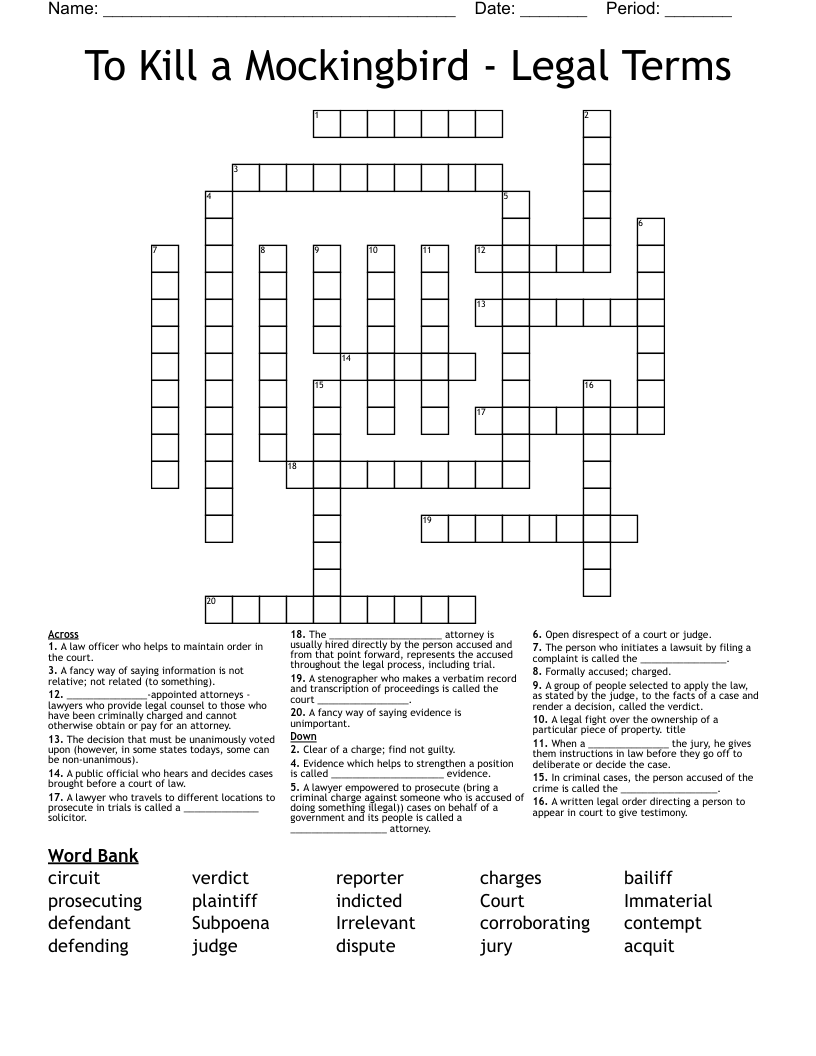
To Kill a Mockingbird - Legal Terms Crossword
This printable crossword puzzle on the topic of Classic Literature has 20 clues. Answers range from 4 to 13 letters long. This crossword is also available to download as a Microsoft Word document or a PDF.
Description
A lawyer empowered to prosecute (bring a criminal charge against someone who is accused of doing something illegal)) cases on behalf of a government and its people is called a __________________ attorney.
A lawyer who travels to different locations to prosecute in trials is called a ______________ solicitor.
The _____________________ attorney is usually hired directly by the person accused and from that point forward, represents the accused throughout the legal process, including trial.
_______________-appointed attorneys - lawyers who provide legal counsel to those who have been criminally charged and cannot otherwise obtain or pay for an attorney.
The person who initiates a lawsuit by filing a complaint is called the ________________.
In criminal cases, the person accused of the crime is called the __________________.
A stenographer who makes a verbatim record and transcription of proceedings is called the court _________________.
A public official who hears and decides cases brought before a court of law.
A law officer who helps to maintain order in the court.
A group of people selected to apply the law, as stated by the judge, to the facts of a case and render a decision, called the verdict.
The decision that must be unanimously voted upon (however, in some states todays, some can be non-unanimous).
A written legal order directing a person to appear in court to give testimony.
Evidence which helps to strengthen a position is called _____________________ evidence.
Open disrespect of a court or judge.
A fancy way of saying information is not relative; not related (to something).
A fancy way of saying evidence is unimportant.
A legal fight over the ownership of a particular piece of property. title
Formally accused; charged.
Clear of a charge; find not guilty.
When a _______________ the jury, he gives them instructions in law before they go off to deliberate or decide the case.