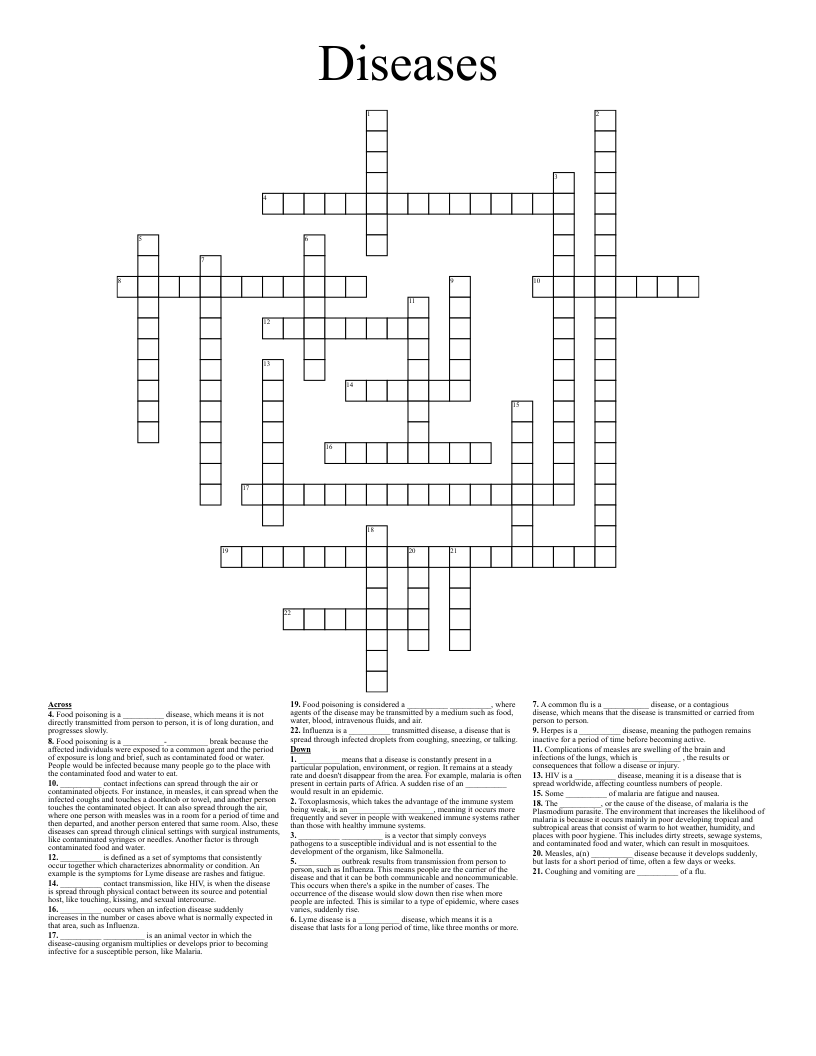
Diseases Crossword
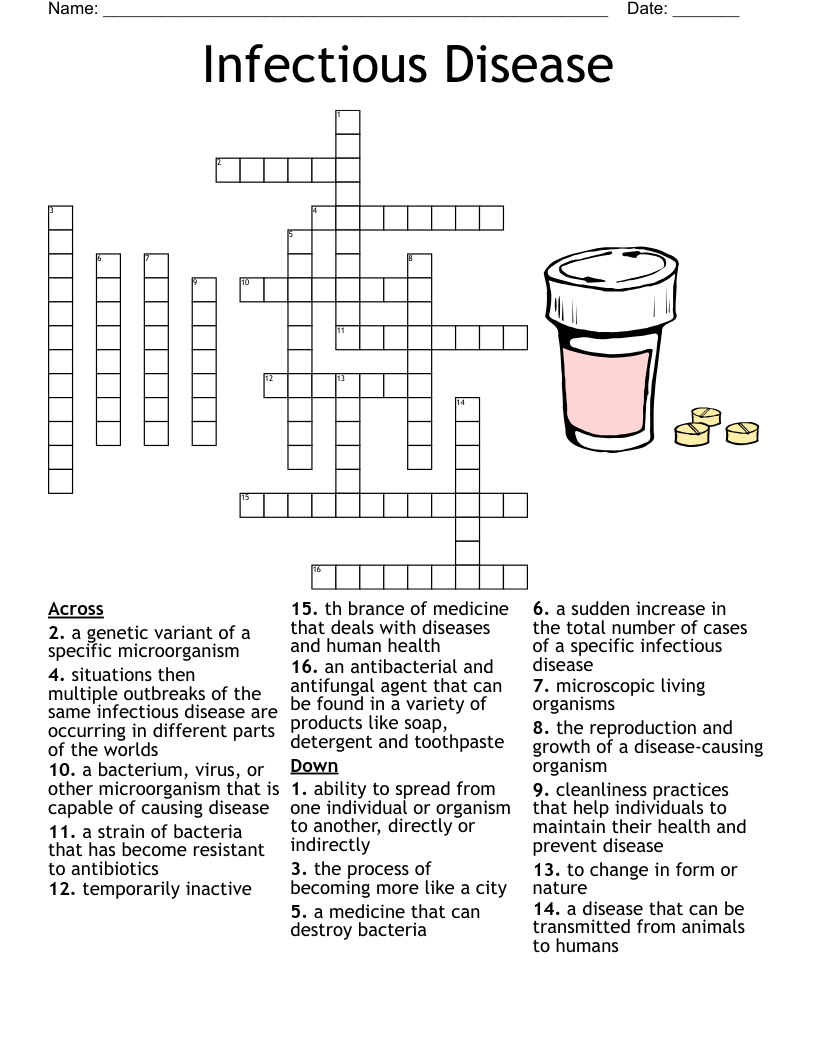
This printable crossword puzzle on the topic of Microbiology has 22 clues. Answers range from 5 to 22 letters long. This crossword is also available to download as a Microsoft Word document or a PDF.
Description
A common flu is a ___________ disease, or a contagious disease, which means that the disease is transmitted or carried from person to person.
Food poisoning is a __________-__________ break because the affected individuals were exposed to a common agent and the period of exposure is long and brief, such as contaminated food or water. People would be infected because many people go to the place with the contaminated food and water to eat.
__________ is defined as a set of symptoms that consistently occur together which characterizes abnormality or condition. An example is the symptoms for Lyme disease are rashes and fatigue.
Complications of measles are swelling of the brain and infections of the lungs, which is __________ , the results or consequences that follow a disease or injury.
Measles, a(n) __________ disease because it develops suddenly, but lasts for a short period of time, often a few days or weeks.
HIV is a __________ disease, meaning it is a disease that is spread worldwide, affecting countless numbers of people.
Toxoplasmosis, which takes the advantage of the immune system being weak, is an __________ __________, meaning it occurs more frequently and sever in people with weakened immune systems rather than those with healthy immune systems.
The __________, or the cause of the disease, of malaria is the Plasmodium parasite. The environment that increases the likelihood of malaria is because it occurs mainly in poor developing tropical and subtropical areas that consist of warm to hot weather, humidity, and places with poor hygiene. This includes dirty streets, sewage systems, and contaminated food and water, which can result in mosquitoes.
Food poisoning is a __________ disease, which means it is not directly transmitted from person to person, it is of long duration, and progresses slowly.
Lyme disease is a __________ disease, which means it is a disease that lasts for a long period of time, like three months or more.
Herpes is a __________ disease, meaning the pathogen remains inactive for a period of time before becoming active.
__________ outbreak results from transmission from person to person, such as Influenza. This means people are the carrier of the disease and that it can be both communicable and noncommunicable. This occurs when there's a spike in the number of cases. The occurrence of the disease would slow down then rise when more people are infected. This is similar to a type of epidemic, where cases varies, suddenly rise.
Food poisoning is considered a __________ __________, where agents of the disease may be transmitted by a medium such as food, water, blood, intravenous fluids, and air.
__________ contact transmission, like HIV, is when the disease is spread through physical contact between its source and potential host, like touching, kissing, and sexual intercourse.
__________ __________ is an animal vector in which the disease-causing organism multiplies or develops prior to becoming infective for a susceptible person, like Malaria.
Coughing and vomiting are __________ of a flu.
Some __________ of malaria are fatigue and nausea.
__________ means that a disease is constantly present in a particular population, environment, or region. It remains at a steady rate and doesn't disappear from the area. For example, malaria is often present in certain parts of Africa. A sudden rise of an __________ would result in an epidemic.
__________ occurs when an infection disease suddenly increases in the number or cases above what is normally expected in that area, such as Influenza.
Influenza is a __________ transmitted disease, a disease that is spread through infected droplets from coughing, sneezing, or talking.
__________ __________ is a vector that simply conveys pathogens to a susceptible individual and is not essential to the development of the organism, like Salmonella.
__________ contact infections can spread through the air or contaminated objects. For instance, in measles, it can spread when the infected coughs and touches a doorknob or towel, and another person touches the contaminated object. It can also spread through the air, where one person with measles was in a room for a period of time and then departed, and another person entered that same room. Also, these diseases can spread through clinical settings with surgical instruments, like contaminated syringes or needles. Another factor is through contaminated food and water.