Test HEALTH puzzle Crossword
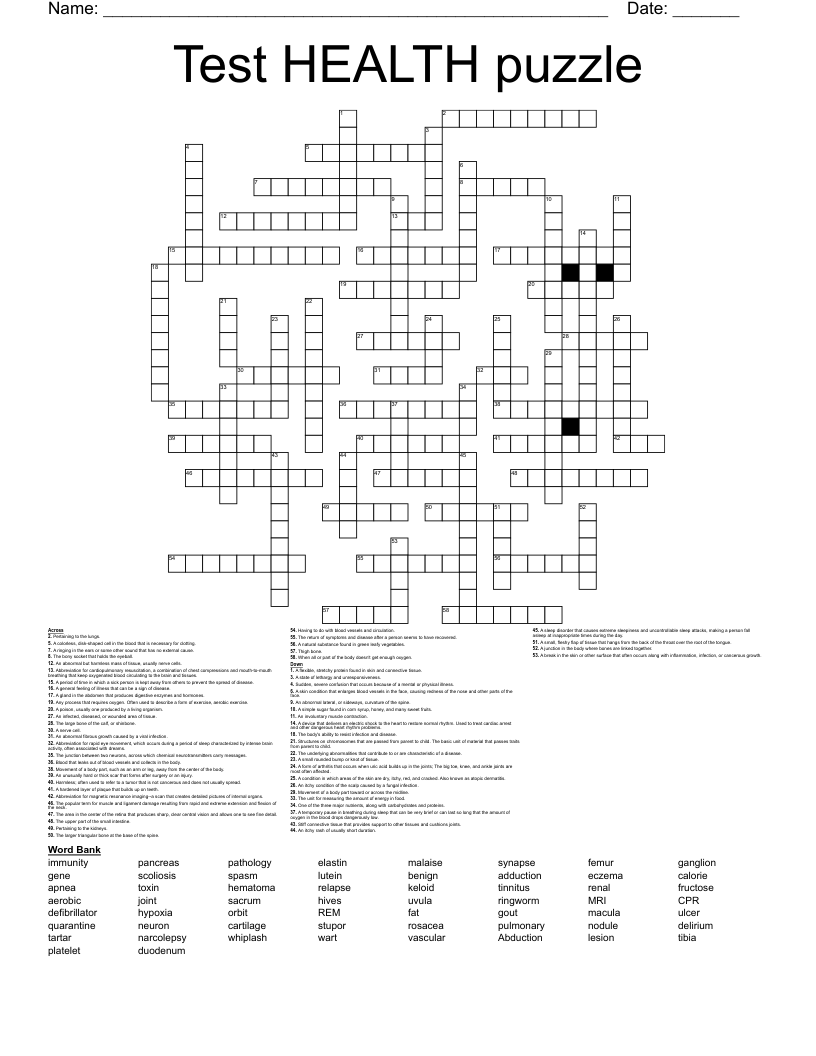
This printable crossword puzzle on the topic of Medical Terminology has 58 clues. Answers range from 3 to 13 letters long. This crossword is also available to download as a Microsoft Word document or a PDF.
Description
Movement of a body part, such as an arm or leg, away from the center of the body.
Movement of a body part toward or across the midline.
A temporary pause in breathing during sleep that can be very brief or can last so long that the amount of oxygen in the blood drops dangerously low.
Harmless; often used to refer to a tumor that is not cancerous and does not usually spread.
The unit for measuring the amount of energy in food.
Stiff connective tissue that provides support to other tissues and cushions joints.
Abbreviation for cardiopulmonary resuscitation, a combination of chest compressions and mouth-to-mouth breathing that keep oxygenated blood circulating to the brain and tissues.
A device that delivers an electric shock to the heart to restore normal rhythm. Used to treat cardiac arrest and other dangerous heart rhythm problems.
Sudden, severe confusion that occurs because of a mental or physical illness.
The upper part of the small intestine.
A condition in which areas of the skin are dry, itchy, red, and cracked. Also known as atopic dermatitis.
A flexible, stretchy protein found in skin and connective tissue.
One of the three major nutrients, along with carbohydrates and proteins.
Thigh bone.
A simple sugar found in corn syrup, honey, and many sweet fruits.
An abnormal but harmless mass of tissue, usually nerve cells.
Structures on chromosomes that are passed from parent to child. The basic unit of material that passes traits from parent to child.
A form of arthritis that occurs when uric acid builds up in the joints; The big toe, knee, and ankle joints are most often affected.
Blood that leaks out of blood vessels and collects in the body.
An itchy rash of usually short duration.
When all or part of the body doesn't get enough oxygen.
The body's ability to resist infection and disease.
A junction in the body where bones are linked together.
An unusually hard or thick scar that forms after surgery or an injury.
An infected, diseased, or wounded area of tissue.
A natural substance found in green leafy vegetables.
The area in the center of the retina that produces sharp, clear central vision and allows one to see fine detail.
A general feeling of illness that can be a sign of disease.
Abbreviation for magnetic resonance imaging--a scan that creates detailed pictures of internal organs.
A sleep disorder that causes extreme sleepiness and uncontrollable sleep attacks, making a person fall asleep at inappropriate times during the day.
A nerve cell.
A small rounded bump or knot of tissue.
The bony socket that holds the eyeball.
A gland in the abdomen that produces digestive enzymes and hormones.
The underlying abnormalities that contribute to or are characteristic of a disease.
A colorless, disk-shaped cell in the blood that is necessary for clotting.
Pertaining to the lungs.
A period of time in which a sick person is kept away from others to prevent the spread of disease.
The return of symptoms and disease after a person seems to have recovered.
Abbreviation for rapid eye movement, which occurs during a period of sleep characterized by intense brain activity, often associated with dreams.
Pertaining to the kidneys.
An itchy condition of the scalp caused by a fungal infection.
A skin condition that enlarges blood vessels in the face, causing redness of the nose and other parts of the face.
The larger triangular bone at the base of the spine.
An abnormal lateral, or sideways, curvature of the spine.
An involuntary muscle contraction.
A state of lethargy and unresponsiveness.
The junction between two neurons, across which chemical neurotransmitters carry messages.
A hardened layer of plaque that builds up on teeth.
The large bone of the calf, or shinbone.
A ringing in the ears or some other sound that has no external cause.
A poison, usually one produced by a living organism.
A break in the skin or other surface that often occurs along with inflammation, infection, or cancerous growth.
A small, fleshy flap of tissue that hangs from the back of the throat over the root of the tongue.
Having to do with blood vessels and circulation.
An abnormal fibrous growth caused by a viral infection.
The popular term for muscle and ligament damage resulting from rapid and extreme extension and flexion of the neck.
Any process that requires oxygen. Often used to describe a form of exercise, aerobic exercise.