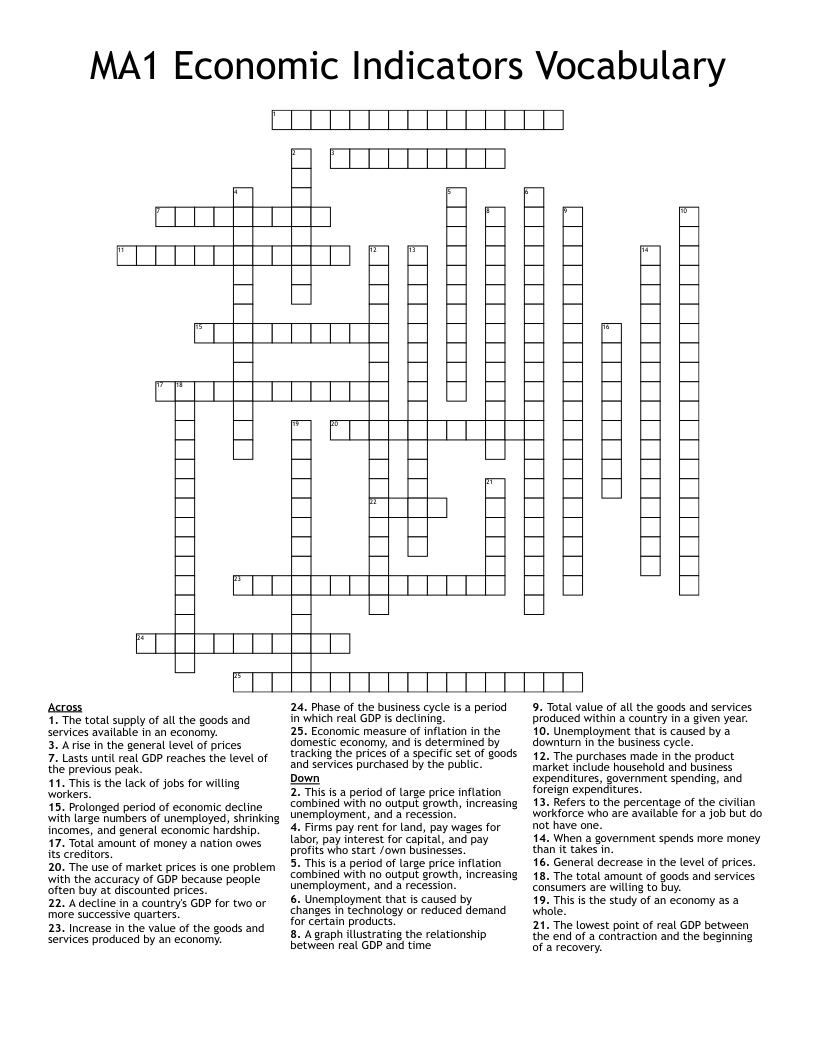
MA1 Economic Indicators Vocabulary Crossword
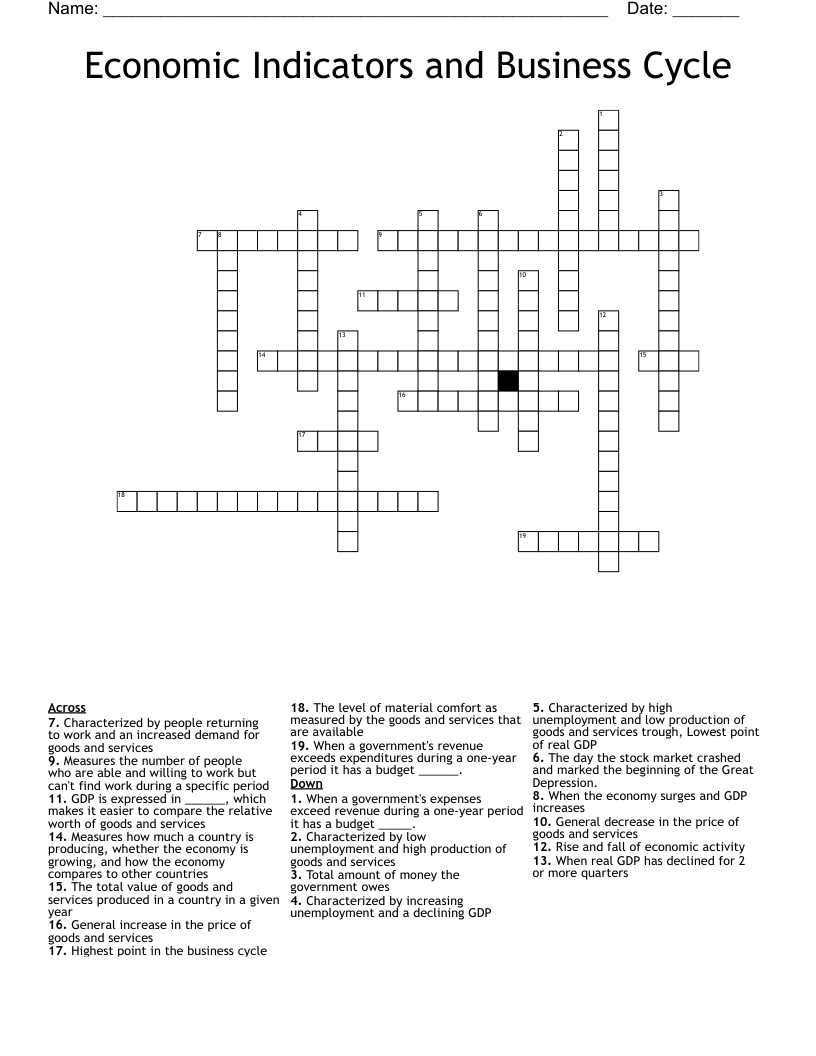
This printable crossword puzzle on the topic of Economics & Business has 25 clues. Answers range from 4 to 22 letters long. This crossword is also available to download as a Microsoft Word document or a PDF.
Description
The total amount of goods and services consumers are willing to buy.
The total supply of all the goods and services available in an economy.
A graph illustrating the relationship between real GDP and time
Economic measure of inflation in the domestic economy, and is determined by tracking the prices of a specific set of goods and services purchased by the public.
Phase of the business cycle is a period in which real GDP is declining.
Unemployment that is caused by a downturn in the business cycle.
General decrease in the level of prices.
Prolonged period of economic decline with large numbers of unemployed, shrinking incomes, and general economic hardship.
Increase in the value of the goods and services produced by an economy.
Lasts until real GDP reaches the level of the previous peak.
The purchases made in the product market include household and business expenditures, government spending, and foreign expenditures.
When a government spends more money than it takes in.
Total value of all the goods and services produced within a country in a given year.
Firms pay rent for land, pay wages for labor, pay interest for capital, and pay profits who start /own businesses.
A rise in the general level of prices
This is the study of an economy as a whole.
The use of market prices is one problem with the accuracy of GDP because people often buy at discounted prices.
Total amount of money a nation owes its creditors.
A decline in a country's GDP for two or more successive quarters.
This is a period of large price inflation combined with no output growth, increasing unemployment, and a recession.
Unemployment that is caused by changes in technology or reduced demand for certain products.
The lowest point of real GDP between the end of a contraction and the beginning of a recovery.
This is a period of large price inflation combined with no output growth, increasing unemployment, and a recession.
Refers to the percentage of the civilian workforce who are available for a job but do not have one.
This is the lack of jobs for willing workers.