Diversity Education Key Terms Worksheet
This printable matching worksheet on the topic of Social Issues has 12 questions and answers to match. This matching worksheet is also available to download as a Microsoft Word document or a PDF.
Description
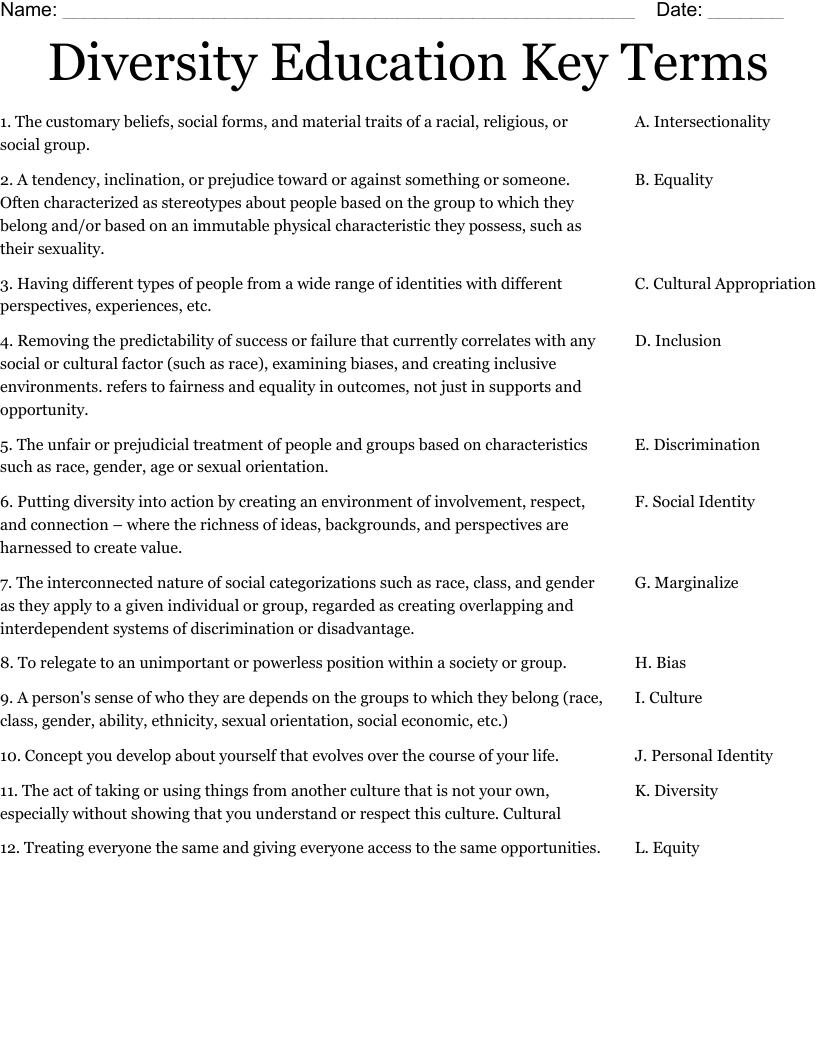
The customary beliefs, social forms, and material traits of a racial, religious, or social group.
A tendency, inclination, or prejudice toward or against something or someone. Often characterized as stereotypes about people based on the group to which they belong and/or based on an immutable physical characteristic they possess, such as their sexuality.
Having different types of people from a wide range of identities with different perspectives, experiences, etc.
Removing the predictability of success or failure that currently correlates with any social or cultural factor (such as race), examining biases, and creating inclusive environments. refers to fairness and equality in outcomes, not just in supports and opportunity.
The unfair or prejudicial treatment of people and groups based on characteristics such as race, gender, age or sexual orientation.
Putting diversity into action by creating an environment of involvement, respect, and connection – where the richness of ideas, backgrounds, and perspectives are harnessed to create value.
The interconnected nature of social categorizations such as race, class, and gender as they apply to a given individual or group, regarded as creating overlapping and interdependent systems of discrimination or disadvantage.
To relegate to an unimportant or powerless position within a society or group.
A person's sense of who they are depends on the groups to which they belong (race, class, gender, ability, ethnicity, sexual orientation, social economic, etc.)
Concept you develop about yourself that evolves over the course of your life.
The act of taking or using things from another culture that is not your own, especially without showing that you understand or respect this culture. Cultural
Treating everyone the same and giving everyone access to the same opportunities.